
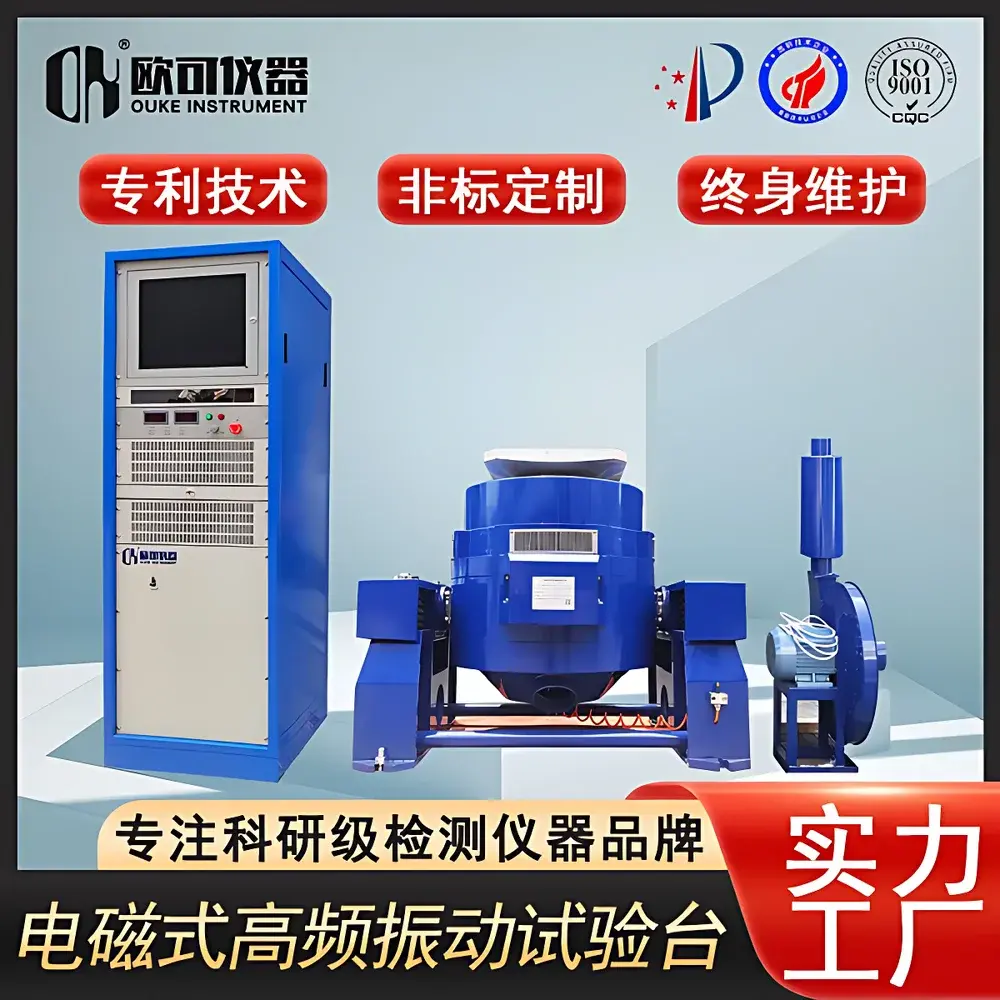
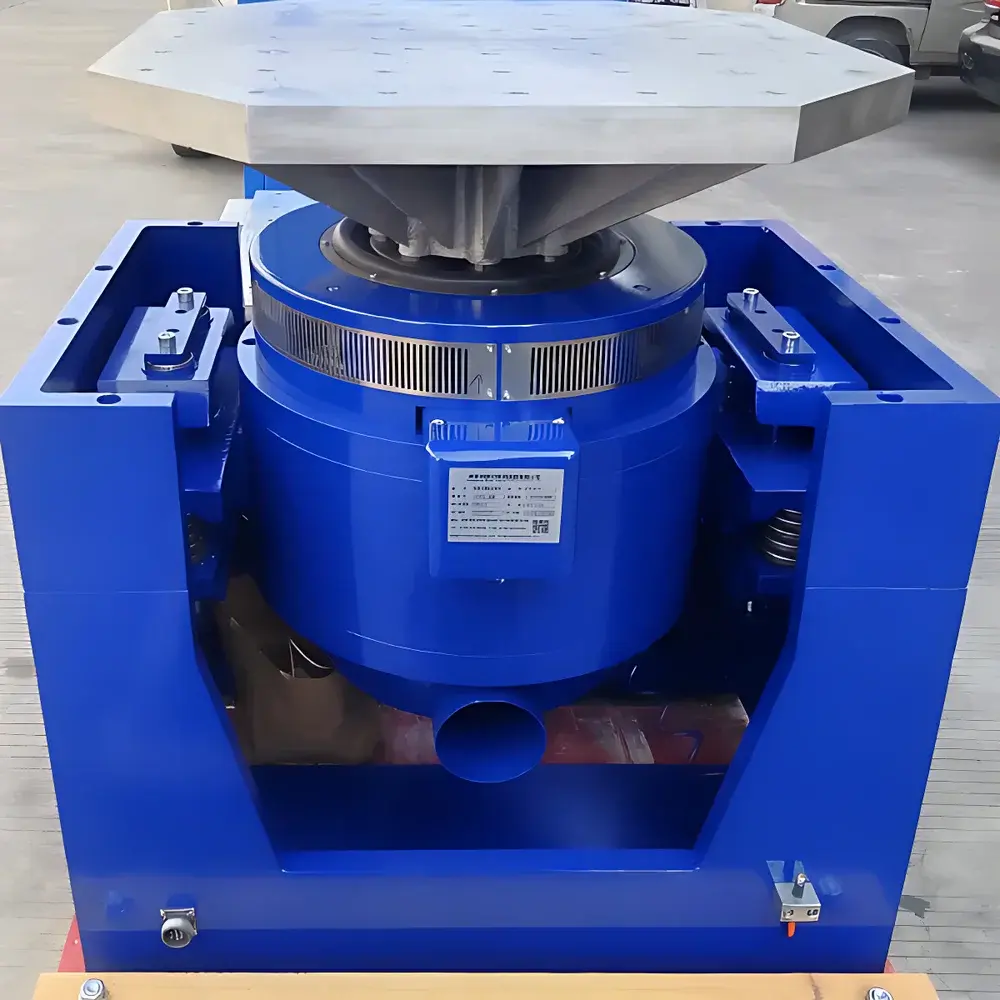
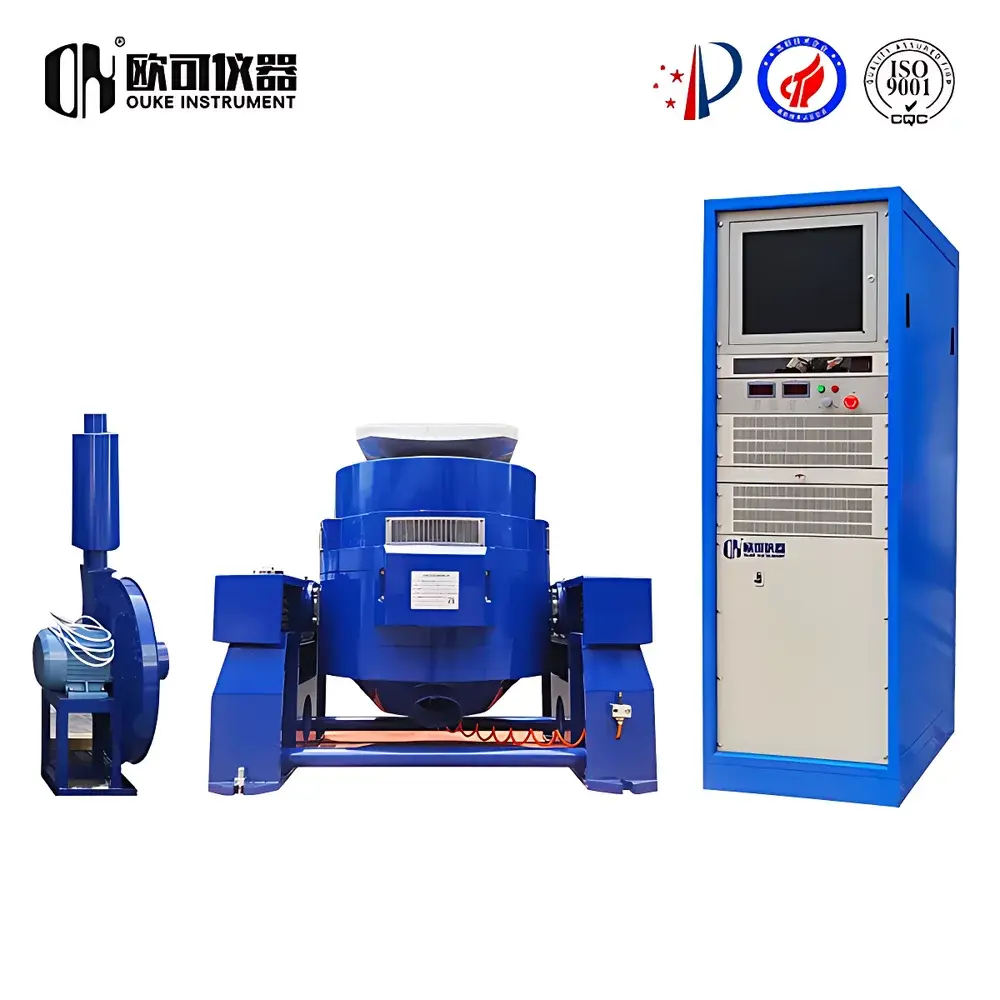
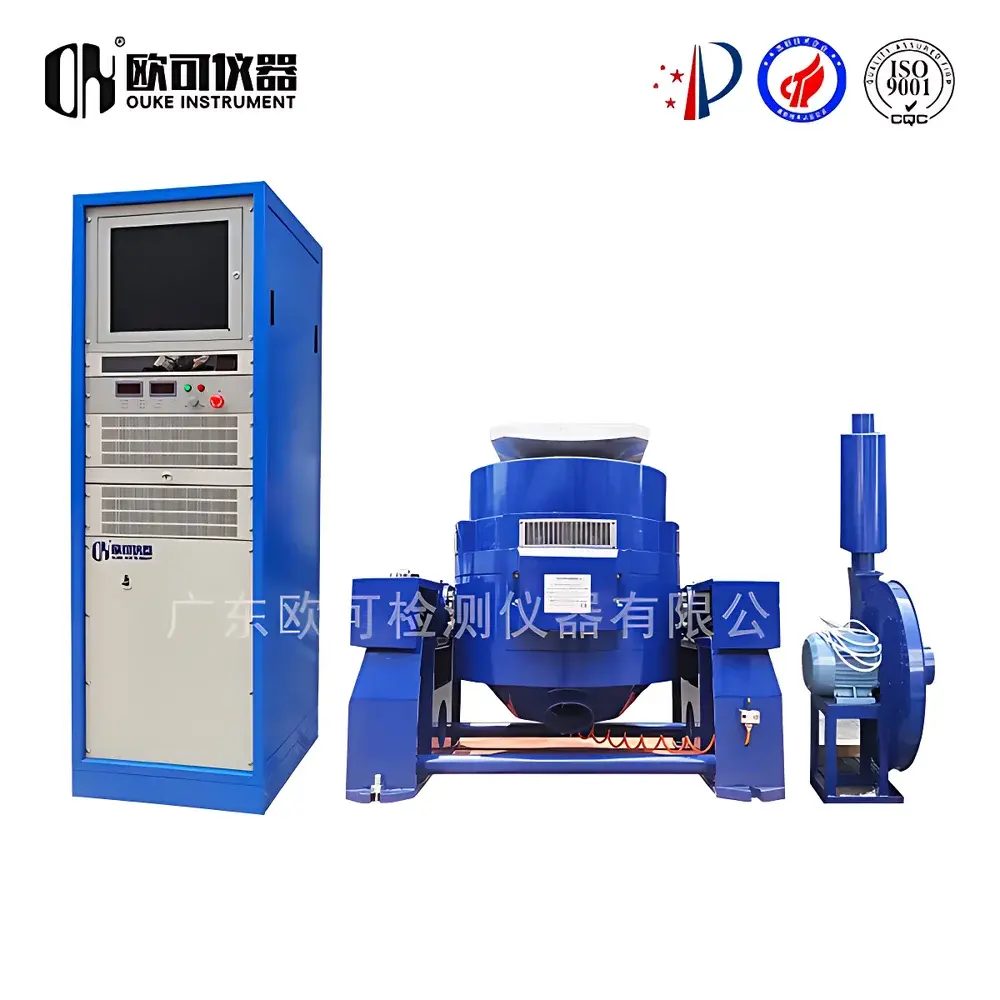
OK Instruments KE-ES-4 Electromagnetic Vertical Vibration Shaker
| Brand | OK Instruments |
|---|---|
| Origin | Guangdong, China |
| Manufacturer Type | Direct Manufacturer |
| Instrument Type | Electromagnetic Vibration Shaker |
| Model | KE-ES-4 |
| Rated Thrust | 1.98 kN |
| Frequency Range | 5–5000 Hz |
| Max. Test Load | 70 kg |
| Table Dimensions | 300 × 300 × 30 mm |
| Max. Acceleration | 10 g |
| Compliance Standards | ASTM D999, ISO 2247, ISO 8568, EN 60068-2-6, ISTA 2A/3A, UL 60950, ANSI S2.18 |
| Power Supply | 380 V, 50 Hz |
| Control Interface | Digital Controller with Real-Time Frequency & Acceleration Monitoring |
| Data Logging | Built-in Timestamped Event Capture (GLP-compliant audit trail) |
Overview
The OK Instruments KE-ES-4 Electromagnetic Vertical Vibration Shaker is a high-fidelity, force-controlled electrodynamic vibration system engineered for precision mechanical stress simulation in laboratory and industrial qualification environments. Based on Lorentz-force actuation principles, the shaker converts electrical current into controlled mechanical motion via a voice-coil motor assembly housed within a rigid, low-resonance structural frame. Its core function is to replicate real-world dynamic loading conditions—including transportation shocks, operational fatigue, and resonant excitation—across a broad frequency spectrum (5–5000 Hz), enabling rigorous assessment of product integrity, solder joint reliability, PCB flexure resistance, and structural damping behavior. Unlike hydraulic or servo-mechanical systems, electromagnetic shakers deliver superior linearity, phase fidelity, and repeatability below 2 kHz—making them the preferred choice for compliance-driven testing per IEC 60068-2-6, MIL-STD-810H Method 514.8, and automotive OEM specifications such as GMW 14872 and Ford CETP 00.00-L-467.
Key Features
- High-thrust electromagnetic actuator delivering 1.98 kN peak sinusoidal force, optimized for broadband random and swept-sine excitation profiles
- Wide operational frequency bandwidth (5–5000 Hz) with <±1 dB amplitude flatness over 10–2000 Hz at rated load
- Rigid aluminum alloy table (300 × 300 × 30 mm) featuring threaded mounting holes (M6, 25 mm pitch grid) and modal damping treatment to suppress parasitic resonances
- Digital closed-loop controller with real-time feedback from integrated accelerometer and position sensor—ensuring traceable acceleration control accuracy within ±0.5 dB across full range
- Thermal management system with forced-air cooling and temperature monitoring to sustain continuous operation at 80% of rated thrust without derating
- Compliance-ready architecture supporting 21 CFR Part 11–compliant user access control, electronic signatures, and immutable test log export (CSV/Excel)
Sample Compatibility & Compliance
The KE-ES-4 accommodates test specimens up to 70 kg mass, with mechanical interface compatibility verified for standard fixtures including slip-table adapters, head expanders, and isolation mounts compliant with ISO 10816-3 vibration severity thresholds. All factory calibration certificates are traceable to NIM (National Institute of Metrology, China) and include uncertainty budgets per ISO/IEC 17025. The system meets essential requirements of the EU Machinery Directive 2006/42/EC and carries CE marking under harmonized standards EN 61000-6-2 (immunity) and EN 61000-6-4 (emission). Test protocols executed on this platform satisfy regulatory validation needs for medical device packaging (ASTM D4169), aerospace avionics (RTCA DO-160 Section 8), and consumer electronics drop-and-vibration certification (IEC 60068-2-64).
Software & Data Management
Control and analysis are performed via OK-VibraSuite™ v4.2—a Windows-based application supporting real-time FFT spectral analysis, resonance search (swept-sine), shock response spectrum (SRS) synthesis, and classical random vibration generation (PSD shaping). All test sessions generate timestamped binary data files (.okv) with embedded metadata: operator ID, environmental conditions (optional external sensor input), calibration status, and hardware configuration snapshot. Audit logs record every parameter change, start/stop event, and user login—retained for ≥36 months with configurable auto-archive to network storage. Export modules support CSV, MATLAB .mat, and UFF58 formats; raw acceleration time histories include ±16-bit resolution at sampling rates up to 51.2 kHz.
Applications
- Transportation simulation per ISTA 3A/3E and ASTM D4728 for packaged goods and logistics containers
- Structural resonance mapping and modal analysis of printed circuit assemblies (PCBAs) and electromechanical subassemblies
- Accelerated life testing of connectors, switches, and MEMS components under variable g-level harmonic excitation
- Qualification of automotive ECUs against GMW 3172 and VW 80101 mechanical durability requirements
- Verification of battery module mechanical integrity under dynamic charge/discharge cycling conditions
- Research-grade material damping characterization using complex modulus extraction from forced oscillation response
FAQ
What is the maximum achievable acceleration at 100 Hz with a 50 kg payload?
At 100 Hz and 50 kg load, the KE-ES-4 maintains ≤10 g peak acceleration while staying within its 1.98 kN thrust limit and thermal design envelope.
Does the system support multi-axis vibration testing?
The KE-ES-4 is a single-axis vertical shaker. For triaxial testing, OK Instruments recommends synchronized deployment of three KE-ES-4 units with master-slave digital phase-locking (requires optional VibraSync™ module).
Is third-party calibration documentation included with shipment?
Yes—each unit ships with a NIM-traceable factory calibration report valid for 12 months, covering force, acceleration, displacement, and frequency response across the full operating range.
Can the controller interface with LabVIEW or Python for automated test sequencing?
Yes—the embedded Ethernet port supports TCP/IP communication with SCPI command set; official drivers and API wrappers are provided for LabVIEW 2020+ and Python 3.8+ (PyVISA-compatible).
How is mechanical safety ensured during high-g testing?
The system incorporates dual-redundant hardware limiters: an analog acceleration limiter (settable from 1–20 g) and a digital velocity limiter (0.5–2.0 m/s), both independently monitored by the safety PLC per EN ISO 13849-1 Category 3.



