
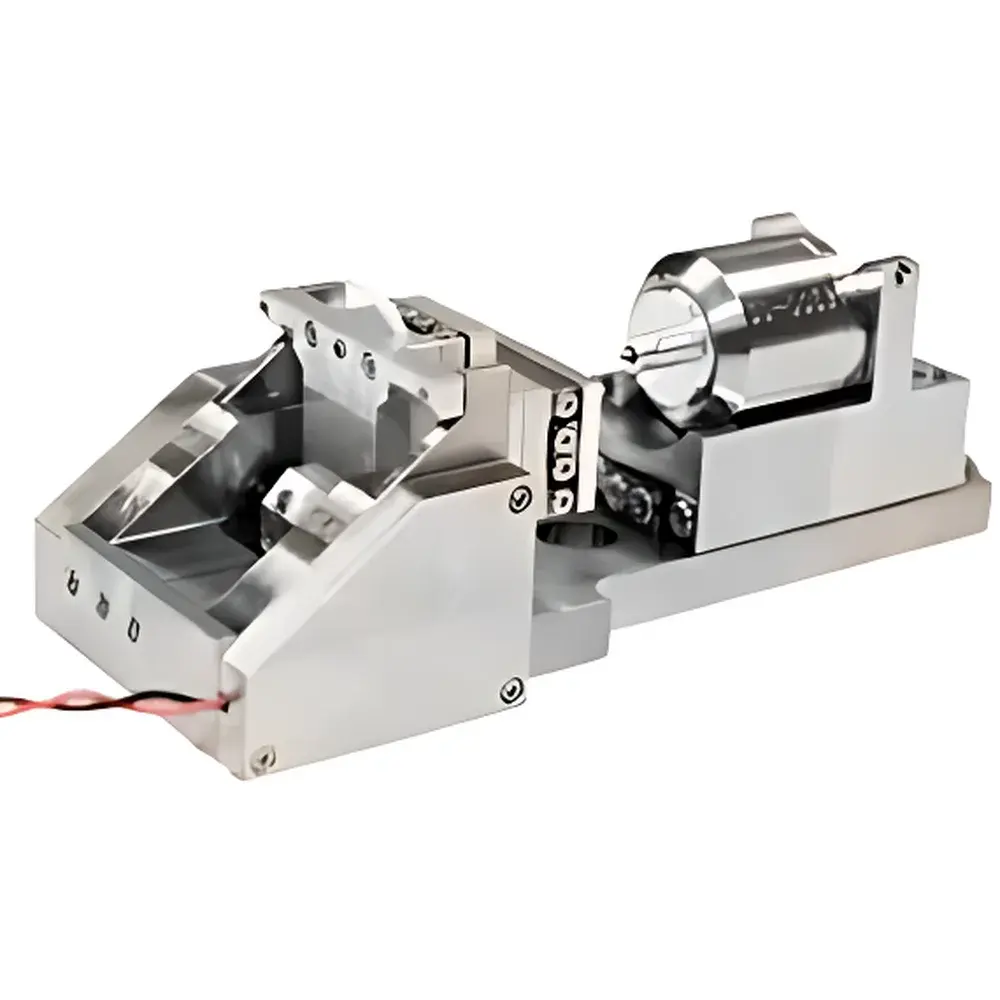
KLA NanoFlip In-Situ Nanomechanical Testing Module
| Brand | KLA |
|---|---|
| Origin | USA |
| Manufacturer Type | Authorized Distributor |
| Product Category | Imported Instrument |
| Model | NanoFlip |
| Price Range | USD 260,000–390,000 (est.) |
| Instrument Type | In-Situ Nanomechanical Testing System |
| Max Indentation Depth | 50 µm |
| Effective Load Range | 50 mN |
| Load Resolution | 3 nN |
| Displacement Range (X/Y) | 20 mm, (Z): 25 mm |
| Displacement Resolution | 4 nm |
| Max Friction Force | 0.05 N |
| Indenter Tip | Diamond Berkovich or Cube-Corner |
Overview
The KLA NanoFlip In-Situ Nanomechanical Testing Module is an ultra-precise, vacuum-compatible nanomechanical characterization platform engineered for real-time mechanical property mapping inside high-resolution imaging environments—including dual-beam FIB-SEM, AFM, optical microscopes, and vacuum chambers. Built upon KLA’s proprietary electromagnetic actuation architecture, the NanoFlip decouples force and displacement measurement at the physical level, eliminating cross-talk and enabling true simultaneous load–displacement control with sub-nanometer stability. Its core measurement principle relies on direct-force feedback via high-bandwidth electromagnetic transducers (20 µs time constant), combined with capacitive displacement sensing (4 nm resolution) and active thermal drift compensation (< 0.05 nm/s). Unlike conventional piezoelectric or voice-coil systems, the NanoFlip’s force actuator delivers a flat frequency response from 0.1 Hz to 1 kHz—enabling dynamic nanoindentation, creep, stress relaxation, and harmonic force modulation across viscoelastic and brittle material classes without hardware reconfiguration.
Key Features
- Vacuum- and SEM/FIB-compatible design: Fully bakeable to 80 °C; EMI-shielded electronics; non-magnetic construction for integration into dual-beam platforms.
- FIB2Test™ sample rotation mechanism: Motorized 90° sample tilt enables seamless transition from FIB milling to nanomechanical testing without sample removal—critical for site-specific correlative analysis.
- Electromagnetic actuation system: 50 mN maximum load, 3 nN force resolution, < 200 nN RMS noise floor, and inherent force–displacement decoupling.
- Nanometer-precision motion stage: X/Y travel of 20 mm, Z travel of 25 mm, with closed-loop position feedback and 4 nm displacement resolution.
- Integrated tip calibration suite: Fully automated, software-driven tip geometry verification using reference materials per ISO 14577-1 and ASTM E2546 standards.
- Modular method libraries: Pre-validated protocols for thin films (hardness, modulus, adhesion), polymers (time-dependent deformation), and biological tissues (hydration-sensitive indentation).
Sample Compatibility & Compliance
The NanoFlip accommodates planar and cross-sectional specimens up to 25 mm in diameter and 10 mm in thickness. It supports conductive, insulating, hydrated, and cryo-fixed samples—enabling testing under ambient, low-humidity, or controlled-gas conditions. All mechanical data acquisition complies with ISO 14577 (Metallic and non-metallic materials — Instrumented indentation test), ASTM E2546 (Standard Guide for Instrumented Indentation Testing), and USP (Mechanical Testing of Pharmaceutical Solid Dosage Forms). Audit trails, electronic signatures, and data integrity controls meet FDA 21 CFR Part 11 requirements when deployed in GLP/GMP-regulated environments.
Software & Data Management
Control and analysis are performed via KLA’s TriboScan™ software platform, which provides full scripting capability (Python API), real-time data streaming, and synchronized multi-channel acquisition (load, displacement, acoustic emission, friction, video feed). Optional NanoBlitz™ 4D software enables high-throughput grid-based indentation mapping, 3D elastic–plastic property reconstruction, and time-resolved property evolution (e.g., hydration swelling, irradiation damage, thermal aging). Raw data exports adhere to HDF5 and NIST MML-compliant formats, ensuring long-term archival and third-party interoperability (e.g., MATLAB, Python SciPy, ImageJ).
Applications
- Site-specific mechanical profiling of TEM lamellae and FIB-milled cross-sections in semiconductor interconnects and battery electrode interfaces.
- In-situ nanoindentation during heating/cooling stages to quantify temperature-dependent modulus and yield behavior in shape-memory alloys and polymer composites.
- Adhesion quantification of thin-film coatings (DLC, TiN, ALD oxides) via scratch testing with normal load control up to 50 mN and lateral velocity up to 500 µm/s.
- Mechanical phenotyping of soft biomaterials—including hydrogels, decellularized scaffolds, and corneal tissue—under physiological humidity and temperature.
- Correlative nanomechanics–chemistry mapping by synchronizing NanoFlip with EDS, EBSD, or Raman spectroscopy in SEM.
FAQ
Is the NanoFlip compatible with existing FIB-SEM platforms from Thermo Fisher, Zeiss, or Hitachi?
Yes—the NanoFlip features standardized flange interfaces (CF-63 or CF-100) and integrated vacuum interlocks. KLA provides OEM integration kits and application engineering support for all major dual-beam platforms.
Does NanoFlip support quantitative scratch testing with friction force measurement?
Yes—it includes a calibrated lateral force sensor (±0.05 N full scale, 50 nN resolution) and synchronized normal–tangential load control for ASTM C1656-compliant scratch adhesion assessment.
Can tip geometry be verified in situ without removing the indenter?
Yes—the integrated tip calibration routine uses atomic step height standards and self-sensing cantilever deflection to determine tip radius, area function, and edge sharpness without manual intervention.
What is the minimum required vacuum level for stable operation?
The NanoFlip operates stably down to 1 × 10⁻⁶ mbar; no oil contamination or outgassing occurs due to all-metal seals and ceramic bearing construction.
Is remote operation supported for multi-user lab environments?
Yes—TriboScan supports role-based access control, networked instrument sharing, and secure web-based monitoring via TLS-encrypted REST API endpoints.



