
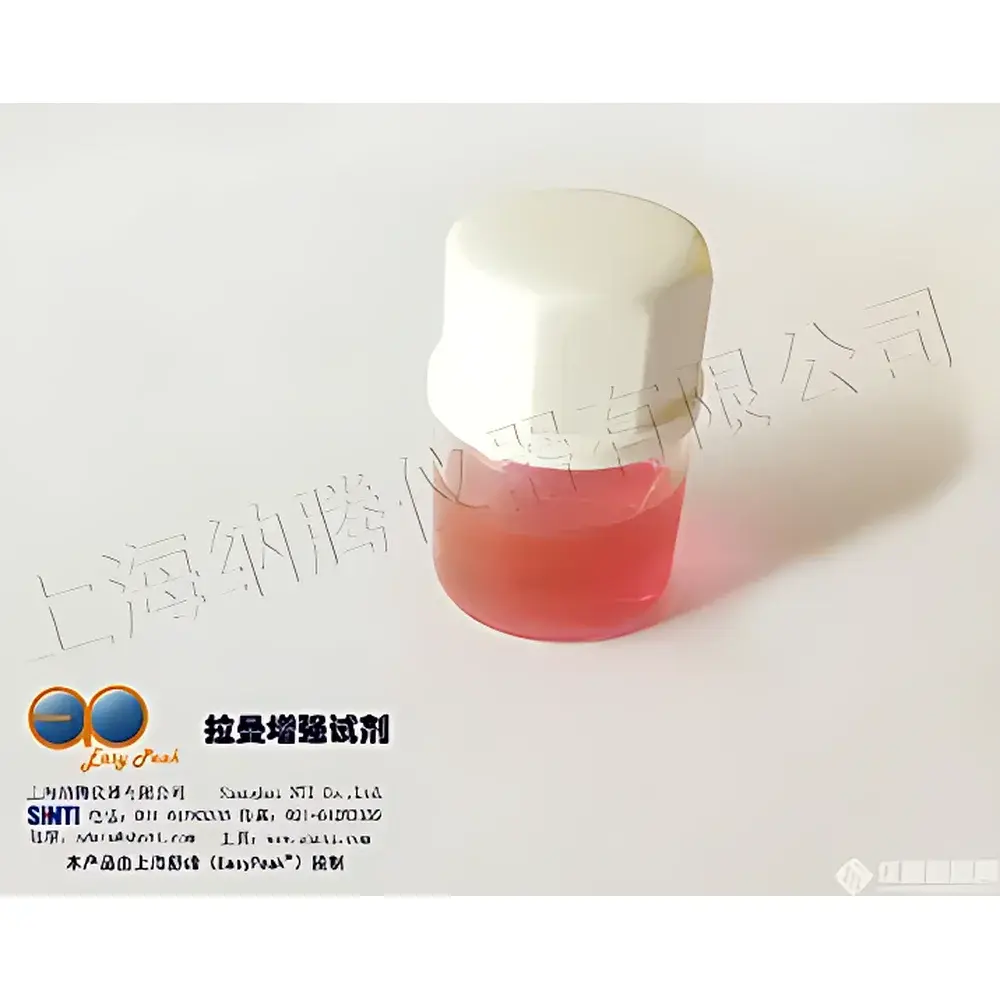
NanoAppo EasyPeak SERS Substrate
| Brand | NanoAppo |
|---|---|
| Origin | Tianjin, China |
| Model | EasyPeak |
| Type | SERS Enhancement Substrate |
| Substrate Composition | Colloidal Silver (Ag) and Colloidal Gold (Au) Nanoparticle Suspensions |
| Storage Condition | 4 °C |
| Shelf Life | Ag-based: 8 months |
| Au-based | 3.5 months |
| Detection Limit (Ag) | 3 × 10⁻⁶ mol/L (2-mercaptopyridine probe) |
| Detection Limit (Au) | 3 × 10⁻⁹ mol/L (Rhodamine 6G probe) |
| Enhancement Factor (Au) | >10⁹ |
| Compliance | Designed for ASTM E1840-23 and ISO/IEC 17025-compliant Raman workflows |
| Software Compatibility | Compatible with standard Raman spectrometer control software (e.g., Thermo Fisher OMNIC, Horiba LabSpec, Renishaw WiRE) |
Overview
The NanoAppo EasyPeak SERS Substrate is a rigorously validated colloidal surface-enhanced Raman scattering (SERS) enhancement platform engineered for high-sensitivity, reproducible molecular detection in analytical chemistry, biomedical research, and environmental monitoring. Unlike generic nanoparticle suspensions, EasyPeak substrates are manufactured under controlled synthesis protocols—developed and quality-assured by Shanghai Shufeng (EasyPeak™)—to deliver consistent plasmonic response across batches. The substrate leverages localized surface plasmon resonance (LSPR) in well-dispersed silver (Ag) and gold (Au) colloids to amplify Raman cross-sections of adsorbed analytes by orders of magnitude. This physical enhancement mechanism enables trace-level identification without chemical labeling, making EasyPeak suitable for label-free quantification of biomolecules (e.g., DNA, proteins, metabolites), dyes, pesticides, and pharmaceutical impurities under standard 532 nm, 633 nm, or 785 nm excitation.
Key Features
- Two chemically distinct, application-optimized formulations: Ag colloid (EasyPeak-1) for broad-spectrum compatibility and cost-sensitive screening; Au colloid (EasyPeak-2) for ultra-low detection limits and superior photostability in prolonged laser exposure.
- Batch-to-batch reproducibility validated via UV-Vis LSPR peak consistency (±2 nm tolerance) and TEM-documented particle size distribution (Ag: 40–60 nm; Au: 50–70 nm).
- Long-term colloidal stability: Ag suspension maintains monodispersity and enhancement efficacy for ≥8 months at 4 °C; Au suspension remains aggregation-free for ≥105 days under identical storage.
- No functionalization required—substrates operate via spontaneous physisorption of thiol-, amine-, or carboxyl-containing analytes onto nanoparticle surfaces, minimizing protocol complexity.
- Compatible with microplate-based high-throughput workflows and drop-cast, spin-coated, or vacuum-filtered deposition methods on quartz, CaF₂, or silicon substrates.
Sample Compatibility & Compliance
EasyPeak substrates demonstrate robust performance across diverse sample matrices—including aqueous biological fluids (serum, saliva, cell lysates), environmental water extracts, and organic solvent suspensions—without requiring extensive pre-purification. Each lot undergoes orthogonal verification using certified reference probes (2-mercaptopyridine for Ag; Rhodamine 6G for Au) to confirm minimum enhancement factor (EF ≥10⁹ for Au) and detection limit compliance per ASTM E1840-23 Annex A2. The substrates support GLP/GMP-aligned workflows when integrated with audit-trail-enabled Raman platforms compliant with FDA 21 CFR Part 11 requirements. Certificate of Analysis (CoA) includes TEM images, DLS hydrodynamic diameter, zeta potential (≥−30 mV for colloidal stability), and batch-specific EF calibration data.
Software & Data Management
EasyPeak does not require proprietary software. It interfaces natively with industry-standard Raman acquisition and processing suites—including Thermo Fisher OMNIC, Horiba LabSpec 6, Renishaw WiRE, and BWtek BWSpec—enabling seamless integration into existing laboratory informatics systems (LIMS). Users may apply standardized baseline correction (Asymmetric Least Squares), cosmic ray removal, and multivariate analysis (PCA, PLS-DA) directly on enhanced spectra. For regulatory environments, metadata tagging (substrate lot ID, preparation date, dilution factor) can be embedded into spectral file headers (JCAMP-DX v6.00 compliant) to satisfy ISO/IEC 17025 documentation requirements.
Applications
- Ultra-trace detection of biomarkers in point-of-care diagnostics (e.g., cortisol, dopamine, amyloid-β fragments).
- Quantitative residue analysis of neonicotinoid insecticides in agricultural runoff (LOD < 1 ppb achievable with Au substrate).
- In-process monitoring of catalytic reactions via real-time SERS tracking of intermediate species adsorbed on nanoparticle surfaces.
- Authentication of natural dyes in cultural heritage artifacts using fingerprint spectral libraries.
- High-content screening of drug–protein binding kinetics through time-resolved SERS intensity decay modeling.
FAQ
What is the recommended centrifugation protocol prior to use?
For optimal monolayer formation, centrifuge Ag or Au colloids at 12,000 × g for 10 min, discard supernatant, and resuspend pellet in deionized water at 1/10 original volume.
Can EasyPeak substrates be used with portable Raman systems?
Yes—both formulations have been validated on handheld 785 nm spectrometers (e.g., Rigaku Progeny, Metrohm Mira) with integration times ≤30 s and laser power ≤50 mW.
Is surface functionalization necessary for non-thiol analytes?
Not required, but optional silanization (e.g., APTES) or polymer coating (e.g., PVP) can improve affinity for charged or hydrophobic molecules—protocols available upon request.
How is lot-to-lot performance verified?
Each production lot includes TEM imaging, UV-Vis extinction spectroscopy, dynamic light scattering (DLS), and SERS activity testing against certified probe standards; full CoA provided digitally with shipment.
Do EasyPeak substrates comply with ISO 13485 for IVD applications?
While the substrates themselves are Class I general-purpose reagents, they are routinely deployed in ISO 13485-certified IVD development labs; formal IVD classification requires end-user validation per IEC 62304 and 62366-1.



