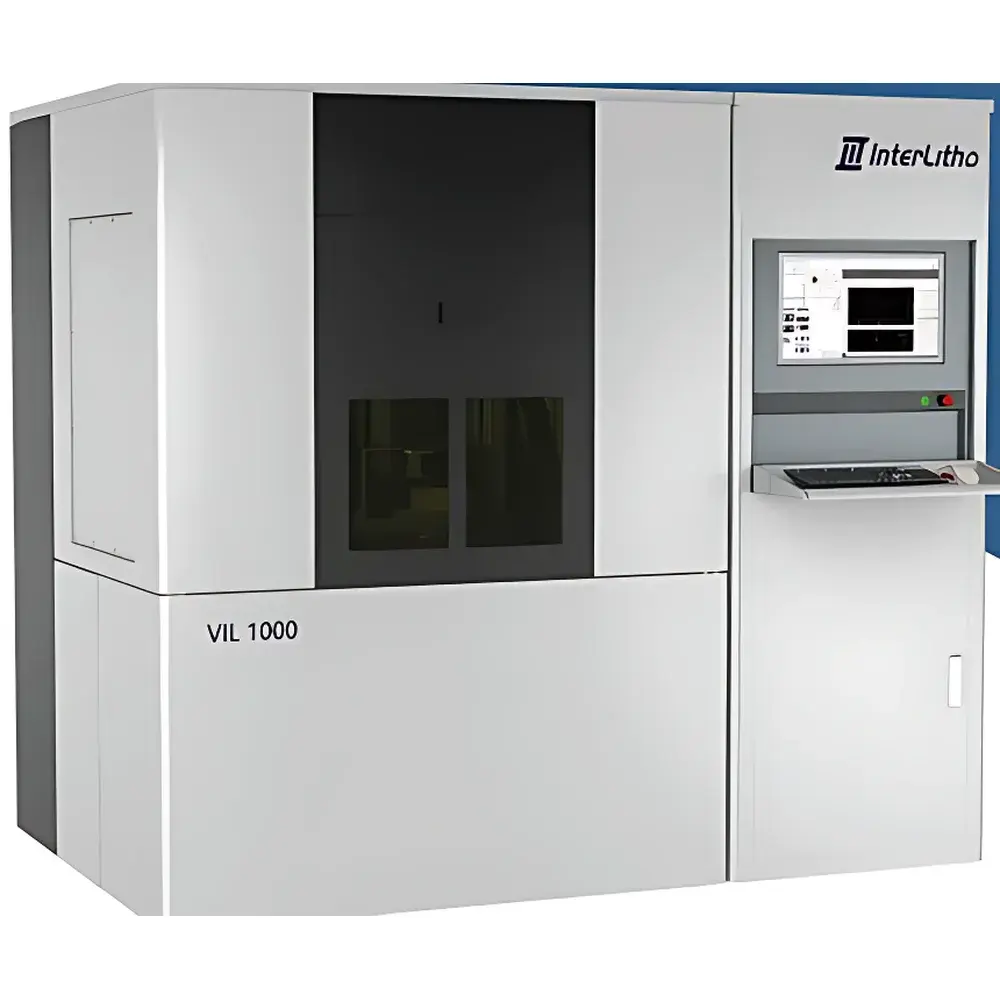
SHNTI VIL1000 Laser Interference Lithography System
| Brand | SHNTI |
|---|---|
| Origin | Shanghai, China |
| Manufacturer Type | Authorized Distributor |
| Product Origin | Domestic (China) |
| Model | VIL1000 |
| Light Source | Coherent Laser (UV/Deep-UV or Visible, Configurable) |
| Minimum Achievable Line Width | <50 nm |
| Grating Period Range | 240–1500 nm |
| Maximum Exposure Field | 200 mm × 200 mm (8-inch wafer compatible) |
| Pattern Reconfigurability | Real-time, maskless, via beam steering optics |
| Positioning Accuracy | Sub-10 nm (closed-loop piezo stage) |
Overview
The SHNTI VIL1000 Laser Interference Lithography System is a high-precision, maskless direct-write instrument engineered for the scalable fabrication of periodic nanoscale structures on semiconductor wafers and planar substrates. Operating on the principle of coherent laser interference—where two or more collimated beams intersect to generate a stable, wavelength-defined standing wave pattern—the VIL1000 enables deterministic patterning without physical masks. Unlike electron-beam or UV projection lithography, interference lithography delivers inherently uniform periodicity across large areas with exceptional reproducibility and minimal proximity effects. The system is optimized for applications requiring high-throughput, sub-100 nm periodic features—particularly in photonic crystal templates, plasmonic metasurfaces, diffractive optical elements, and bio-sensing chip fabrication. Its architecture integrates active vibration isolation, real-time interferometric fringe stabilization, and closed-loop nanometer-precision sample positioning to ensure long-exposure fidelity over 8-inch (200 mm) substrates.
Key Features
- Maskless, interference-based patterning with no reticle dependency—enabling rapid design iteration and zero mask cost per layout change.
- Field-reconfigurable exposure geometry: supports 1D linear gratings, 2D square/hexagonal lattices, and user-defined supercell arrangements within a standard 20 mm × 20 mm field; multiple fields stitched seamlessly across full 200 mm wafers.
- Sub-50 nm minimum physical linewidth achievable under optimized resist processing (e.g., HSQ or ZEP520A), verified by SEM metrology and AFM line-profile analysis.
- Active fringe stabilization subsystem compensates for thermal drift and acoustic perturbations in real time, maintaining phase coherence over multi-hour exposures.
- Integrated high-resolution laser interferometry feedback loop ensures sample stage positioning accuracy better than ±5 nm (3σ) over full travel range.
- Modular optical path accommodates multiple laser wavelengths (325 nm HeCd, 355 nm DPSS, or 405 nm diode), enabling process tuning for resist sensitivity and resolution trade-offs.
Sample Compatibility & Compliance
The VIL1000 accepts standard silicon, fused silica, sapphire, GaAs, and glass substrates up to 200 mm diameter and 10 mm thickness. Chuck vacuum and kinematic alignment support both bare wafers and those pre-coated with spin-cast resists (positive/negative tone, including AR-P 6200, ma-N, and hydrogen silsesquioxane). The system complies with ISO 14644-1 Class 5 cleanroom operational requirements when installed with optional laminar flow enclosure. All motion control firmware and exposure logging adhere to GLP-compliant audit trail protocols, supporting traceable process documentation required for R&D reporting and technology transfer. While not certified to FDA 21 CFR Part 11 out-of-the-box, the software architecture supports third-party electronic signature integration for regulated environments.
Software & Data Management
Control is executed via SHNTI’s proprietary VIL-Studio platform—a Windows-based application built on Qt and Python 3.9, featuring intuitive graphical pattern definition, multi-layer alignment preview, and exposure dose mapping. Pattern files are imported in GDSII or SVG format; arbitrary unit-cell definitions are parameterized using Python scripting hooks. All exposure parameters—including laser power, exposure time, stage velocity, and interferometer phase offset—are logged with timestamped metadata in SQLite databases. Export options include CSV (for metrology correlation), TIFF (for overlay inspection), and HDF5 (for machine learning dataset generation). Remote monitoring and batch job queuing are supported via RESTful API endpoints, enabling integration into factory automation frameworks (SECS/GEM compliant upon request).
Applications
- Fabrication of master templates for nanoimprint lithography (NIL) in micro-optics and LED light extraction structures.
- High-uniformity plasmonic grating arrays for surface-enhanced Raman spectroscopy (SERS) substrates and biosensor chips.
- Photonic crystal slabs and metamaterial unit cells for integrated photonics research and telecom wavelength filtering.
- Periodic anti-reflective and superhydrophobic surface textures for solar cell and MEMS packaging applications.
- Rapid prototyping of calibration standards for CD-SEM and scatterometry tool validation.
FAQ
What resist types are validated for use with the VIL1000?
Standard e-beam resists (HSQ, ZEP520A), UV-curable polymers (SU-8, OrmoStamp), and high-resolution negative-tone photoresists (ma-N 2400 series) have been characterized for optimal contrast and development latitude.
Can the system perform multi-layer alignment?
Yes—integrated CCD-based alignment scope with sub-pixel centroid detection enables overlay registration accuracy better than ±30 nm (3σ) between layers.
Is vacuum operation supported?
The base configuration operates at ambient atmosphere; optional vacuum-compatible chamber and load-lock module are available for oxygen-sensitive resist processes.
How is beam coherence maintained over extended exposures?
A dual-path Mach–Zehnder interferometer continuously monitors and corrects for path-length drift using piezo-driven mirror actuators with 0.1 nm resolution feedback.
Does the system support DOE (Design of Experiments) automation?
VIL-Studio includes parametric sweep modules for systematic variation of dose, period, and incident angle—exporting structured datasets for statistical process control (SPC) analysis.