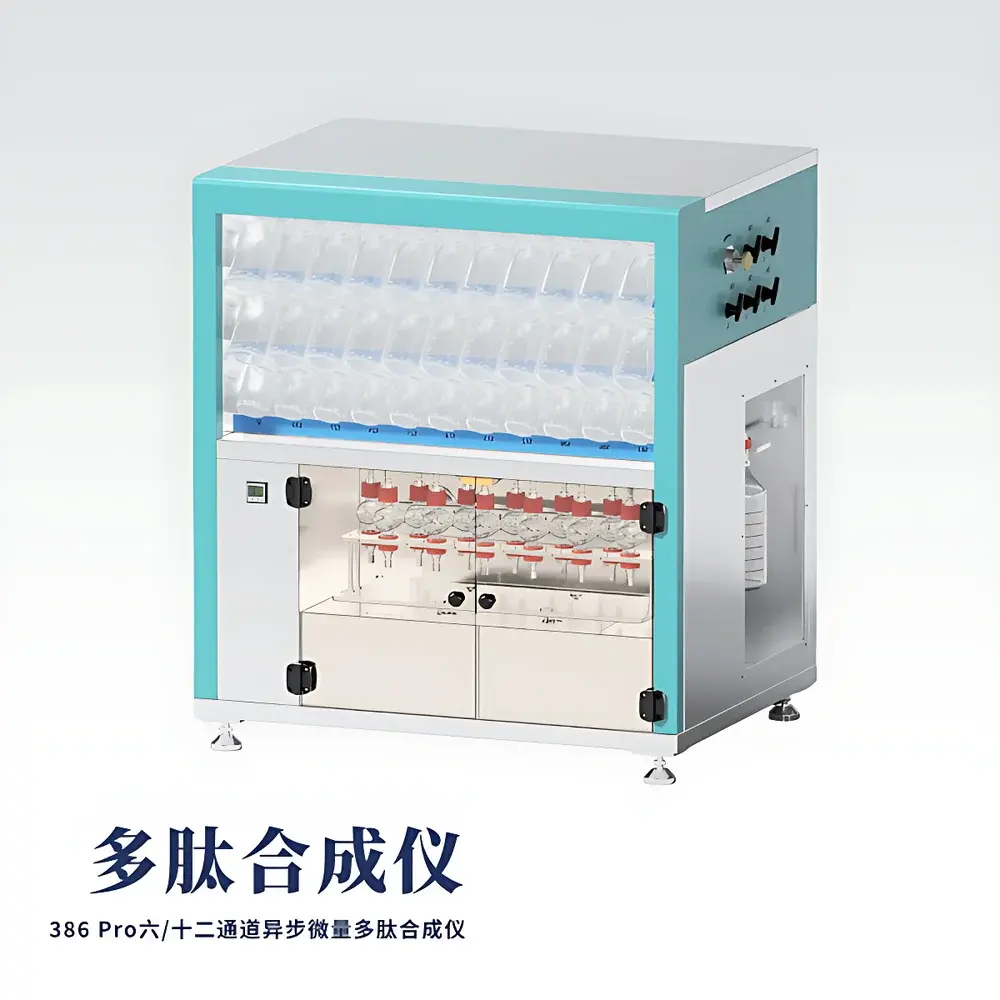
Dilun Bio 386 Pro Six/Twelve-Channel Asynchronous Microscale Peptide Synthesizer
| Brand | Dilun Bio |
|---|---|
| Origin | Beijing, China |
| Model | 386 Pro |
| Amino Acid Delivery | Automated quantitative dispensing (0.1 mL precision) |
| Reagent Delivery | Automated quantitative dispensing (0.1 mL precision) |
| Synthesis Scale | 0.01–0.6 mmol |
| Reaction Vessel Count | 1 |
| Reaction Vessel Capacity | 10/25 mL |
| Heating Method | 360° circumferential electromagnetic induction hot-air heating |
| Mixing Mechanism | Vortex oscillation + nitrogen bubbling |
| Amino Acid Positions | 28 |
| Activator Positions | 4 |
| Solvent Positions | 4–6 |
| Solvent Reservoir Options | 0.5 L, 1 L, 2 L, 5 L, 10 L |
| Power Supply | 110/220 V, 50/60 Hz |
| Dimensions (W×D×H) | 82 × 62 × 92 cm |
| Weight | 75 kg |
Overview
The Dilun Bio 386 Pro Six/Twelve-Channel Asynchronous Microscale Peptide Synthesizer is a fully automated solid-phase peptide synthesis (SPPS) platform engineered for high-fidelity, parallelized microscale synthesis under rigorously controlled chemical conditions. Based on the Fmoc/t-Bu strategy, the system implements precise stoichiometric delivery of amino acids and coupling reagents via calibrated peristaltic or syringe-based quantitative dispensing (±0.1 mL accuracy), enabling reproducible stepwise elongation of peptide chains across multiple independent reaction channels. Its asynchronous architecture allows each channel to execute custom-defined protocols—including individualized deprotection time, activation method (e.g., HATU/DIC, PyBOP/DIEA), coupling duration, and resin handling timing—without synchronization constraints. This capability is critical for optimizing difficult sequences, incorporating non-standard or sterically hindered residues, and conducting comparative synthetic route screening. The 360° circumferential electromagnetic induction heating system ensures uniform thermal distribution within the reaction vessel (10–50 mL capacity), minimizing localized overheating and supporting temperature-sensitive chemistries such as pseudoproline dipeptide incorporation or cysteine-rich sequence assembly.
Key Features
- True asynchronous operation across six or twelve independently programmable synthesis channels
- Modular reagent management: 28 amino acid positions (120/250 mL bottles), 4 activator ports, and 4–6 solvent ports—all with quantitative dispensing at ±0.1 mL resolution
- Dual-mode mixing: programmable vortex oscillation combined with regulated nitrogen gas sparging for efficient resin suspension and mass transfer
- Integrated thermal control: contactless electromagnetic induction heating with real-time PID-regulated temperature feedback (range: ambient to 90 °C)
- Flexible resin handling: manual or semi-automated insertion/removal of peptide-resin at any synthesis step without interrupting other channels
- Multi-user authentication and method isolation: role-based login supports concurrent users operating distinct synthesis protocols with audit-trail-enabled method versioning
- Robust mechanical architecture: stainless-steel fluidic pathways, chemically resistant PTFE/PFA tubing, and sealed solvent reservoirs compliant with ICH Q7 solvent storage guidelines
Sample Compatibility & Compliance
The 386 Pro accommodates standard SPPS resins—including Wang, Rink amide MBHA, and 2-Cl-Trt—and supports both Fmoc and Boc chemistries with appropriate reagent configuration. It is compatible with common coupling reagents (HBTU, HATU, DIC, DCC), activators (HOAt, Oxyma Pure), and deprotection agents (20% piperidine in DMF, TFA cocktails). All fluidic components meet USP Class VI biocompatibility standards. The instrument’s operational log and method parameters are timestamped and user-attributed, satisfying basic GLP documentation requirements. While not pre-certified for 21 CFR Part 11, its software architecture supports integration with validated electronic lab notebook (ELN) systems via CSV/JSON export and optional API extension for full regulatory traceability in GMP environments.
Software & Data Management
The embedded touchscreen interface runs Dilun SynthOS v3.x, a deterministic real-time OS designed for deterministic sequence execution and fault-tolerant error recovery. Each synthesis run generates a structured metadata file containing reagent lot numbers, dispense volumes, temperature profiles, mixing cycles, and event timestamps. Export formats include .csv (for LIMS ingestion), .pdf (for protocol archiving), and .xml (for ELN interoperability). Audit trails record all user actions—including method edits, parameter overrides, and emergency aborts—with immutable SHA-256 hashing. Remote monitoring is supported via encrypted HTTPS web interface; local data persistence uses industrial-grade SD card with wear-leveling and journaling filesystem.
Applications
- Rapid optimization of challenging peptide sequences (e.g., aggregation-prone, hydrophobic, or post-translationally modified peptides)
- Parallel synthesis of peptide libraries for epitope mapping, SAR studies, or vaccine candidate screening
- Microscale synthesis for NMR or crystallography sample preparation (≤0.1 mmol scale)
- Method development for continuous-flow or hybrid batch-flow SPPS workflows
- Training and education in advanced peptide chemistry at academic core facilities
- QC batch synthesis of reference standards under defined SOPs for analytical method validation
FAQ
Does the 386 Pro support both Fmoc and Boc chemistry?
Yes—the system is chemically agnostic and configurable for either strategy via user-defined reagent assignments and deprotection/coupling parameters.
Can synthesis be paused and resumed on individual channels?
Yes—each channel maintains independent state tracking; resin may be manually removed and reloaded without affecting other active syntheses.
What solvent compatibility does the fluidic system provide?
All wetted materials are resistant to DMF, DCM, NMP, THF, acetonitrile, and TFA; compatibility with chlorinated solvents requires optional Hastelloy-compatible valves.
Is remote software update supported?
Firmware updates are delivered via signed USB drive; over-the-air updates require on-premise network configuration and IT approval per institutional cybersecurity policy.
How is calibration traceability maintained?
Dispense accuracy is verified using gravimetric calibration per ISO 8655-6; certificates are issued with each annual service visit and archived in the instrument’s local database.