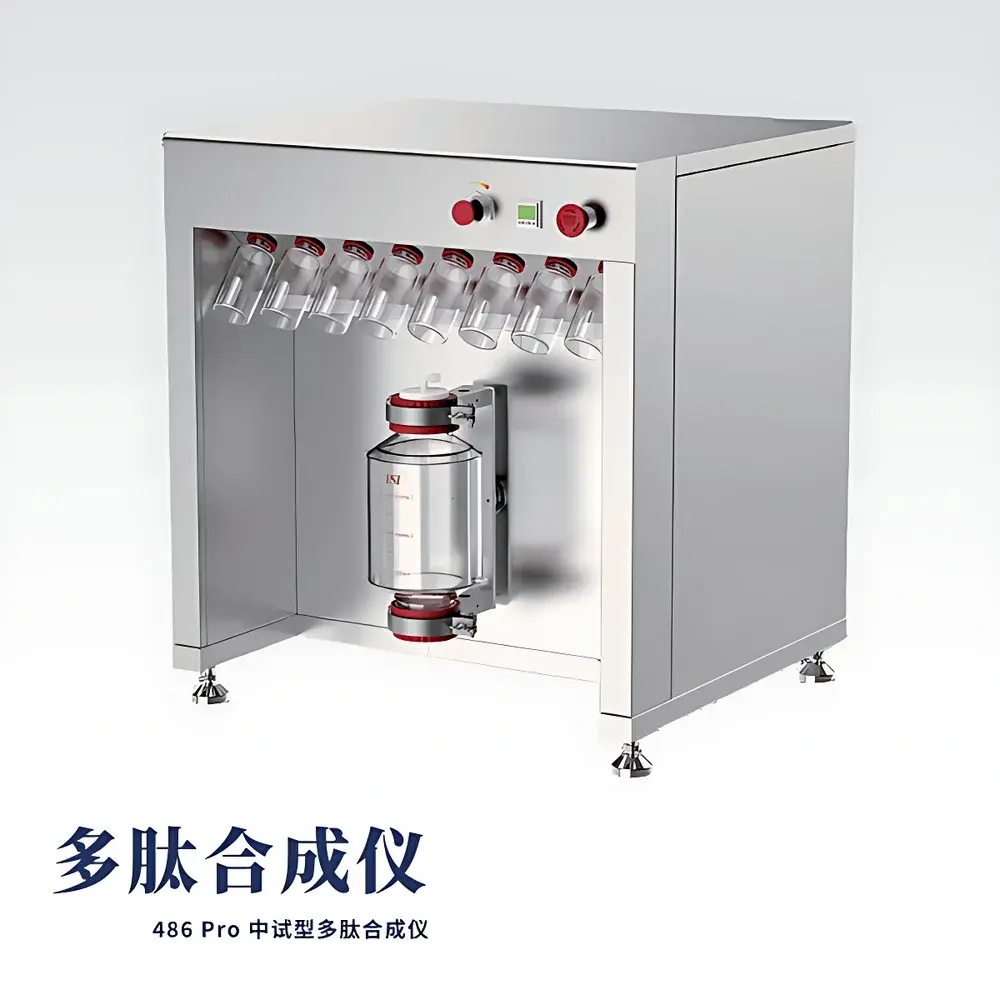
Dilun Bio 486 Pro Pilot-Scale Peptide Synthesizer
| Brand | Dilun Bio |
|---|---|
| Origin | Beijing, China |
| Model | 486 Pro |
| Amino Acid Addition | Automated |
| Reagent Addition | Automated |
| Synthesis Scale | 2–60 mmol |
| Reactor Count | 2 |
| Reactor Volume Options | 0.5 / 1 / 2 L and 1 / 2 / 5 L |
| Amino Acid Positions | 6 or 8 |
| Solvent Ports | 5 or 7 |
| Solvent Reservoir Capacity | 10 / 20 / 50 L |
| Mixing Mechanism | 180° bidirectional mechanical inversion with infinitely variable speed control |
| Power Supply | 110/220 V, 50/60 Hz |
| Dimensions (W×D×H) | 770×600×750 mm or 850×850×900 mm |
| Weight | 68 kg or 110 kg |
| Quantitative Dispensing Accuracy | ±1 mL |
Overview
The Dilun Bio 486 Pro Pilot-Scale Peptide Synthesizer is an automated solid-phase peptide synthesis (SPPS) platform engineered for reproducible, scalable production of custom peptides under controlled laboratory and pilot manufacturing conditions. Based on the Fmoc/tBu strategy, it supports both pre-activation and simultaneous activation protocols—enabling precise coupling kinetics management across diverse amino acid sequences, including sterically hindered or aggregation-prone residues. Designed for transition from research-scale synthesis to process development, the system integrates gravimetric amino acid dispensing, volumetric reagent delivery, and programmable reaction vessel agitation to ensure high coupling efficiency, low deletion rates, and batch-to-batch consistency. Its dual-reactor architecture allows parallel synthesis of two independent sequences or staggered scale-up trials—critical for method optimization, impurity profiling, and regulatory documentation in GLP-compliant environments.
Key Features
- Automated amino acid and reagent handling with ±1 mL quantitative dispensing accuracy, minimizing manual intervention and operator-induced variability.
- Dual independent reactor stations accommodating interchangeable vessels (0.5/1/2 L and 1/2/5 L), supporting flexible scale adjustment from 2 mmol to 60 mmol per run.
- 180° bidirectional mechanical inversion mixing with continuously adjustable speed—eliminating magnetic stir bars and ensuring uniform resin suspension without shear degradation.
- Configurable amino acid positions (6 or 8) and solvent ports (5 or 7), compatible with standard 0.25–1 L amino acid bottles and up to 50 L bulk solvent reservoirs.
- Modular fluidic architecture with chemically resistant tubing and valves rated for DMF, DCM, NMP, piperidine, and TFA—ensuring long-term integrity during repetitive wash, deprotection, and coupling cycles.
- Integrated environmental monitoring (temperature, pressure, flow status) with real-time logging—supporting audit-ready traceability required for FDA 21 CFR Part 11 and ISO 13485-aligned workflows.
Sample Compatibility & Compliance
The 486 Pro accommodates a broad range of resin types—including Wang, Rink amide, 2-chlorotrityl, and Sieber resins—with compatibility verified for common coupling reagents (HBTU/HOBt/DIPEA, DIC/OxymaPure, PyBOP). It meets essential design requirements for Good Manufacturing Practice (GMP)-adjacent development work, with hardware and software architecture aligned to ASTM E2500-13 (user requirement specification) and ICH Q5E (comparability of biotechnological/biological products). All wetted materials comply with USP Class VI standards; electrical safety conforms to IEC 61010-1. While not certified as GMP equipment per se, its operational logs, password-protected method editing, and electronic signature support enable compliance with GLP and internal quality systems in pharmaceutical R&D settings.
Software & Data Management
The synthesizer operates via a dedicated Windows-based control interface with role-based access levels (operator, supervisor, administrator). Each synthesis protocol stores full parameter history—including reagent lot numbers, dispense volumes, mixing duration, dwell times, and temperature profiles. Data export is supported in CSV and PDF formats; raw log files include timestamps synchronized to UTC and are write-protected post-run. Audit trail functionality records all user actions (login/logout, method modification, emergency stop), satisfying ALCOA+ principles (Attributable, Legible, Contemporaneous, Original, Accurate, Complete, Consistent, Enduring, Available). Remote diagnostics are enabled via secure TLS-encrypted connection, allowing qualified engineers to review system health without accessing proprietary synthesis data.
Applications
- Process development and optimization of therapeutic peptide candidates prior to cGMP manufacturing.
- Synthesis of labeled peptides (e.g., isotopically enriched, fluorescently tagged) for structural biology and binding assays.
- Production of immunogen-grade peptides for antibody generation and epitope mapping studies.
- Parallel synthesis of peptide libraries for structure–activity relationship (SAR) analysis in early drug discovery.
- Scale-down modeling for technology transfer between lab, pilot, and commercial manufacturing units.
- Training platform for academic and industrial personnel in SPPS best practices, including side-chain protection strategies and cleavage optimization.
FAQ
What synthesis strategies does the 486 Pro support?
It supports both Fmoc- and Boc-based solid-phase synthesis, with configurable deprotection cycles and coupling reagent selection optimized for each chemistry.
Can the system be integrated into a larger automation ecosystem?
Yes—via RS-232 and Ethernet interfaces, it accepts external start/stop commands and exports status signals compatible with PLC-based facility control systems.
Is validation documentation available?
Dilun Bio provides IQ/OQ templates aligned with ASTM E2500, along with factory test reports covering fluidic calibration, temperature stability, and motion repeatability.
What maintenance intervals are recommended?
Preventive maintenance is advised every 500 hours of operation or annually—whichever occurs first—with scheduled inspection of valve actuators, pump tubing, and reactor seals.
Does the instrument support custom resin loading procedures?
Yes—users may define manual or semi-automated resin swelling, draining, and washing steps outside standard coupling cycles, with full parameter logging.