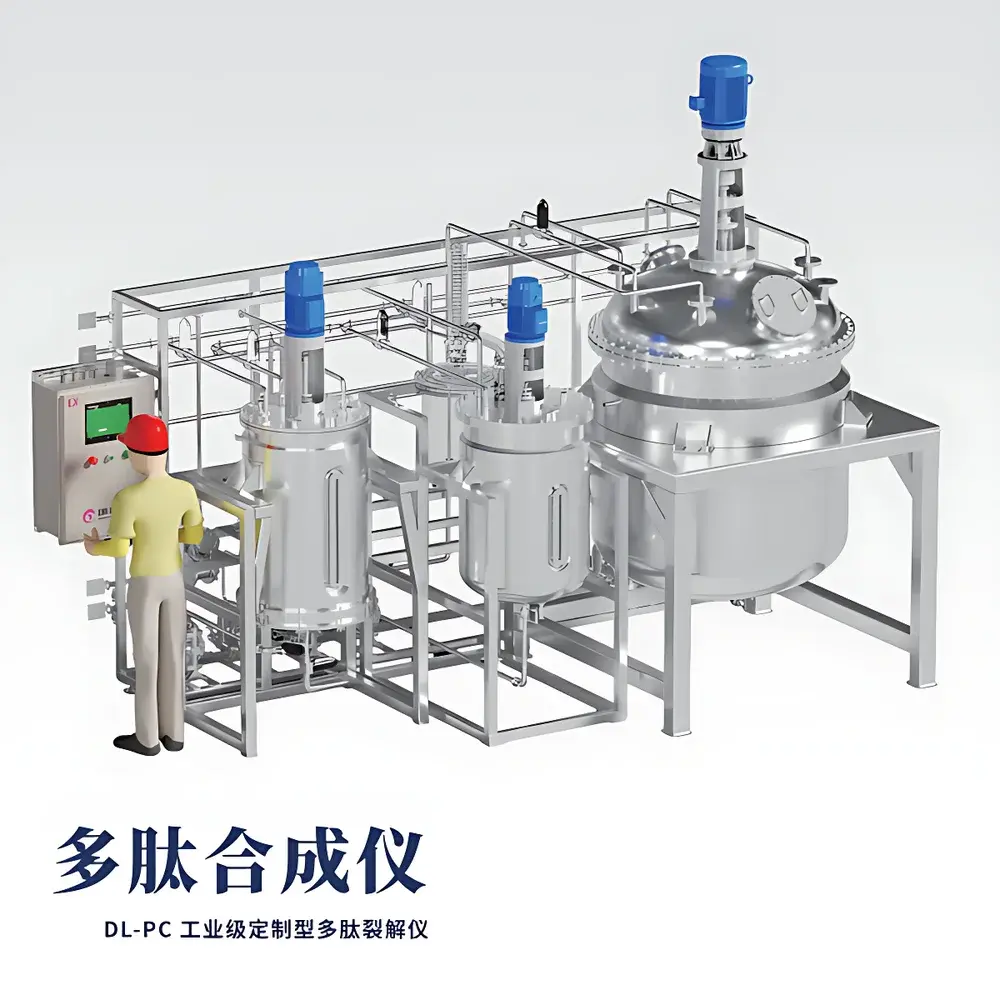
Dilun DL-PC Industrial-Grade Custom Peptide Cleavage System
| Brand | Dilun |
|---|---|
| Origin | Beijing, China |
| Manufacturer Type | Authorized Distributor |
| Product Origin | Domestic (China) |
| Model | DL-PC |
| Quotation | Upon Request |
| Amino Acid Delivery | Automated |
| Reagent Delivery | Automated |
| Synthesis Scale | 1.8–3.6 mol |
| Reactor Count | 1 |
| Reactor Volume Range | 20–250 L |
| Cleavage Vessel Capacity | 20–250 L |
| Solvent Positioning Sites | ≤5 |
| Concentration Vessel | 1 unit |
| Precipitation Vessel | 1 unit |
| Cleavage Temperature Control Range | −20 to +50 °C |
| Vessel Material | 316L Stainless Steel with Hastelloy lining or PTFE-E coating |
| Agitation Mode | Mechanical Stirring |
| Power Supply | 220/380 V AC |
| Explosion Protection Rating | Exia IIC T4 GB |
Overview
The Dilun DL-PC Industrial-Grade Custom Peptide Cleavage System is a purpose-engineered, modular cleavage platform designed for scalable, GMP-aligned solid-phase peptide synthesis (SPPS) workflows. Unlike conventional benchtop cleavage reactors, the DL-PC implements a three-vessel architecture—comprising a dedicated cleavage vessel, concentration vessel, and precipitation (settling) vessel—each constructed from 316L stainless steel with chemically inert internal linings (Hastelloy alloy or PTFE-E coating) to ensure compatibility with aggressive cleavage cocktails such as TFA-based reagents, scavengers, and low-temperature anhydrous solvents. The system operates on the principle of controlled acidolysis under precisely regulated thermal and mechanical conditions: cleavage proceeds in the primary reactor under programmable temperature control (−20 °C to +50 °C), followed by solvent removal via vacuum-assisted concentration and final peptide precipitation through controlled antisolvent addition and phase separation. All critical process parameters—including internal pressure, jacket and bulk solvent temperature, agitation speed, and volumetric reagent transfer—are continuously monitored, logged, and alarm-triggered in real time via integrated industrial-grade sensors and PLC-based control logic.
Key Features
- Modular tri-vessel configuration (cleavage/concentration/precipitation) enabling sequential, closed-system processing without manual intermediate transfers
- Double-jacketed vessels with optical viewports for real-time visual monitoring of reaction homogeneity, precipitate formation, and phase separation
- Automated, gravimetrically calibrated peristaltic and piston-driven quantitative pumps for precise delivery of TFA, scavengers (e.g., triisopropylsilane, water, ethanedithiol), and antisolvents (e.g., cold diethyl ether)
- Programmable temperature control across all vessels using dual-zone heating/cooling jackets; capable of sub-zero cleavage for acid-labile sequences
- Explosion-proof design compliant with Exia IIC T4 GB certification—suitable for Class I, Division 1 hazardous locations handling volatile organic solvents
- Full audit trail capability: timestamped parameter logging (±0.1 °C temperature resolution, ±1 rpm agitation accuracy, ±0.5% volumetric repeatability) with configurable data export (CSV, PDF)
Sample Compatibility & Compliance
The DL-PC accommodates a broad spectrum of resin-bound peptide substrates—including Wang, Rink amide, 2-chlorotrityl, and Sieber resins—across scales from 1.8 to 3.6 mol, supporting batch sizes up to 250 L reaction volume. Its chemically resistant wetted path ensures compatibility with standard cleavage cocktails (e.g., TFA/H2O/TIS 95:2.5:2.5 v/v/v), as well as custom formulations containing phenol, thioanisole, or dimethyl sulfide. The system meets foundational requirements for pharmaceutical manufacturing environments: vessel surface finish (Ra ≤ 0.4 µm), traceability of material certifications (ASME BPVC Section VIII, EN 13445), and documentation packages aligned with FDA 21 CFR Part 11 (electronic records/signatures), EU Annex 11, and ISO 13485. Validation support includes IQ/OQ protocols, FAT/SAT documentation, and risk assessments per ISO 14971.
Software & Data Management
The DL-PC is operated via a ruggedized HMI touchscreen interface running embedded Linux-based control firmware. Process methods are defined using a stepwise scripting engine supporting conditional logic (e.g., “hold at −10 °C until TFA concentration reaches 92%”, “initiate precipitation upon turbidity threshold detection”). All operational data—including sensor inputs, pump actuation events, alarm logs, and user actions—are stored locally on encrypted SSD storage with optional redundant network backup. Raw datasets comply with ALCOA+ principles (Attributable, Legible, Contemporaneous, Original, Accurate, Complete, Consistent, Enduring, Available) and support direct integration into LIMS or MES platforms via OPC UA or Modbus TCP. Electronic signatures, role-based access control (RBAC), and full change history tracking satisfy GLP/GMP data integrity mandates.
Applications
- Industrial-scale cleavage of therapeutic peptides (e.g., GLP-1 analogs, somatostatin derivatives, antimicrobial peptides) under cGMP conditions
- Process development and tech transfer from lab-scale synthesizers (e.g., CEM Liberty Blue, AAPPTec Focus XC) to production batches
- Stability-indicating cleavage studies requiring strict thermal control to minimize side reactions (e.g., tert-butyl cation alkylation, aspartimide formation)
- High-value peptide API manufacturing where solvent recovery, residual TFA quantification, and particle size distribution of precipitated crude product are critical quality attributes (CQAs)
- Contract manufacturing organizations (CMOs) supporting multi-client campaigns with method segregation and electronic batch record (EBR) generation
FAQ
What is the maximum allowable working pressure for the cleavage vessel?
The DL-PC cleavage vessel is rated for a maximum working pressure of 0.6 MPa (gauge) at 50 °C, with burst pressure exceeding 1.8 MPa per ASME Section VIII Div. 1.
Can the system be validated for regulatory submissions (e.g., FDA IND/BLA)?
Yes—the system supports full qualification (IQ/OQ/PQ), including calibration certificates traceable to NIST standards, material test reports (MTRs), and vendor-supplied validation templates compatible with ICH Q5C, Q5D, and Q7 guidelines.
Is remote monitoring and troubleshooting supported?
The DL-PC includes built-in Ethernet connectivity with TLS-secured remote desktop access (via approved VPN), enabling real-time diagnostics, firmware updates, and collaborative troubleshooting by Dilun Field Application Engineers.
How is solvent recovery handled during concentration?
The concentration vessel integrates a condenser-cooled vacuum distillation loop with automated fraction collection; recovered TFA and co-solvents can be routed to external storage or inline purification modules.
Does the system support PAT (Process Analytical Technology) integration?
Yes—4–20 mA analog outputs and digital I/O ports are available for integration with in-line FTIR, Raman, or turbidity probes, enabling real-time endpoint determination and adaptive control strategies.
Related Products