
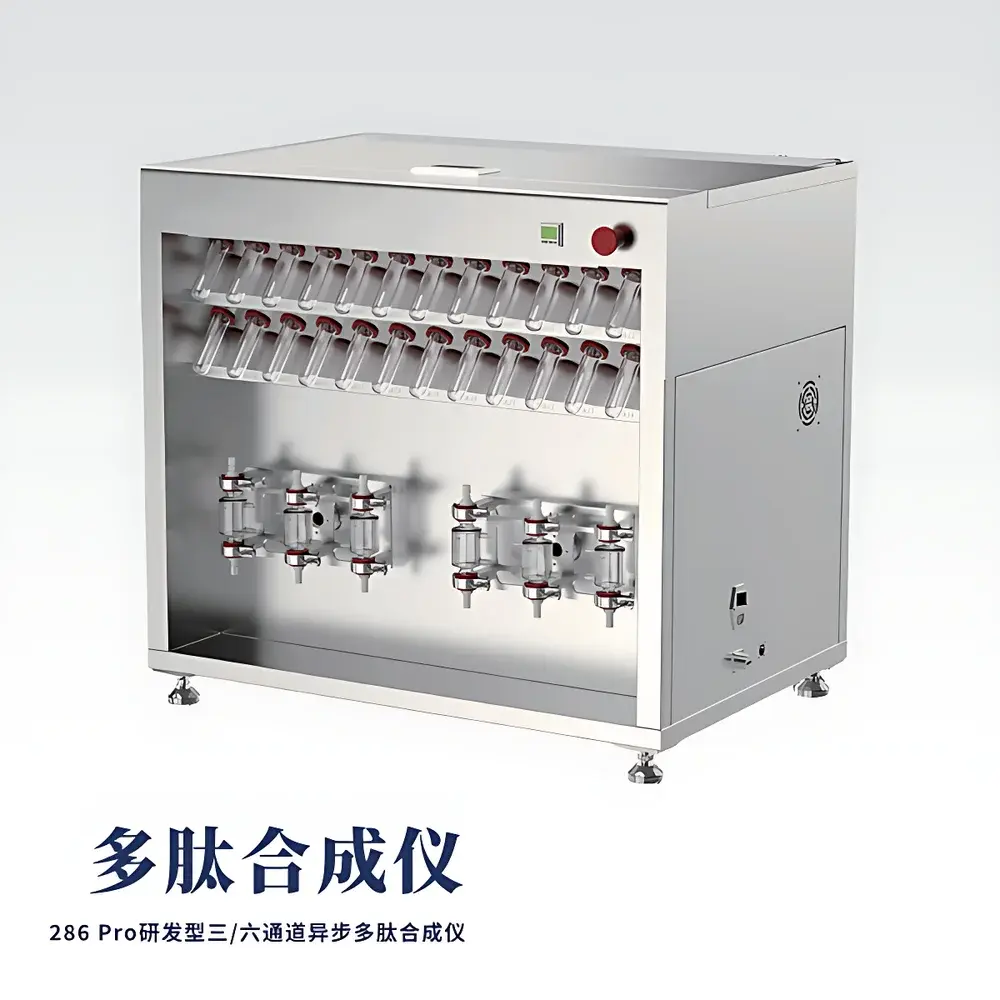
Dilun Bio 286 Pro Research-Grade Asynchronous Multi-Channel Peptide Synthesizer
| Brand | Dilun Bio |
|---|---|
| Origin | Beijing, China |
| Model | 286 Pro |
| Amino Acid Delivery | Automated |
| Reagent Delivery | Automated |
| Synthesis Scale | 0.05–10 mmol |
| Reactor Count | 3 (expandable to 6) |
| Reactor Volume Options | 25/50 mL, 100/200 mL, 200/500 mL |
| Amino Acid Positions | 24 |
| Activator Solvent Positions | 4 |
| Other Solvent Positions | 4 |
| Solvent Reservoir Capacity | 0.5–10 L |
| Temperature Control | 360° circumferential electromagnetic induction hot-air heating |
| Mixing Mode | 180° bidirectional tumbling + nitrogen sparging |
| Amino Acid Quantitative Transfer | full dissolution & complete transfer |
| Activator Dispensing Accuracy | ±0.1 mL |
| Solvent Dispensing Accuracy | ±1 mL |
| Dimensions (W×D×H) | 90 × 62 × 82 cm |
| Weight | 87 kg |
| Power Supply | 110/220 V, 50/60 Hz |
Overview
The Dilun Bio 286 Pro is a research-grade, asynchronous multi-channel solid-phase peptide synthesizer engineered for high-fidelity, parallel synthesis of custom peptides across diverse scales—from exploratory nanomole optimization to gram-scale preparative runs (up to ~5 g crude product per batch). It operates on the principle of Fmoc- or Boc-based solid-phase synthesis (SPPS), integrating precise reagent metering, programmable reaction kinetics, and independent channel control to accommodate heterogeneous coupling/deprotection protocols within a single run. Unlike conventional synchronous synthesizers, the 286 Pro enables true per-residue customization: each amino acid addition step can be assigned unique activation chemistry (e.g., HATU/DIPEA, DIC/Oxyma, or PyBOP), distinct deprotection conditions (piperidine concentration, temperature, duration), and variable coupling times—critical for synthesizing challenging sequences containing sterically hindered, aggregation-prone, or post-translationally modified residues. Its modular reactor architecture supports three standard channels (expandable to six via hardware upgrade), with interchangeable reactor vessels ranging from 25 mL to 500 mL, enabling seamless transition from screening to scale-up without method revalidation.
Key Features
- Asynchronous channel operation: Each of the 3 (or 6) synthesis channels executes independently—different peptide sequences, coupling strategies, and timing profiles may run concurrently.
- 24-position amino acid station with 15–100 mL bottle compatibility; quantitative dissolution and full-transfer delivery ensures stoichiometric accuracy and minimizes residual carryover.
- Dual-mode mixing: 180° bidirectional tumbling combined with regulated nitrogen sparging provides uniform resin suspension and efficient mass transfer across all vessel sizes.
- Circumferential 360° electromagnetic induction hot-air heating delivers rapid, uniform thermal control (±0.5 °C stability) without direct contact—eliminating hot spots and enhancing reproducibility in temperature-sensitive couplings.
- Four dedicated activator ports with ±0.1 mL precision dispensing; four additional solvent ports with ±1 mL accuracy; optional solvent reservoirs (0.5 L to 10 L) support unattended overnight synthesis.
- Multi-user secure login system with role-based access control: Operators log in independently, load private synthesis methods, and maintain audit-trail–enabled session records compliant with GLP documentation requirements.
Sample Compatibility & Compliance
The 286 Pro accommodates standard polystyrene, PEG-PS, and ChemMatrix® resins (100–200 mg loading), as well as specialty supports for pseudoproline dipeptides, backbone-amide linker (BAL), or safety-catch resins. It supports common SPPS reagents—including piperidine/DMF for Fmoc removal, TFA cocktails for cleavage, and HOBt, HOAt, Oxyma Pure, and COMU derivatives for activation. The system complies with ISO 9001:2015 manufacturing standards and incorporates design elements aligned with FDA 21 CFR Part 11 expectations: electronic signatures, user authentication, immutable method logs, and timestamped event records. While not certified for GMP production environments, its architecture supports validation packages (IQ/OQ/PQ) required for regulated academic core facilities and preclinical CMC development labs.
Software & Data Management
The synthesizer is controlled via Dilun SynthOS™ v3.x—a Windows-based platform supporting method creation, real-time monitoring (temperature, pressure, valve status, fluid level), and automated error recovery (e.g., clog detection, low-solvent alerts). All synthesis parameters—including residue-specific coupling time, deprotection concentration, activation reagent selection, and wash cycle counts—are stored as editable XML-based method files. Audit trails capture operator ID, timestamp, parameter changes, and execution outcomes. Raw data exports in CSV and PDF formats facilitate integration with LIMS systems and regulatory submissions. Remote diagnostics capability allows authorized service engineers to assess instrument health and troubleshoot via encrypted TLS connection—without accessing proprietary synthesis protocols.
Applications
- Rapid parallel synthesis of peptide libraries for epitope mapping, SAR studies, and hit-to-lead optimization.
- Preparative synthesis of immunogens, antigens, and reference standards for LC-MS/MS assay development (e.g., 1–5 g crude material for purification and characterization).
- Method development for difficult sequences: N-methylated, D-amino acid–containing, cyclic, or branched peptides requiring customized activation kinetics.
- Academic and contract research organization (CRO) labs performing early-stage peptide drug discovery where flexibility, traceability, and scalability are prioritized over throughput-only automation.
- Technology transfer from lab-scale to pilot-scale synthesis, leveraging identical reaction engineering principles across vessel sizes.
FAQ
Can the 286 Pro synthesize peptides using both Fmoc and Boc chemistries?
Yes—the system supports interchangeable reagent sets and customizable deprotection/coupling protocols, enabling method adaptation for either strategy without hardware modification.
Is reactor volume change possible during an ongoing synthesis?
No—vessel size must be selected prior to initiation; however, the same method can be validated across multiple reactor volumes (25 mL to 500 mL) due to consistent thermal and mixing performance.
Does the system provide electronic records suitable for FDA-regulated submissions?
It generates ALCOA+–compliant audit trails (attributable, legible, contemporaneous, original, accurate) and supports 21 CFR Part 11–aligned configurations when deployed with validated IT infrastructure and procedural controls.
What maintenance is required for long-term operational reliability?
Scheduled quarterly calibration of fluidic actuators and annual verification of temperature uniformity and dispensing accuracy are recommended; consumables include silicone tubing, O-rings, and filter cartridges—all available as certified OEM parts.
Is remote software update supported?
Yes—SynthOS™ updates are delivered via secure HTTPS download; version history and rollback capability are embedded in the firmware management module.





