
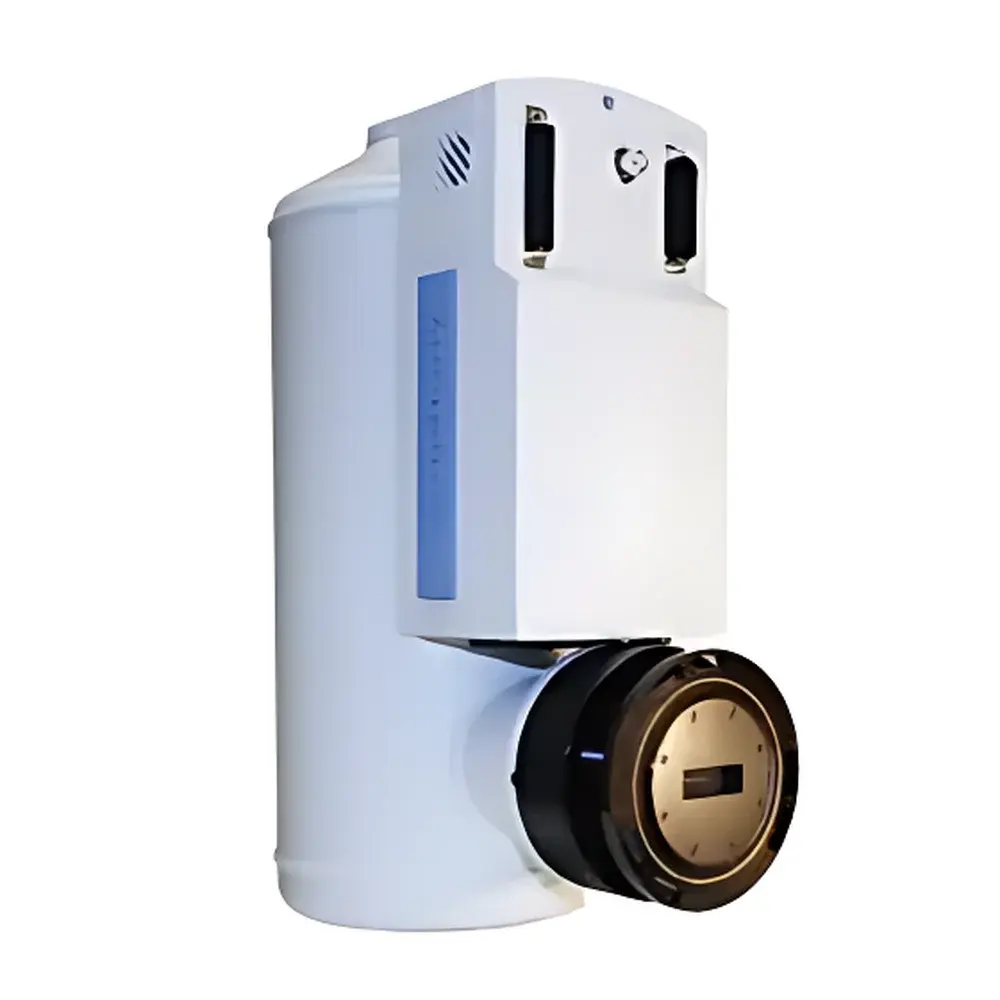
HORIBA Jobin Yvon IGA Series InGaAs Array Detector
| Brand | HORIBA |
|---|---|
| Origin | USA |
| Model | IGA array |
| Spectral Range | 0.8–1.7 µm or 1.0–2.2 µm |
| Pixel Configurations | 512× or 1024× (pixel pitch: 125 µm or 150 µm × 250 µm or 500 µm) |
| Cooling Options | Thermoelectric (TE) or Liquid Nitrogen (LN₂) |
| Operating Temperature (LN₂) | –103 °C |
| Interface | USB 2.0 / Camera Link (configurable) |
| Software Integration | SynerJY® SDK, LabVIEW® VIs |
| Compliance | CE, RoHS |
Overview
The HORIBA Jobin Yvon IGA Series InGaAs array detector is a high-performance near-infrared (NIR) photodetector engineered for demanding spectroscopic applications requiring exceptional sensitivity, low dark current, and stable spectral response across the 0.8–1.7 µm and 1.0–2.2 µm spectral windows. Based on indium gallium arsenide (InGaAs) photodiode array technology, the IGA detector operates on the principle of photon-to-electron conversion in a reverse-biased p–n junction, optimized for quantum efficiency >70% across its designated range. Its architecture supports both thermoelectric (TE) and liquid nitrogen (LN₂) cooling—enabling operation at –103 °C under cryogenic conditions—to suppress thermal noise and extend integration times for weak-signal detection. Designed as a modular component, it integrates natively with HORIBA’s family of scanning and imaging spectrometers—including the iHR, Triax, and Synapse platforms—delivering calibrated, time-resolved spectral data suitable for research-grade NIR reflectance, transmission, fluorescence, and process monitoring applications.
Key Features
- Two spectral configurations: 0.8–1.7 µm and 1.0–2.2 µm variants, each available with TE or LN₂ cooling options
- Cryogenic LN₂ cooling capability to –103 °C, reducing dark current by up to three orders of magnitude versus uncooled operation
- High linearity (>99.9% across full dynamic range), ensuring quantitative accuracy without post-acquisition correction
- Dual acquisition modes: selectable via software—high-sensitivity mode (optimized for low-light SNR) and high-dynamic-range mode (for wide-intensity span measurements)
- Multiple pixel formats: 512- and 1024-pixel linear arrays with configurable pixel pitches (125 µm or 150 µm) and active heights (250 µm or 500 µm) to match optical f/# and resolution requirements
- Low-noise analog front-end and 16-bit digitization, supporting sub-electron read noise performance under optimal cooling
Sample Compatibility & Compliance
The IGA detector is compatible with solid, liquid, and gaseous samples when used in conjunction with appropriate optical interfaces—such as fiber-coupled probes, integrating spheres, or transmission cells—and is routinely deployed in ASTM E1421-compliant NIR spectroscopy workflows. Its mechanical design conforms to standard spectrograph slit-mounting interfaces (e.g., C-mount, F-mount adaptors) and supports vacuum-compatible operation when integrated into controlled-environment systems. The detector meets CE marking requirements for electromagnetic compatibility (EMC Directive 2014/30/EU) and environmental safety (RoHS Directive 2011/65/EU). While not a standalone analytical instrument, its output data may be incorporated into GLP/GMP-regulated environments when paired with validated spectrometer systems and documented calibration protocols traceable to NIST standards.
Software & Data Management
The IGA detector is fully supported by HORIBA’s SynerJY® spectroscopy control suite, enabling synchronized acquisition, real-time preview, dark/reference subtraction, and spectral calibration. The included Software Development Kit (SDK) provides C/C++, Python, and .NET APIs for custom automation, including trigger synchronization, region-of-interest (ROI) readout, and non-uniformity correction (NUC) matrix application. LabVIEW® Virtual Instruments (VIs) are provided for rapid integration into existing NI-based test benches. All acquired datasets are stored in vendor-neutral HDF5 format with embedded metadata—including exposure time, temperature, gain setting, and spectral calibration coefficients—ensuring FAIR (Findable, Accessible, Interoperable, Reusable) data principles. Audit trails and user-access logs can be enabled in enterprise deployments compliant with FDA 21 CFR Part 11 when interfaced with validated LIMS or ELN systems.
Applications
- Near-infrared chemical imaging of pharmaceutical tablets and coatings (USP )
- Quantitative analysis of moisture, protein, and fat content in agricultural commodities
- In-line monitoring of polymerization kinetics and catalyst behavior in chemical reactors
- Low-light NIR fluorescence lifetime measurements in semiconductor defect analysis
- Gas-phase absorption spectroscopy for trace hydrocarbon detection (e.g., CH₄, CO, NH₃)
- Time-resolved pump-probe experiments in ultrafast spectroscopy setups
FAQ
What cooling methods are supported, and how do they affect dark current?
The IGA detector supports both thermoelectric (TE) and liquid nitrogen (LN₂) cooling. LN₂ operation achieves –103 °C sensor temperature, reducing dark current to ≤0.1 e⁻/pixel/s—critical for long-exposure NIR measurements. TE cooling typically maintains –20 to –40 °C, offering sufficient noise suppression for routine laboratory use.
Can the detector be used with non-HORIBA spectrometers?
Yes—the IGA series features standardized electrical and mechanical interfaces (including USB 2.0 and Camera Link options) and open SDKs, enabling integration with third-party spectrometers and OEM optical engines, subject to optical coupling validation.
Is spectral calibration performed at the factory?
Each unit ships with a NIST-traceable wavelength calibration certificate and pixel-response uniformity map. Users may perform additional calibration using certified reference sources (e.g., tungsten-halogen lamps, rare-earth oxide filters) within SynerJY®.
What is the typical frame rate in high-sensitivity mode?
Frame rates depend on array size and exposure settings; for the 512-pixel configuration, full-frame readout ranges from 100 Hz (short exposure) to 1–5 Hz (long-integration, LN₂-cooled mode).
Does the detector support triggering and synchronization?
Yes—hardware TTL trigger input/output ports enable precise external synchronization with lasers, choppers, or data acquisition systems, supporting gated acquisition and multi-channel timing alignment.
Related Products



