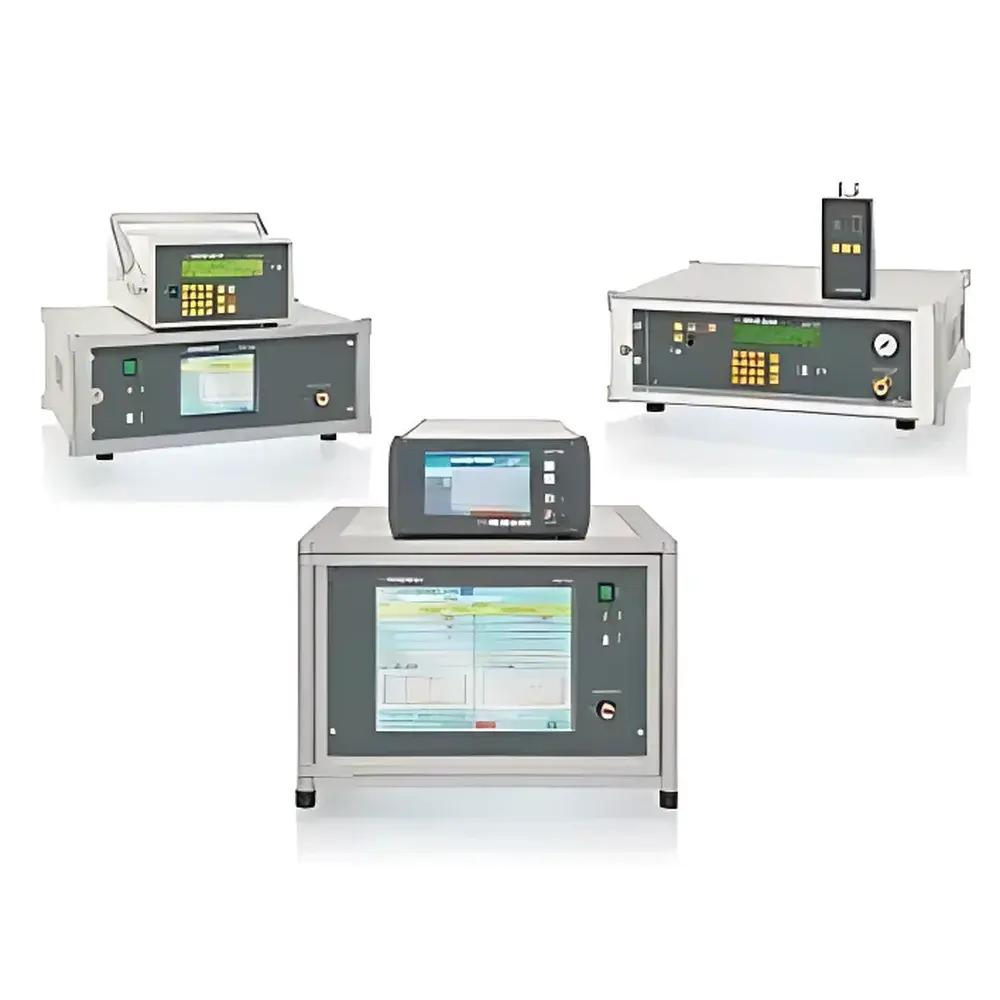
JWFroehlich MPS Series Pressure Decay Leak Tester
| Brand | JWFroehlich |
|---|---|
| Origin | Germany |
| Model | MPS Series |
| Measurement Principle | Pressure Decay (Relative & Differential) |
| Test Pressure Range | –0.8 to 20 bar |
| Compliance | Designed for ISO 50001-aligned industrial QA/QC environments, compatible with GLP/GMP audit trails via optional software modules |
| Target Applications | Automotive powertrain component leak testing (cylinder heads, engine blocks, transmission housings, fuel rails, compressors) |
Overview
The JWFroehlich MPS Series Pressure Decay Leak Tester is an industrial-grade, microprocessor-controlled leak detection system engineered for high-reliability quantitative assessment of sealed components in manufacturing and quality assurance environments. Based on the physical principle of pressure decay analysis—measuring minute pressure differentials over time under controlled isothermal conditions—the MPS Series implements two validated pneumatic methodologies: relative pressure decay and differential pressure decay. These methods comply with fundamental thermodynamic constraints described in ISO 20487 (leak testing terminology) and align with test protocol frameworks referenced in ASTM E432 and ISO 12236. The system is purpose-built for production-integrated final inspection of critical fluid-path components where integrity failure could result in safety compromise, regulatory nonconformance, or field performance degradation.
Key Features
- Modular architecture supporting both relative-pressure and differential-pressure decay configurations within a single platform
- Dual-sensor topology with high-stability piezoresistive pressure transducers (±0.05% FS accuracy, temperature-compensated)
- Integrated thermal stabilization circuitry to minimize drift during extended hold phases (critical for sub-mbar/h resolution)
- Real-time pressure monitoring with configurable sampling intervals (10 ms to 5 s), enabling adaptive test sequencing
- Robust aluminum alloy chassis rated IP54 for operation in factory-floor environments with oil mist, vibration, and ambient temperature fluctuations (10–40 °C)
- Pre-calibrated test port interfaces (G¼” BSP and NPT options) with integrated quick-connect fittings and flow-limiting orifices for standardized volume compensation
- Onboard diagnostics including sensor self-test, leak-path continuity verification, and environmental drift compensation logs
Sample Compatibility & Compliance
The MPS Series accommodates a broad range of metallic and composite workpieces common in automotive, aerospace, and hydraulic system manufacturing. Validated test geometries include cylinder heads with multi-port coolant/oil passages, cast aluminum engine blocks, welded fuel rail assemblies, planetary gear carrier housings, hermetic compressor casings, and brake master cylinder bodies. All configurations support volumetric compensation for fixture-induced dead space—enabling repeatable results across part families without hardware reconfiguration. The system meets mechanical safety requirements per EN ISO 13857 and pneumatic system design guidelines per ISO 4414. When paired with JWFroehlich’s optional LMS-Connect software suite, full 21 CFR Part 11 compliance is achievable—including electronic signatures, audit trail generation, and role-based access control for regulated QA environments.
Software & Data Management
Control and data acquisition are managed through the embedded MPS Control Interface (v3.2+), featuring intuitive touchscreen navigation and real-time pressure curve visualization. Raw test data—including pressure vs. time traces, decay rate derivatives, and pass/fail thresholds—is exportable in CSV and XML formats. Optional LMS-Connect software extends functionality to centralized fleet management, SPC charting (X̄/R, Cpk), automated report generation (PDF/Excel), and MES integration via OPC UA or Modbus TCP. All software modules maintain timestamped event logging with user attribution, supporting traceability requirements under IATF 16949 Clause 8.5.1.2 and ISO 9001:2015 Clause 8.5.2.
Applications
- Final leak verification of internal combustion engine components prior to assembly line release
- In-process validation of vacuum-assisted casting porosity in aluminum die-cast housings
- Post-weld integrity screening of stainless steel fuel delivery manifolds
- Functional qualification of electro-hydraulic control units (EHCU) subjected to burst-pressure preconditioning
- Supplier audit readiness testing for Tier-1 OEMs requiring zero-defect gate criteria (e.g., BMW Q-Report, Ford Q1)
- Design validation testing during DFMEA execution for new powertrain architectures
FAQ
What distinguishes relative-pressure decay from differential-pressure decay in the MPS Series?
Relative-pressure mode uses a single reference sensor measuring absolute pressure change in the test part; it is optimal for low-pressure, high-volume applications with relaxed sensitivity requirements. Differential mode employs two matched sensors—one on the test part and one on a matched reference cavity—enabling rejection of ambient temperature and supply pressure fluctuations, thereby achieving sub-0.1 Pa/s resolution at 20 bar test pressure.
Can the MPS Series be integrated into an existing PLC-controlled assembly line?
Yes. Standard digital I/O (24 VDC, sink/source configurable) and optional PROFINET/EtherNet/IP communication modules enable seamless handshaking with Rockwell, Siemens, and Beckhoff controllers. Hardware interlock signals (start, pass, fail, fault) conform to IEC 61508 SIL2 functional safety profiles.
Is calibration traceable to national standards?
All pressure transducers are supplied with individual DAkkS-accredited calibration certificates (traceable to PTB), valid for 12 months under normal operating conditions. Field recalibration kits and certified service intervals are documented in the Maintenance Manual (Ref. MPS-MAN-EN-Rev.4.1).