
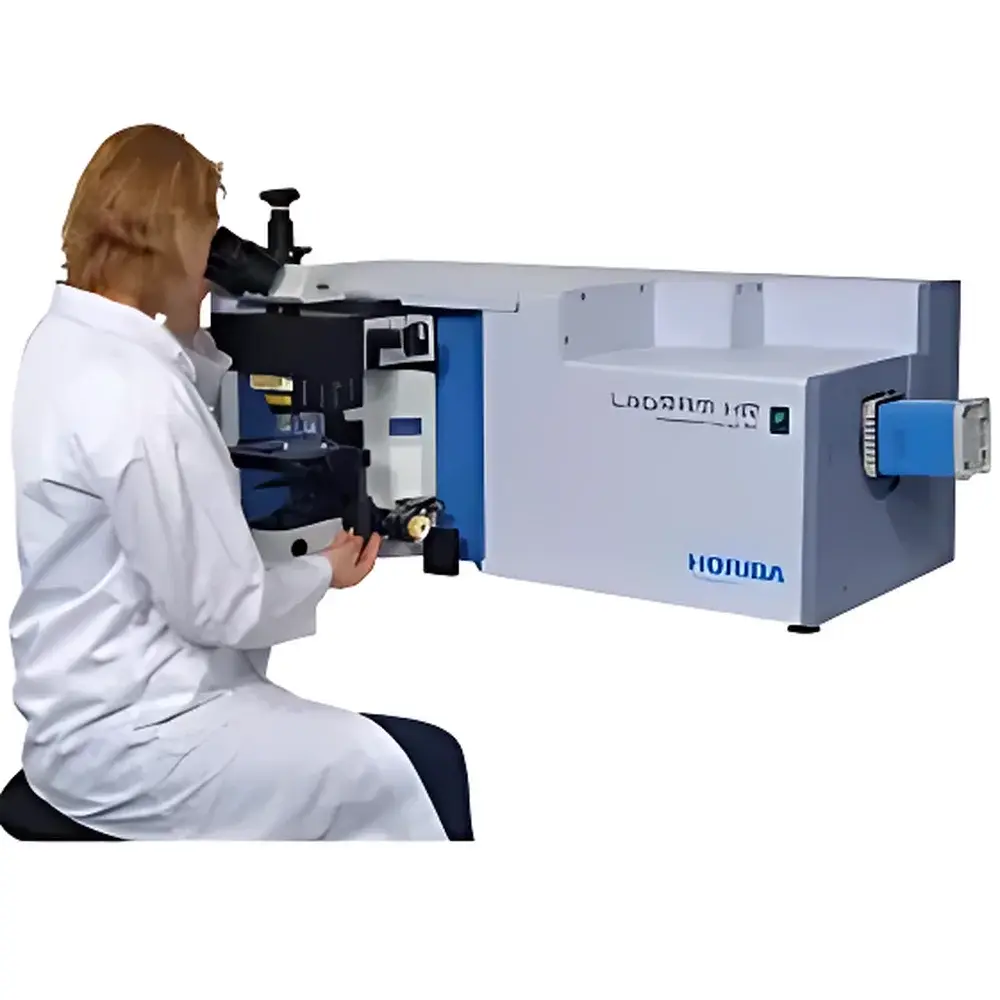
HORIBA LabRAM HR Evolution High-Resolution Confocal Raman Spectrometer
| Brand | HORIBA |
|---|---|
| Origin | France |
| Model | LabRAM HR Evolution |
| Instrument Type | Confocal Micro-Raman Spectrometer |
| Spectral Range | 200–2100 nm |
| Focal Length | 800 mm |
| Spectral Dispersion | Flat-field output optimized for large-format CCD detectors |
| Laser Power Control | Multi-step motorized neutral density filters |
| Detector | Research-grade air-cooled large-chip CCD |
| Low-Wavenumber Capability | Down to 10 cm⁻¹ |
| Spatial Resolution | Sub-micron (diffraction-limited, wavelength- and objective-dependent) |
| Automation | Fully motorized optical path, filter wheels, grating turrets, and XYZ stage |
| Software Platform | LabSpec 6 with embedded chemometrics, fluorescence subtraction, particle search, and audit-trail-ready data handling |
Overview
The HORIBA LabRAM HR Evolution is a research-grade confocal micro-Raman spectrometer engineered for high-fidelity molecular fingerprinting and structural characterization across materials science, pharmaceuticals, geology, and nanotechnology. Based on a single-stage Czerny–Turner spectrograph architecture with an 800 mm focal length, it delivers exceptional spectral resolution without the complexity or throughput penalty of multi-stage systems. Its flat-field spectrograph design enables optimal coupling with large-format, back-illuminated CCD detectors—ensuring high quantum efficiency across UV–VIS–NIR excitation ranges (200–2100 nm). The system employs true confocal microscopy optics with motorized pinhole control, enabling precise depth sectioning and 3D volumetric mapping at sub-micron lateral resolution (dependent on objective NA and excitation wavelength). Unlike scanning probe or widefield approaches, the LabRAM HR Evolution captures chemically specific vibrational spectra with spatial localization defined by diffraction-limited excitation and detection volumes—making it indispensable for heterogeneous sample analysis, phase identification, stress/strain mapping, and crystallinity assessment.
Key Features
- True confocal optical architecture with motorized pinhole and high-NA microscope objectives for axial resolution control and 3D tomographic imaging
- Full-wavelength automation: seamless switching between UV (244/325 nm), visible (473/532/633 nm), and NIR (785/1064 nm) lasers via software-controlled turret and alignment compensation
- Ultra-low wavenumber capability down to 10 cm⁻¹ using specialized notch filters and optimized optical path design—enabling analysis of lattice modes, phonons, and interlayer vibrations in 2D materials
- Triple-detector configuration support: simultaneous or sequential use of EMCCD, InGaAs, and deep-depletion CCD for extended dynamic range and spectral coverage
- Integrated high-precision XYZ motorized stage with sub-100 nm repeatability, compatible with environmental stages (cryo, heating, humidity) and in situ cells
- Patented dual-beam path design eliminates realignment when switching between UV and VIS/NIR channels—maintaining calibration integrity and reducing downtime
- Real-time Raman, photoluminescence (PL), and fluorescence imaging at video-rate speeds using region-of-interest (ROI) acquisition and hardware binning
Sample Compatibility & Compliance
The LabRAM HR Evolution accommodates diverse sample geometries—from bulk solids and thin films to powders, liquids, biological tissues, and semiconductor wafers—via interchangeable microscope configurations (upright, inverted, or open-frame). Optional transmission modules, polarization accessories, fiber-optic probes, and AFM/Raman hyphenation kits extend analytical flexibility for process monitoring, failure analysis, and correlative microscopy. All instrument control, data acquisition, and post-processing comply with GLP/GMP documentation requirements. LabSpec 6 supports 21 CFR Part 11-compliant user access controls, electronic signatures, and full audit trails—including timestamped parameter logs, raw spectrum metadata, and versioned processing history. System validation packages align with ISO/IEC 17025 and ASTM E1840-20 guidelines for spectroscopic instrumentation qualification.
Software & Data Management
LabSpec 6 serves as the unified platform for instrument orchestration, spectral acquisition, multivariate analysis, and report generation. Its modular architecture integrates chemometric tools—including PCA, cluster analysis, MCR-ALS, and supervised classification—directly into the workflow without external export. Advanced algorithms enable automatic fluorescence background removal using iterative polynomial fitting and morphological filtering, while “Particle Search” identifies and classifies Raman-active features within large-area maps based on spectral similarity and intensity thresholds. All spectra are stored in HDF5 format with embedded metadata (excitation wavelength, grating, slit width, integration time, objective ID), ensuring FAIR (Findable, Accessible, Interoperable, Reusable) data principles. Batch processing pipelines support automated QA/QC reporting for regulated environments.
Applications
- Polymorph screening and crystallinity quantification in active pharmaceutical ingredients (APIs) per USP and ICH Q5A
- Strain and doping level mapping in graphene, transition metal dichalcogenides (TMDs), and heterostructures
- Corrosion product identification and oxide layer thickness estimation on metallic alloys
- Microplastic identification and polymer degradation analysis in environmental samples
- In situ electrochemical Raman studies of battery electrode interfaces under potentiostatic control
- Single-cell metabolic profiling via Raman microspectroscopy combined with stable isotope probing
FAQ
What excitation wavelengths are supported, and how is laser alignment maintained during switching?
The system natively supports 244, 325, 473, 532, 633, 785, and 1064 nm lasers. Dual optical paths eliminate realignment needs; each channel is factory-aligned and validated with NIST-traceable reference standards.
Is low-wavenumber operation below 100 cm⁻¹ possible without vacuum or cryogenic cooling?
Yes—the ultra-low wavenumber module achieves 10 cm⁻¹ cutoff under ambient conditions using optimized edge filters and stray-light suppression baffling.
Can LabSpec 6 generate compliant reports for FDA submissions?
Yes—when deployed with validated installation qualification (IQ), operational qualification (OQ), and configured user roles, LabSpec 6 meets 21 CFR Part 11 requirements for electronic records and signatures.
How is spatial resolution quantified, and what limits its performance?
Lateral resolution follows Abbe’s criterion (~λ/2NA); typical values range from 250 nm (532 nm, 100×/0.95 NA) to 500 nm (785 nm, 50×/0.75 NA). Axial resolution is governed by confocality and pinhole size, typically 1–2 µm.
Are third-party detector integrations supported?
HORIBA provides SDKs and documented APIs for custom detector integration; however, full functionality—including synchronization, dark current correction, and metadata tagging—is guaranteed only with HORIBA-certified detectors.



