
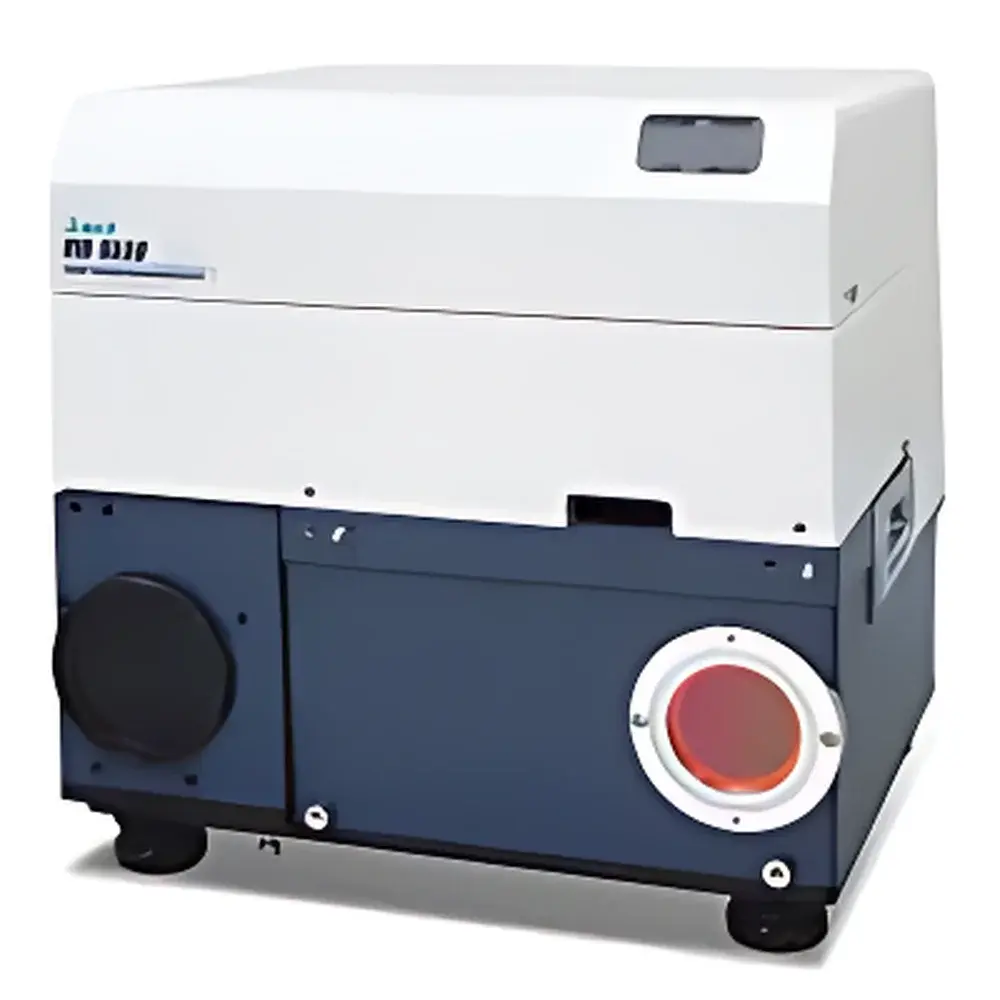
VIR-9000 Portable Fourier Transform Infrared (FTIR) Spectrometer
| Origin | Japan |
|---|---|
| Type | Portable FTIR Spectrometer |
| Model | VIR-9000 |
| Wavenumber Range | 4000–400 cm⁻¹ (standard DLATGS configuration) |
| Spectral Resolution | 4, 6, or 8 cm⁻¹ (user-selectable) |
| Interferometer Scan Speed | 0.5, 2.0, or 4.0 mm/sec |
| Detector | Thermoelectrically Cooled DLATGS (standard) |
| Signal-to-Noise Ratio | ≥10,000:1 (at 4 cm⁻¹, 60-second co-addition, near 2200 cm⁻¹) |
| Power Supply | 12 V DC (vehicle-compatible) |
| Software Platform | KnowItAll® IR Library & Functional Group Analysis Suite |
Overview
The VIR-9000 Portable Fourier Transform Infrared (FTIR) Spectrometer is an engineered solution for field-deployable molecular identification and quantitative analysis. Based on Michelson interferometry, the instrument acquires full mid-infrared spectra by measuring the interference pattern of broadband IR radiation modulated through a moving mirror assembly. Its compact optical bench—integrated with a high-stability, sealed interferometer and precision-machined alignment optics—ensures consistent spectral fidelity under non-laboratory conditions. Designed for operational continuity in variable environments, the VIR-9000 maintains thermal and mechanical stability across ambient temperatures from 5 °C to 40 °C and relative humidity up to 80% (non-condensing). Unlike benchtop FTIR systems, it eliminates reliance on vibration-isolated tables or climate-controlled rooms, enabling direct spectroscopic interrogation at production lines, hazardous material response sites, customs inspection zones, and environmental monitoring stations.
Key Features
- Compact, ruggedized chassis with integrated battery-ready 12 V DC input—compatible with automotive power systems and portable power stations.
- User-selectable spectral resolution (4, 6, or 8 cm⁻¹) and interferometer scan velocity (0.5–4.0 mm/sec), balancing measurement speed against spectral detail for time-sensitive applications.
- Thermoelectrically cooled deuterated triglycine sulfate (DLATGS) detector as standard, delivering stable responsivity and low drift over extended field deployments; optional mercury cadmium telluride (MCT) detector available for enhanced sensitivity in trace gas or low-concentration solid-phase analysis.
- Modular accessory interface supporting ATR (attenuated total reflectance), diffuse reflectance, transmission cells, and open-path gas cells—enabling rapid method reconfiguration without realignment.
- Embedded real-time spectrum preview and onboard spectral subtraction capabilities reduce post-acquisition processing latency during on-site decision-making.
Sample Compatibility & Compliance
The VIR-9000 accommodates solid, liquid, paste, and gaseous samples via interchangeable sampling modules. Standard configurations include single-bounce diamond ATR for polymers, pharmaceutical tablets, and coatings; specular reflectance for metal oxides and thin films; and flow-through gas cells for continuous emission monitoring. When equipped with its optional open-path configuration, the system supports path lengths up to 20 m for ambient air or stack gas analysis—fully compatible with EPA Method 320 and ISO 14912 for infrared gas quantification. All hardware and firmware comply with IEC 61326-1 (EMC for laboratory equipment) and IEC 61010-1 (safety requirements for electrical equipment). Data acquisition and processing workflows support audit-trail generation per FDA 21 CFR Part 11 when used with validated KnowItAll® software configurations under GLP/GMP environments.
Software & Data Management
The VIR-9000 operates natively with Bio-Rad’s KnowItAll® IR spectroscopy platform (v10.7+), licensed for spectral library search (≥300,000 reference spectra), functional group annotation, mixture deconvolution, and custom method scripting. Raw interferograms and processed absorbance/transmittance spectra are stored in standardized JCAMP-DX v6 format, ensuring interoperability with LIMS, ELN, and third-party chemometric tools (e.g., MATLAB, Python scikit-learn). The software enforces role-based user access control, electronic signature capture, and immutable metadata logging—including instrument ID, operator ID, timestamp, environmental sensor readings (optional), and acquisition parameters—for regulatory traceability. Batch export supports CSV, PDF, and XML formats compliant with ISO/IEC 17025 documentation requirements.
Applications
- Pharmaceutical raw material verification and counterfeit drug screening at distribution hubs.
- In-process quality control of polymer extrusion, coating uniformity, and adhesive curing kinetics.
- Environmental field analysis of VOC emissions, landfill gas composition, and industrial stack effluents.
- Forensic trace evidence characterization (e.g., paint chips, fibers, explosives residues).
- Academic and industrial field spectroscopy training—leveraging portability for outdoor, museum, or archaeological site analysis.
FAQ
What is the typical wavenumber range covered by the standard DLATGS configuration?
The VIR-9000 with DLATGS detector delivers reliable spectral coverage from 4000 cm⁻¹ to 400 cm⁻¹—optimized for organic functional group identification and inorganic lattice vibration analysis.
Can the instrument operate continuously on vehicle power without overheating?
Yes—the thermal management system includes passive heat-sink architecture and intelligent fan modulation, validated for uninterrupted operation at 12 V DC input under sustained 35 °C ambient conditions.
Is spectral calibration traceable to NIST standards?
Each unit ships with factory-installed polystyrene film and water vapor reference spectra; users may perform daily verification using built-in automated calibration routines aligned to NIST SRM 1921b.
Does the open-path gas module require external laser alignment tools?
No—the retroreflector-based open-path design uses self-aligning kinematic mounts and factory-calibrated beam collimation, eliminating field alignment procedures.
How is data integrity ensured during wireless transfer from the instrument to a secure network?
All wireless communication (Wi-Fi 5, 802.11ac) employs TLS 1.2 encryption; data packets are digitally signed and verified upon receipt in the KnowItAll® server environment.






