
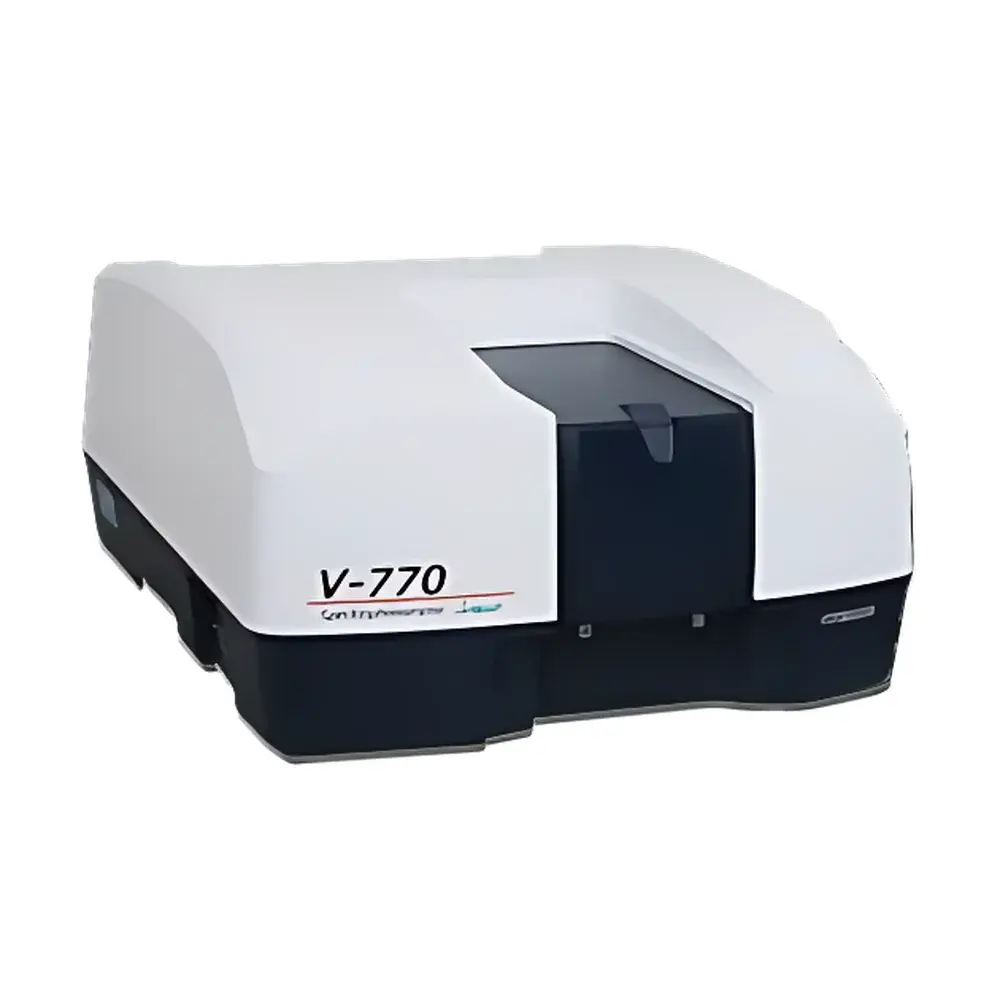
JASCO V-770 UV-Vis-NIR Spectrophotometer
| Brand | JASCO |
|---|---|
| Origin | Japan |
| Model | V-770 |
| Optical Design | Double-beam |
| Detector | Photomultiplier Tube (PMT) & Peltier-cooled PbS detector |
| Wavelength Range | 190–3200 nm |
| Spectral Bandwidth | 0–40 nm |
| Wavelength Accuracy | ±0.3 nm (UV-Vis), ±1.5 nm (NIR) |
| Wavelength Repeatability | ±0.05 nm (UV-Vis), ±0.2 nm (NIR) |
| Stray Light | ≤0.005% |
| Automation | Motorized wavelength scanning and auto-alignment |
Overview
The JASCO V-770 UV-Vis-NIR Spectrophotometer is a high-performance double-beam optical instrument engineered for precision absorbance, transmittance, and reflectance measurements across an exceptionally broad spectral range—from deep ultraviolet (190 nm) through visible light to extended near-infrared (up to 3200 nm). Built upon JASCO’s six-decade legacy in spectroscopic instrumentation design, the V-770 employs a dual-detector architecture: a high-sensitivity photomultiplier tube (PMT) for the UV-Vis region and a thermoelectrically cooled PbS detector optimized for stable, low-noise NIR signal acquisition. Its optical path integrates advanced diffraction gratings, motorized slit control, and real-time beam alignment feedback—ensuring long-term photometric stability and spectral fidelity. The system is designed for rigorous laboratory environments where trace-level quantification, material characterization, and regulatory-compliant data integrity are critical, including applications aligned with ASTM E275, ISO 9001, and USP spectrophotometric validation guidelines.
Key Features
- Extended spectral coverage from 190 nm to 3200 nm—enabling unified analysis of electronic transitions (UV-Vis) and vibrational overtones (NIR) without instrument switching.
- Double-beam optical configuration with real-time reference compensation, minimizing drift due to lamp instability or environmental fluctuations.
- High-resolution wavelength scanning (0.05 nm repeatability in UV-Vis) supported by precision stepper-motor-driven monochromator and automated grating selection.
- Dual-detector system: PMT for high quantum efficiency below 900 nm; Peltier-cooled PbS detector for enhanced signal-to-noise ratio and thermal stability above 900 nm.
- Variable spectral bandwidth (0–40 nm) with continuously adjustable slit width, permitting optimization between resolution and throughput per application requirement.
- Stray light suppression to ≤0.005%—critical for accurate measurement of highly absorbing samples and low-transmittance thin films.
- Modular optical platform compatible with vacuum purging (for <190 nm operation) and optional deuterium/halogen/Xe lamp sources.
Sample Compatibility & Compliance
The V-770 supports diverse sample formats via standardized 10-mm cuvette holders, temperature-controlled cell compartments (−10 °C to 110 °C), and a comprehensive suite of accessories—including integrating spheres (60 mm and 150 mm diameters), absolute reflectance modules, fiber-optic probes, cryogenic sample stages, and in-situ flow cells. It meets key international compliance frameworks: data acquisition and reporting align with FDA 21 CFR Part 11 requirements when used with Spectra Manager™ software configured for audit trail, electronic signatures, and user access controls. All optical components comply with ISO 17025 calibration traceability standards, and routine performance verification follows JIS K 0115 and ASTM E1421 protocols.
Software & Data Management
Controlled exclusively via JASCO’s Spectra Manager™ II software (Windows-based), the V-770 provides integrated instrument control, spectral acquisition, baseline correction, derivative analysis, and multi-curve overlay. Optional application-specific modules include: Colorimetry Analysis (CIE L*a*b*, ΔE calculations), Thin-Film Thickness Measurement (based on interference fringe modeling), Energy Bandgap Determination (Tauc plot generation), and Solar Radiation Performance Evaluation (ASTM G173 spectral irradiance weighting). Raw data are stored in vendor-neutral ASCII or JCAMP-DX formats; metadata embedding supports GLP/GMP documentation workflows, including timestamped operator logs, instrument configuration snapshots, and calibration history tracking.
Applications
The V-770 serves as a foundational analytical tool across multiple technical domains: in materials science, it characterizes optical bandgaps of semiconductors, refractive index dispersion of optical coatings, and NIR absorption signatures of polymers; in pharmaceutical development, it validates excipient compatibility, monitors degradation kinetics, and performs dissolution testing per USP ; in photovoltaics R&D, it measures external quantum efficiency (EQE) and antireflective coating performance; in catalysis and surface chemistry, it enables in-situ DRIFTS (Diffuse Reflectance IR Fourier Transform Spectroscopy) coupling via fiber-optic interfaces; and in quality assurance laboratories, it delivers traceable color measurement for pigments, dyes, and cosmetic formulations under CIE illuminants D65 and A.
FAQ
What is the maximum achievable resolution in UV-Vis mode?
The V-770 achieves nominal resolution down to 0.1 nm at 2 nm spectral bandwidth, with wavelength repeatability of ±0.05 nm confirmed per NIST-traceable line source verification.
Can the instrument operate under inert atmosphere or vacuum?
Yes—optional purge ports enable nitrogen or argon purging for oxygen-sensitive UV measurements below 200 nm; vacuum-compatible versions are available for sub-190 nm operation.
Is spectral calibration traceable to national standards?
All factory calibrations use NIST-certified holmium oxide and didymium filters; users may perform periodic verification using JASCO’s certified wavelength and photometric standards (Cat. No. SM-STD-WL/SM-STD-ABS).
How does the dual-detector switching work during scan?
Automated detector selection occurs at ~850 nm based on pre-defined threshold settings; seamless transition is managed by internal synchronization logic to prevent data gaps or intensity discontinuities.
Are IQ/OQ/PQ validation documents available?
JASCO provides comprehensive Instrument Qualification (IQ) and Operational Qualification (OQ) templates compliant with Annex 11 and ISO/IEC 17025; Performance Qualification (PQ) protocols are application-specific and developed collaboratively with end users.




