
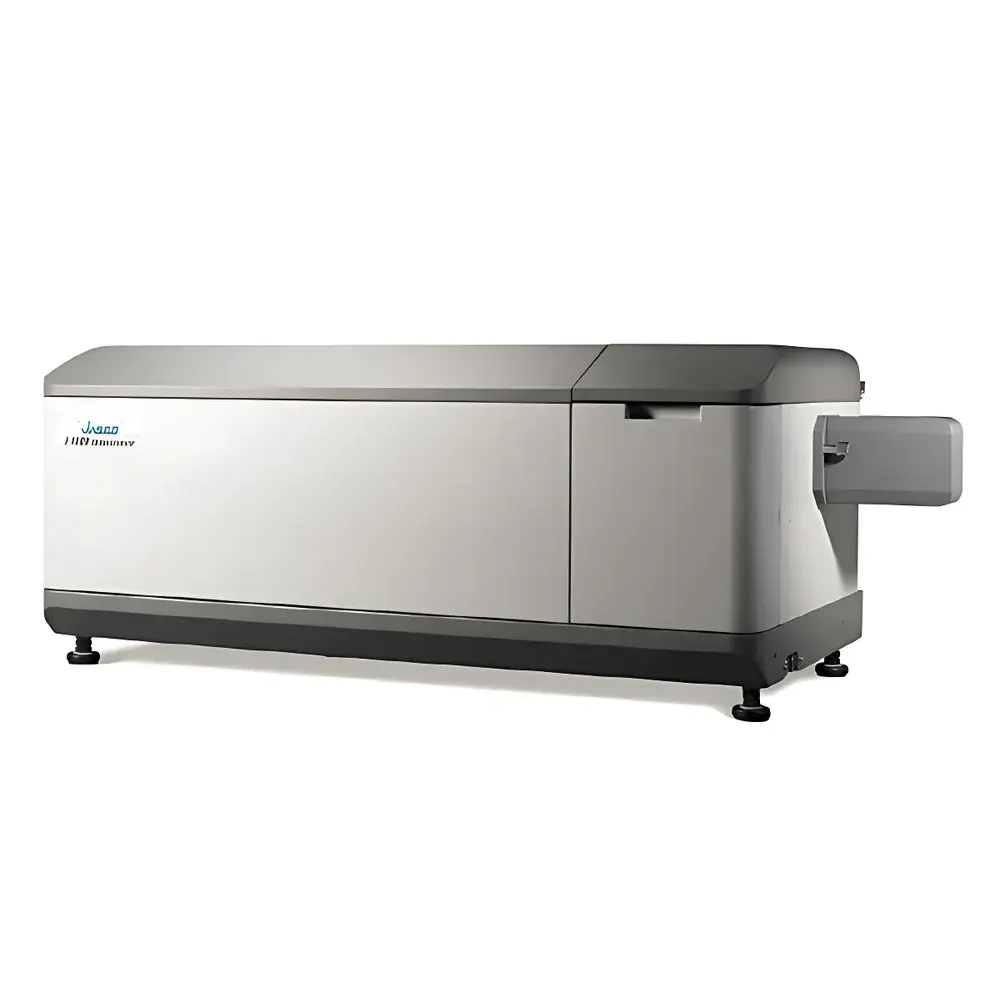
JASCO J-1500 Circular Dichroism Spectrometer
| Brand | JASCO |
|---|---|
| Origin | Japan |
| Model | J-1500 |
| Instrument Type | Circular Dichroism (CD) Spectrometer |
| Wavelength Range | 163–950 nm (extendable to 1600 nm) |
| Standard Measurement Modes | CD, LD, UV-Vis |
| Optical System | Dual Photoelastic Modulator (PEM) with Vacuum UV-optimized Polarization Optics |
| Compliance | Designed for GLP/GMP-aligned laboratories |
Overview
The JASCO J-1500 Circular Dichroism Spectrometer is a high-performance, research-grade CD instrument engineered for quantitative chiroptical characterization of biomolecules, small-molecule pharmaceuticals, and advanced chiral materials. Based on the fundamental principle of differential absorption of left- and right-circularly polarized light, the J-1500 delivers high signal-to-noise ratio CD spectra across an exceptionally broad spectral range—from vacuum ultraviolet (VUV) at 163 nm to near-infrared (NIR) at 950 nm—with optional extension to 1600 nm via dedicated optics modules. Its dual photoelastic modulator (PEM) polarization system minimizes stray light and enhances sensitivity in the critical far-UV region (<190 nm), where secondary structural signatures of proteins (e.g., α-helix, β-sheet) and nucleic acids are most pronounced. The instrument’s modular architecture supports simultaneous acquisition of multiple optical signals—including circular dichroism (CD), linear dichroism (LD), and conventional UV-Vis absorbance—enabling correlative analysis without sample repositioning or instrument recalibration.
Key Features
- Triple-mode optical detection platform: native support for CD, LD, and UV-Vis spectroscopy in a single measurement cycle
- Vacuum-compatible optical path with dual PEM system optimized for <190 nm operation, ensuring high fidelity in protein secondary structure analysis
- Extended wavelength capability: standard 163–950 nm range; upgradeable to 1600 nm for NIR chiral vibrational studies and polymer characterization
- High-throughput HPLC-CD integration: fully compatible with LCCD-420 flow cells and standard HPLC systems using low-pH mobile phases (e.g., pH 2.0 phosphate/acetonitrile) for enantiomeric purity assessment of chiral drugs such as warfarin
- Modular accessory interface supporting rapid hardware reconfiguration for diverse experimental demands
- Robust thermal management architecture enabling stable baseline performance during extended temperature ramps (±0.01 °C stability over 24 h)
Sample Compatibility & Compliance
The J-1500 accommodates a wide variety of sample formats—including cuvettes (standard, microvolume, and thermostatted), solid-state films, lyophilized powders, and HPLC eluates—without requiring optical realignment. Its sample compartment is designed to meet ISO/IEC 17025 requirements for analytical instrument qualification and supports IQ/OQ/PQ documentation workflows. When operated with JASCO’s SpectraManager™ software in audit-trail mode, the system complies with FDA 21 CFR Part 11 for electronic records and signatures. All firmware and calibration routines adhere to ASTM E2581 (Standard Practice for CD Spectroscopy of Proteins) and ICH Q5C (Quality of Biotechnological Products: Stability Testing of Biotechnological/Biological Products).
Software & Data Management
SpectraManager™ v3.x provides full instrument control, real-time spectral visualization, and automated data processing—including baseline correction, smoothing, unit conversion (mdeg → Δε), and secondary structure deconvolution using reference databases (e.g., CONTINLL, SELCON3, CDSSTR). The software supports GLP-compliant data archiving with time-stamped, user-locked audit trails, electronic signature capture, and role-based access control. Raw data files are stored in vendor-neutral ASCII format (.txt) and JASCO-native .jcd format, both fully exportable for third-party analysis (e.g., MATLAB, Python SciPy, CDtoolX). Batch processing scripts enable unattended overnight runs for thermal denaturation series or ligand titration experiments.
Applications
- Protein folding/unfolding thermodynamics: monitoring lysozyme thermal denaturation via temperature-controlled CD scans from 5–95 °C
- Enantiomeric excess determination in synthetic chiral compounds using HPLC-CD coupling
- Structural stability profiling of monoclonal antibodies under varying pH, ionic strength, and excipient conditions
- Chiral nanomaterial characterization (e.g., plasmonic nanoparticles, cellulose nanocrystals) across UV-NIR domains
- Time-resolved stopped-flow CD for early folding intermediates and kinetic pathway analysis
- Magnetic circular dichroism (MCD) studies of paramagnetic metalloproteins when equipped with optional superconducting magnet attachment
FAQ
What is the minimum sample volume required for standard CD measurements?
With the standard 0.1 mm pathlength quartz cell, typical protein concentrations of 0.1–0.5 mg/mL require 300–400 µL; microvolume accessories reduce this to ≤50 µL.
Can the J-1500 perform kinetic measurements?
Yes—when paired with the SF-1500 stopped-flow accessory, it achieves time resolution down to 1 ms for rapid folding or binding events.
Is vacuum UV operation (below 190 nm) possible without purging?
No—optimal VUV performance requires continuous nitrogen purge or vacuum evacuation of the optical bench to minimize O2 absorption.
Does the system support automated titration experiments?
Yes—the TTA-1500 automatic titrator enables precise reagent addition with synchronized spectral acquisition and concentration tracking.
How is instrument calibration verified?
Using NIST-traceable standards: ammonium d-10-camphorsulfonate for CD intensity, holmium oxide filter for wavelength accuracy, and potassium dichromate for photometric linearity.





