
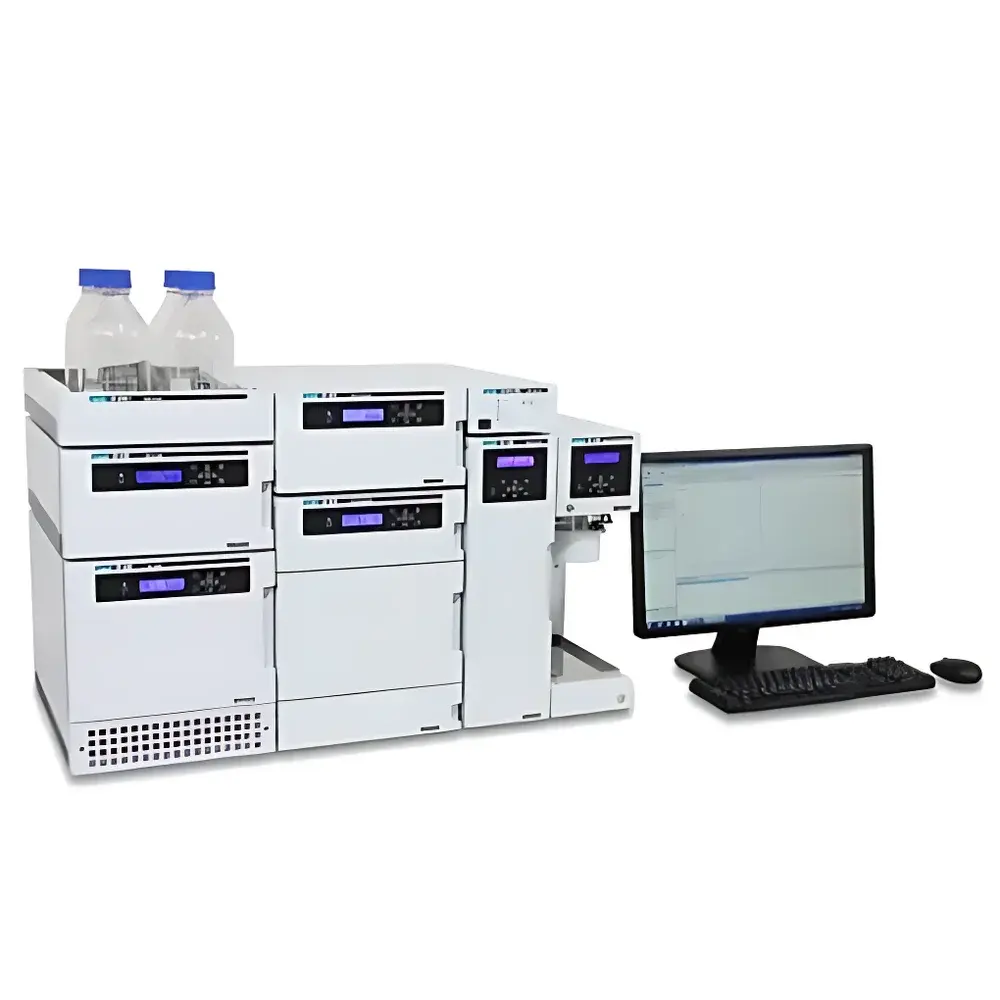
JASCO LC-4000 Supercritical Fluid Chromatography System
| Brand | JASCO |
|---|---|
| Origin | Japan |
| Manufacturer Type | Authorized Distributor |
| Origin Category | Imported |
| Model | LC-4000 |
| Instrument Type | High-Throughput Supercritical Fluid Chromatograph |
| Flow Rate Range | 0.5–150.0 mL/min |
| Maximum Operating Pressure | 30 MPa |
| Flow Precision | <0.1% RSD |
| Injection Volume Range | 0.1–20,000 µL |
| Injection Positions | 180 |
| Column Oven Temperature Range | Ambient to 90°C |
| UV-Vis Detection Wavelength Range | 190–900 nm |
Overview
The JASCO LC-4000 Supercritical Fluid Chromatography (SFC) System is a high-performance, modular analytical platform engineered for rapid, selective, and environmentally sustainable separation of chiral and achiral compounds. Unlike conventional liquid chromatography, SFC employs carbon dioxide (CO₂) in its supercritical state—as the primary mobile phase—leveraging its unique physicochemical properties: low viscosity (~1/10 that of liquid solvents), high diffusivity (~10× greater than liquids), and tunable solvent strength. These characteristics enable faster mass transfer, reduced backpressure resistance, and higher linear velocities without compromising resolution. The system operates within a precisely controlled pressure–temperature envelope where CO₂ remains supercritical (T > 31.1°C, P > 7.38 MPa), with optional co-solvent (e.g., methanol, ethanol, isopropanol) delivery for polarity modulation. Integrated back-pressure regulation maintains thermodynamic stability across the column and detector, ensuring reproducible retention times and baseline integrity.
Key Features
- Modular architecture supporting both analytical- and preparative-scale SFC workflows, with seamless integration of binary or ternary solvent delivery, automated sample injection, column oven, UV-Vis detection, and back-pressure control.
- High-flow binary pump capable of delivering CO₂ and organic modifier at independent, programmable rates (0.5–150.0 mL/min), optimized for rapid gradient elution and method scalability.
- Ultra-stable flow precision (<0.1% RSD) ensured by dual-piston positive displacement pumping and real-time pressure feedback compensation.
- 180-position autosampler with variable loop injection (0.1–20,000 µL), temperature-controlled sample compartment (4–40°C), and needle wash capability for carryover minimization.
- Column oven with precise thermal control (ambient to 90°C, ±0.1°C) and active pre-heating of mobile phase lines to prevent CO₂ condensation.
- UV-Vis photodiode array detector covering 190–900 nm with 1 nm wavelength resolution, enabling spectral deconvolution and peak purity assessment.
- Rugged stainless-steel fluidic path rated to 30 MPa, compatible with aggressive modifiers and extended operation under supercritical conditions.
Sample Compatibility & Compliance
The LC-4000 accommodates a broad range of compound classes—including small-molecule pharmaceuticals, natural products, lipids, polymers, and chiral intermediates—without derivatization. Its compatibility with silica-, polysaccharide-, and hybrid-based chiral stationary phases (e.g., Chiralpak®, Lux®) supports enantioselective separations mandated by ICH Q5A and USP . The system meets core requirements for GLP-compliant laboratories: full audit trail logging (user actions, method changes, calibration events), electronic signatures per FDA 21 CFR Part 11, and traceable instrument qualification (IQ/OQ/PQ) documentation support. All hardware components comply with ISO 9001 manufacturing standards and CE marking for electromagnetic compatibility (EMC) and safety (IEC 61010-1).
Software & Data Management
Controlled via JASCO’s ChromNAV software (v2.5+), the LC-4000 provides intuitive method development tools including pressure–temperature–modifier optimization wizards, gradient scouting, and peak tracking algorithms. Raw data are stored in vendor-neutral .cdf format compliant with ASTM E1947 and accessible through third-party CDS platforms (e.g., OpenLab CDS, Chromeleon). The software supports automated system suitability testing (SST) per USP , generates compliance-ready reports with embedded chromatograms, spectra, and metadata, and enables secure multi-user access with role-based permissions. Audit trails are encrypted, time-stamped, and exportable in PDF/A-1b format for regulatory submission.
Applications
- Chiral purity assessment of active pharmaceutical ingredients (APIs) per ICH Q6A and Q7 guidelines.
- Rapid method development for lipidomics and metabolomics profiling using sub-2-µm chiral columns.
- Green analytical chemistry workflows replacing >80% of acetonitrile/methanol usage in QC release testing.
- Preparative purification of gram-scale enantiomers with online fraction collection and real-time UV-triggered collection.
- Stability-indicating assays for oxidative and hydrolytic degradation products under mild, non-thermal conditions.
- Analysis of thermally labile compounds (e.g., vitamins, carotenoids) unsuitable for GC or high-temperature HPLC.
FAQ
What distinguishes SFC from HPLC in terms of analysis time and solvent consumption?
SFC typically achieves 3–10× faster separations than HPLC at equivalent resolution due to higher diffusion coefficients and lower mobile-phase viscosity. Organic solvent consumption is reduced by 80–90%, primarily because CO₂ constitutes >70% of the mobile phase volume.
Can the LC-4000 be used for preparative-scale purification?
Yes—the system supports flow rates up to 150 mL/min and pressure-rated components suitable for milligram-to-gram scale isolation when configured with appropriate column dimensions and fraction collectors.
Is CO₂ handling safe in routine laboratory operation?
CO₂ is non-toxic, non-flammable, and commercially available in certified high-purity grades (≥99.995%). The LC-4000 includes integrated pressure relief valves, leak detection sensors, and ventilation interlocks compliant with OSHA 1910.1000 and local gas cabinet regulations.
How does temperature affect retention and selectivity in SFC?
In SFC, temperature modulates both CO₂ density (and thus solvent strength) and analyte–stationary phase interactions. A 5°C increase typically reduces retention by 10–20% while enhancing resolution of early-eluting peaks; precise oven control (±0.1°C) is therefore critical for method robustness.
Does the system support method transfer from HPLC to SFC?
ChromNAV includes an HPLC-to-SFC conversion module that estimates optimal CO₂/modifier ratios, flow rates, and temperature based on existing reversed-phase methods, accelerating cross-platform validation.





