
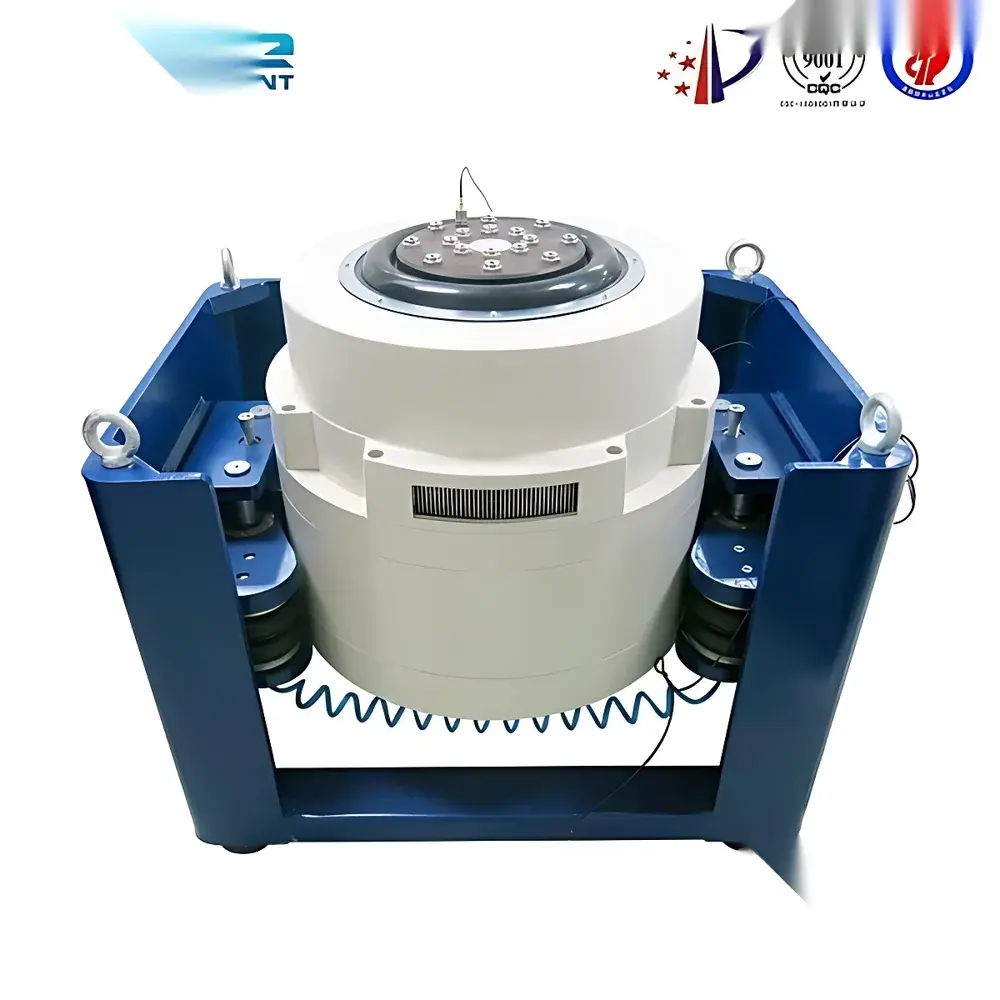
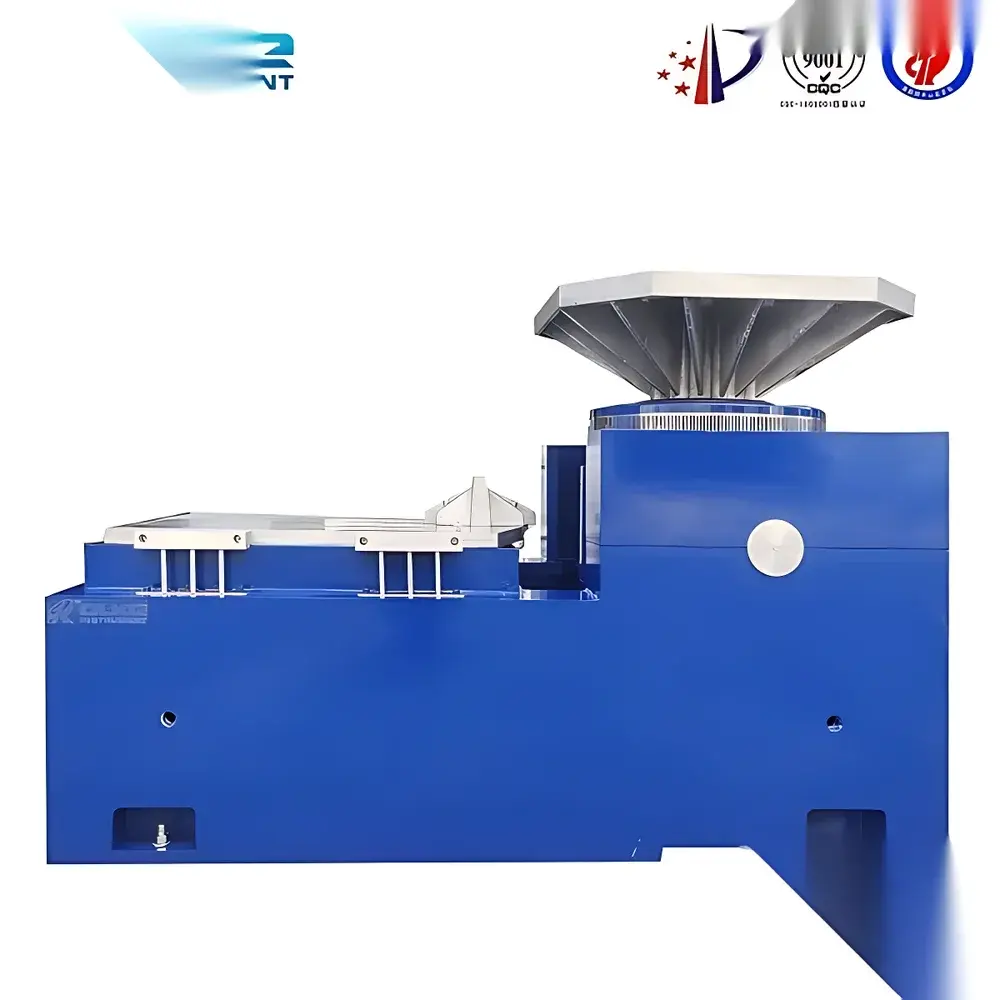
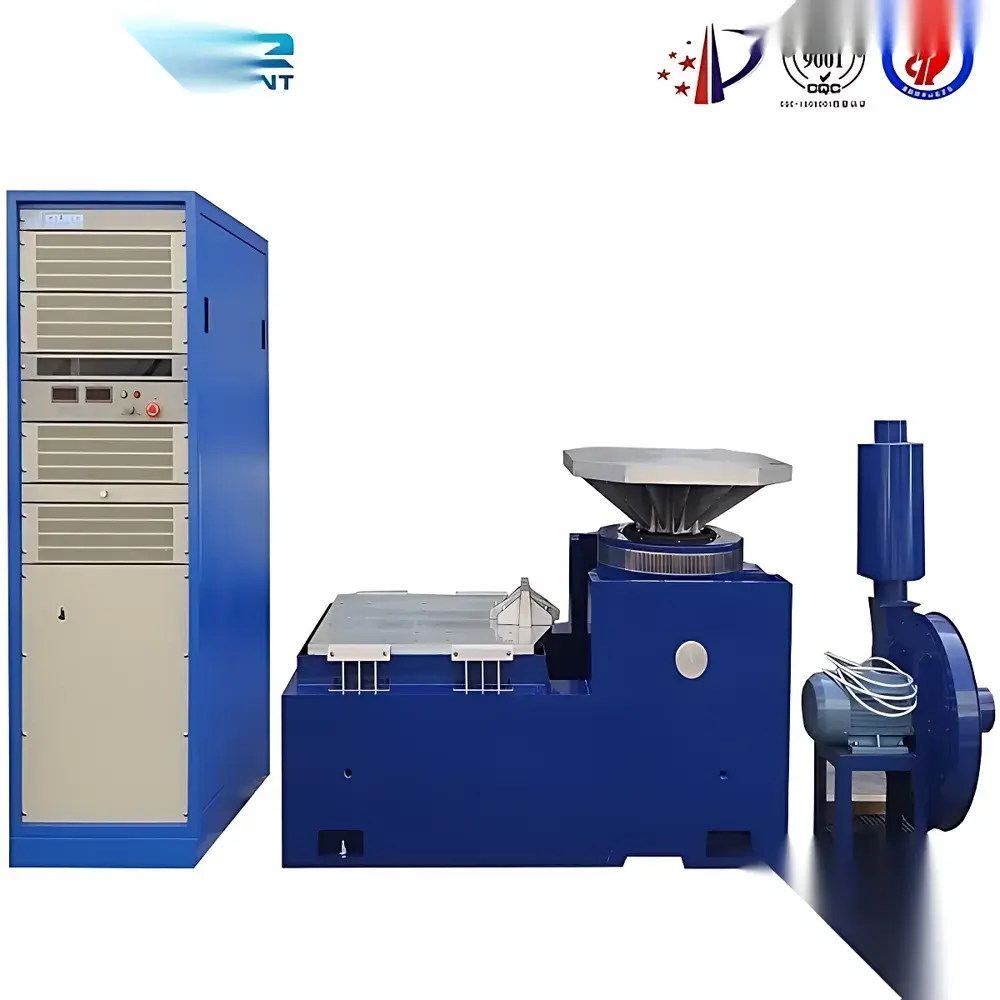
OUKE OK-ES Series Electromagnetic Vibration Shaker System – 6-DOF Multi-Axis Shaking Table for Vertical, Horizontal & Triaxial Testing
| Brand | OUKE |
|---|---|
| Model Series | OK-ES |
| Frequency Range | 0.5–600 Hz (±0.1%) |
| Max. Load Capacity | 80 kg (100 kg peak) |
| Peak Acceleration | 0–15 g (0–150 m/s²) |
| Peak Sine Force | 1500 kgf |
| Displacement (p-p) | 0–4 mm |
| 台面尺寸 | 500 × 500 × 6 mm (standard) |
| 台体 Dimensions (H×W×D) | 500 × 550 × 500 mm |
| Power Input | 20 A, 200–240 VAC ±20%, 50/60 Hz |
| Power Consumption | 4.4 kW |
| Cooling Method | Natural Air Cooling |
| Operating Ambient | −10 °C to +80 °C, 10–95% RH |
| Noise Level | ≤50 dB(A) |
| Magnetic Field Emission | ≤100 mG at 1 m |
| Control Interface | RS-485 (PC-compatible) |
| Resolution | Frequency display to 0.01 Hz |
| Compliance | Supports ASTM D999, ISO 2247, IEC 60068-2-6, MIL-STD-810H, GB/T 4857.7, GB/T 2423.10 |
Overview
The OUKE OK-ES Series Electromagnetic Vibration Shaker System is an industrial-grade, multi-axis electrodynamic shaker engineered for rigorous physical property testing under controlled dynamic mechanical stress. Unlike single-axis or mechanically coupled platforms, the OK-ES integrates independent electromagnetic actuation across all six degrees of freedom (6-DOF) — enabling simultaneous and programmable excitation along X (left-right), Y (front-back), and Z (up-down) axes. Its core operating principle relies on Lorentz-force-driven coil-magnet interaction, delivering high-fidelity sinusoidal, swept-sine, random, and road-simulation waveforms with precise amplitude and acceleration control. Designed for laboratory validation, reliability screening, and qualification testing in electronics, automotive components, packaging, aerospace subsystems, and medical devices, the system complies with internationally recognized vibration test standards including ISO 2247 (packaging), IEC 60068-2-6 (environmental testing), and MIL-STD-810H (method 514.8). The rigid aluminum alloy table structure — optimized for modal stability with a low center-of-gravity profile (500 mm height) and 24 × M10 threaded mounting holes — ensures minimal parasitic resonance and repeatable transmissibility up to 600 Hz.
Key Features
- True 6-DOF synchronized motion capability: supports concurrent triaxial sinusoidal, random, and road-profile vibration without mechanical coupling artifacts.
- Programmable waveform generation: selectable full-wave or half-wave sine, multi-order random spectra, standardized road profiles (e.g., ISO 8608), logarithmic sweep, resonant dwell, and user-defined time-history inputs.
- High-resolution digital control: frequency resolution down to 0.01 Hz; independent real-time adjustment of acceleration (0–15 g), displacement (0–4 mm p-p), and duration (user-defined in seconds).
- Dual independent output channels: enables redundant drive configuration or parallel excitation of auxiliary fixtures.
- Integrated environmental tolerance: rated for continuous operation between −10 °C and +80 °C at up to 95% non-condensing humidity; magnetic field emission <100 mG at 1 m distance per IEEE Std. 299.
- RS-485 interface standard: supports integration with SCADA systems, LabVIEW-based automation, and third-party data acquisition platforms for GLP/GMP-compliant audit trails.
- Modular table options: six standard platform sizes (200 × 200 mm to 1500 × 1500 mm); custom machining available for application-specific mounting geometries.
Sample Compatibility & Compliance
The OK-ES accommodates test specimens ranging from small PCB assemblies (<0.5 kg) to full-scale automotive ECUs or industrial enclosures (up to 80 kg nominal, 100 kg short-term). Its low-profile, stiff table design minimizes bending mode interference, ensuring force transmission fidelity across the full 0.5–600 Hz bandwidth. The system meets mechanical safety requirements per IEC 61000-4-2 (ESD immunity) and IEC 61000-4-3 (radiated RF immunity). Calibration traceability follows ISO/IEC 17025 guidelines; each unit ships with a factory-issued calibration certificate covering acceleration sensitivity, displacement linearity, and frequency response flatness (±1.5 dB from 5–500 Hz). Optional LD-T1 vibration meter (sold separately) provides on-the-fly verification of peak acceleration (0.1–199.9 m/s²) and displacement (0.001–19.99 mm), supporting in-situ validation per ASTM E756 and ISO 5347-13.
Software & Data Management
The OK-ES operates natively via embedded microcontroller firmware with optional PC-based software suite (Windows 10/11 compatible). This software enables full test sequencing — including infinite-loop programmable profiles combining sweep, dwell, random, and step-level segments — with timestamped waveform logging at ≥10 kHz sampling. All test parameters (frequency, amplitude, acceleration, dwell time, transition rate) are stored in encrypted binary files compliant with FDA 21 CFR Part 11 for electronic records and signatures. Audit trail functionality logs operator ID, parameter changes, start/stop timestamps, and calibration event history. Export formats include CSV, MATLAB .mat, and universal HDF5 for post-processing in Python, MATLAB, or commercial FEA tools. Remote monitoring and alarm notification (via TCP/IP or Modbus TCP) support centralized lab management systems.
Applications
- Electronics reliability: solder joint fatigue assessment, connector retention testing, MEMS device shock/vibration qualification per JEDEC JESD22-B103.
- Packaging validation: simulation of distribution environment stresses per ASTM D4169 and ISTA 3A/3E protocols.
- Aerospace component screening: flutter margin evaluation, avionics mounting integrity, and harness vibration endurance per DO-160 Section 8.
- Automotive R&D: NVH analysis of infotainment modules, battery module mounting robustness, and ADAS sensor housing resonance mapping.
- Medical device certification: vibration-induced loosening resistance of implantable device housings per ISO 14971 and IEC 60601-1-11.
- Academic research: structural dynamics modeling, modal identification, and active damping algorithm development using measured FRFs.
FAQ
Does the OK-ES support real-time closed-loop control?
Yes — optional closed-loop feedback via integrated accelerometers or external LD-T1 sensor enables adaptive amplitude/acceleration regulation during sweep and random tests.
Can the system perform simultaneous multi-axis random vibration per ISO 10326-2?
Yes — the 6-DOF architecture allows correlated or uncorrelated random excitation across X/Y/Z with independently defined PSD profiles and cross-spectral coherence settings.
Is factory calibration traceable to national metrology institutes?
All calibration certificates reference NIST-traceable reference accelerometers and laser interferometric displacement verification per ISO 16063-21.
What maintenance is required for long-term performance stability?
No routine lubrication or consumables; periodic verification of coil resistance, suspension integrity, and amplifier thermal derating is recommended annually per manufacturer’s maintenance schedule.
Can test reports be generated in compliance with ISO/IEC 17025 documentation requirements?
Yes — the software includes configurable report templates with digital signature fields, revision control, and embedded calibration metadata meeting ILAC P12 and EURACHEM guidelines.



