
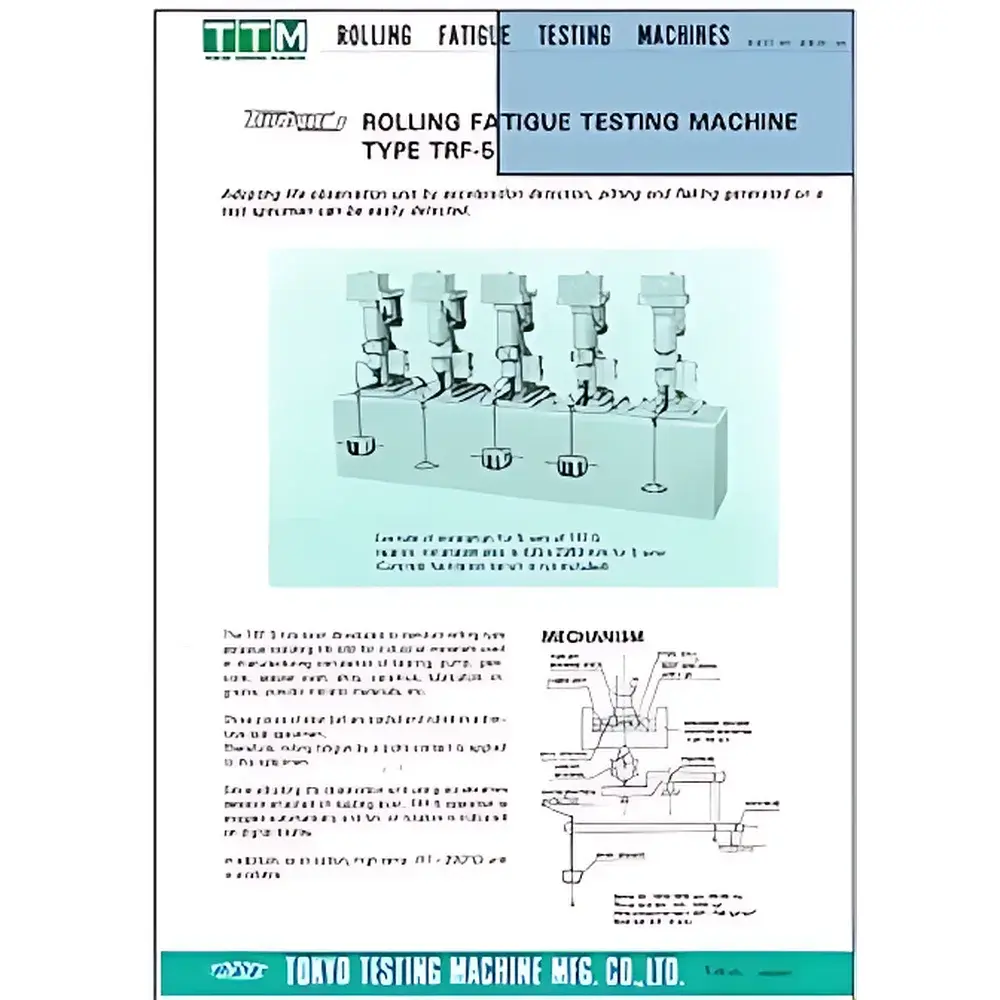
Takatori TRF-1000/5-H High-Temperature Rolling Contact Fatigue Tester
| Origin | Japan |
|---|---|
| Manufacturer Type | Authorized Distributor |
| Origin Category | Imported |
| Model | TRF-1000/5-H |
| Load Range | 1–10 kN (lever ratio 1:30) |
| Load Accuracy | ±1% of indicated value |
| Rotational Speed | 0–1500 rpm (±3%, 50 Hz) |
| Max Test Temperature | 200 °C |
| Temp. Stability | ±2 °C |
| Heating Power | 480 W (dual 240 W elements) |
| Specimen | Ø60 × 15 mm disc |
| Steel Balls | Ø3/8 inch (3 pcs per test) |
| Vibration Detection Range | 0.03–3 G, 5 Hz–10 kHz |
| Counter Resolution | 9-digit cumulative rotation count |
| Cooling Water Requirement | 10 L/min at ≤0.2 MPa, inlet temp ≤30 °C |
| Net Weight | ~1200 kg (excl. dead weights) |
| Power Supply | 3P AC 380 V, 50 Hz, 30 A |
Overview
The Takatori TRF-1000/5-H is a precision-engineered high-temperature rolling contact fatigue tester designed for accelerated life evaluation of bearing-grade materials under controlled thermomechanical loading. It implements the standardized three-ball-on-disc configuration to generate repeated point-contact Hertzian stresses—mimicking real-world rolling element fatigue conditions in bearings, gears, and rotating machinery components. The system applies static radial loads (1–10 kN) via calibrated dead-weight levers with a fixed 1:30 mechanical advantage, ensuring traceable force application compliant with ASTM E1077 and ISO 281 Annex D methodologies. Unlike conventional wear testers, the TRF-1000/5-H focuses exclusively on subsurface-initiated fatigue failure modes—including spalling, pitting, and white etching crack (WEC) precursors—rather than surface abrasion alone. Its integrated high-temperature unit enables testing from ambient to 200 °C, supporting lubricant degradation studies, thermal softening assessments of case-hardened steels, and ceramic/metallic coating performance validation under service-relevant thermal gradients.
Key Features
- Automated life termination via acceleration-based fatigue detection: an accelerometer mounted directly on the loading lever continuously monitors vibrational signatures associated with subsurface microcrack propagation and early-stage flaking; threshold-triggered shutdown preserves specimen integrity for post-test metallurgical analysis.
- High-stability thermal chamber with PID-controlled heating (±2 °C), dual 240 W heaters, independent overheat protection, and cooling water interlock—ensuring safe, repeatable elevated-temperature operation up to 200 °C.
- 9-digit cumulative rotation counter with digital display, synchronized with test initiation and automatic stop events; supports long-duration endurance tests exceeding 10⁷ cycles without manual intervention.
- Rigid steel base frame (separate-type construction) with coaxial alignment tolerance <0.005 mm, minimizing parasitic bending moments and ensuring pure rolling kinematics during high-load operation.
- Modular specimen holder system compatible with high-temp-rated fixtures, bearing rings, and powder-metallurgy compacts; includes five sets of high-temp specimen holders and standardized tooling for rapid setup and repeatability.
- Comprehensive safety architecture: emergency stop, cooling water flow monitoring, heater overtemperature cutoff, counter overflow logic, and independent sensor-failure detection—all hardwired into the control console per IEC 61508 SIL1 requirements.
Sample Compatibility & Compliance
The TRF-1000/5-H accommodates disc-shaped specimens measuring Ø60 × 15 mm, suitable for hardened steels (e.g., SUJ2, 52100), carburized alloys, nitrided surfaces, ceramic composites (Si₃N₄, ZrO₂), and thin-film coated substrates. Standardized Ø3/8 inch steel balls (AISI 52100, hardness 60–64 HRC) provide consistent Hertzian stress fields. Optional bearing ring fixtures enable direct evaluation of inner/outer raceway geometry. The system complies with foundational fatigue testing principles referenced in ISO 281:2021 (rolling bearing fatigue life), ASTM D4170 (grease corrosion resistance), and JIS B 1518 (rolling contact fatigue testing methods). All load calibration certificates are traceable to NMIJ (National Metrology Institute of Japan) standards. Data acquisition and event logging meet GLP audit requirements, with timestamped stop triggers archived for regulatory review.
Software & Data Management
While the TRF-1000/5-H operates via hardware-integrated controls (push-button start/stop, digital counter, analog PID temperature display), its architecture supports optional RS-232 or Ethernet interface modules for external data logging. Rotation count, temperature setpoint/actual, load status, and alarm flags (vibration trigger, overheat, water flow loss) can be streamed to third-party SCADA or LIMS platforms. The Life Observation Unit outputs analog voltage signals proportional to acceleration magnitude (0–10 V = 0–3 G), enabling integration with oscilloscopes or FFT analyzers for spectral fatigue signature analysis. All operational parameters—including test duration, cumulative rotations, thermal ramp profiles, and stop-event timestamps—are recorded in non-volatile memory and exportable as CSV files. Firmware adheres to FDA 21 CFR Part 11 principles where electronic records are employed, supporting user authentication, audit trails, and electronic signatures via add-on software packages.
Applications
- Rolling contact fatigue life assessment of bearing steels under dry, humid, and lubricated high-temperature conditions.
- Evaluation of surface engineering treatments: nitriding, carburizing, DLC coatings, and laser surface melting for improved subsurface crack resistance.
- Accelerated aging studies of grease and lubricating oils—quantifying thermal-oxidative breakdown effects on film strength and fatigue mitigation.
- Qualification testing of powder metallurgy components used in automotive transmissions and wind turbine gearboxes.
- Research into white etching cracks (WECs) and hydrogen-assisted fatigue mechanisms in high-strength steels.
- Validation of ceramic hybrid bearing materials (Si₃N₄ balls + steel races) for aerospace and medical device applications.
FAQ
What is the maximum allowable test temperature, and how is thermal stability maintained?
The high-temperature unit achieves a maximum operating temperature of 200 °C with ±2 °C stability over 1-hour dwell periods, enforced by dual-zone PID control and redundant overheat cutoff circuits.
How does the life observation system detect fatigue onset before visible surface damage occurs?
The accelerometer on the loading lever captures high-frequency vibration energy (5–10 kHz) generated by subsurface microcrack coalescence and localized plastic deformation—events that precede macroscopic flaking by thousands of cycles.
Is the system compliant with international standards for bearing fatigue testing?
Yes—its mechanical design, load application methodology, and specimen geometry align with ISO 281 Annex D and JIS B 1518 for rolling contact fatigue life evaluation; calibration documentation is NMIJ-traceable.
Can the TRF-1000/5-H operate without the high-temperature option?
Yes—the base configuration functions from ambient temperature; the high-temp module is field-installable as a factory-authorized option.
What maintenance intervals are recommended for long-term reliability?
Lubrication of the main shaft bearing every 500 hours; annual verification of load lever calibration and accelerometer sensitivity; biannual inspection of heater insulation resistance and cooling water filter integrity.



