
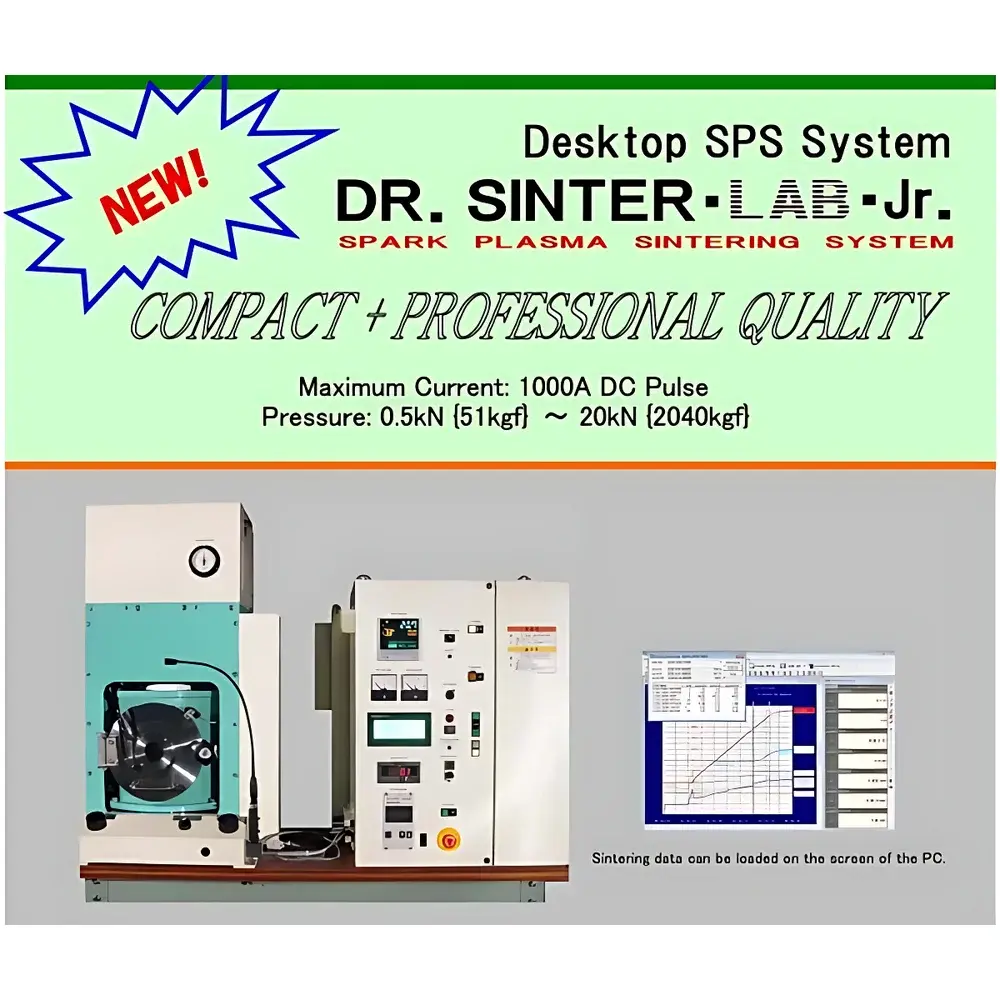
SPS-211Lx Spark Plasma Sintering System
| Origin | Japan |
|---|---|
| Manufacturer Type | Authorized Distributor |
| Origin Category | Imported |
| Model | SPS-211Lx |
| Pricing | Available Upon Request |
Overview
The SPS-211Lx Spark Plasma Sintering (SPS) System is a compact, high-efficiency pulsed direct-current sintering platform engineered for rapid densification of advanced functional materials under controlled temperature, pressure, and atmosphere conditions. Unlike conventional hot-pressing or furnace-based sintering, the SPS process leverages joule heating induced by high-density pulsed DC current passing directly through the conductive die–sample assembly—enabling ultrafast heating rates (up to 1000 °C/min), precise thermal profiling, and minimal grain growth. This principle supports non-equilibrium processing essential for metastable phases, nanocrystalline architectures, and thermally sensitive composites. The system is designed for laboratory-scale R&D in academic and industrial settings where reproducible, low-thermal-budget consolidation of multi-component systems—including insulating polymers, semiconducting ceramics, metallic alloys, and hybrid organic–inorganic powders—is required.
Key Features
- Integrated pulsed DC power supply with adjustable pulse width (1–50 ms), frequency (1–10 Hz), and peak current (up to 10 kA), enabling fine control over energy input and microstructural evolution.
- Modular vacuum/atmosphere chamber rated to 10−3 Pa base pressure, compatible with inert gas (Ar, N2) or reactive atmosphere (H2, forming gas) sintering via optional mass flow controllers.
- Hydraulic pressure system delivering up to 50 kN axial load (adjustable from 0.1 to 50 kN) with real-time closed-loop force feedback and position monitoring.
- Graphite die compatibility with standard inner diameters (Ø20–Ø60 mm), supporting both uniaxial pressing and pressure-free sintering modes via removable die inserts.
- Embedded thermocouple (Type C, up to 2500 °C) and pyrometric temperature measurement (dual-wavelength, 800–2500 °C) for cross-validated thermal control and gradient minimization.
- Compact footprint (W × D × H ≈ 900 × 750 × 1800 mm) with CE-compliant safety interlocks, emergency stop circuitry, and integrated cooling water management (flow ≥ 15 L/min, ΔT ≤ 5 °C).
Sample Compatibility & Compliance
The SPS-211Lx accommodates diverse feedstock forms: nanopowders (metallic, ceramic, polymer-coated), lamellar precursors, multilayer green tapes, and pre-compacted pellets. It enables co-sintering of dissimilar materials (e.g., metal–ceramic interfaces, graded thermoelectrics, polymer–filler composites) without interfacial delamination, owing to synchronized thermal–mechanical activation. The system complies with ISO 17025 calibration traceability requirements for temperature and force sensors. Its operational parameters support method development aligned with ASTM E2492 (Standard Guide for SPS of Ceramics), ISO 2738 (Sintered Metal Materials—Specifications), and JIS R 1634 (Spark Plasma Sintering of Advanced Ceramics). Full audit trail functionality—including user login, parameter change logs, and timestamped run records—meets GLP and pre-GMP documentation expectations for early-stage material qualification.
Software & Data Management
Control and monitoring are executed via a dedicated Windows-based SPS Control Suite featuring real-time graphical display of temperature, pressure, displacement, current, and voltage waveforms. All data streams are acquired at ≥100 Hz sampling rate and stored in HDF5 format for interoperability with MATLAB, Python (h5py), and commercial CAE platforms. The software supports programmable multi-step sintering profiles (ramp/hold/cool sequences), conditional logic triggers (e.g., hold until ΔT < 2 °C across thermocouple zones), and automated post-run report generation (PDF + CSV). Data export adheres to ASTM E1447 and ISO/IEC 17025 clause 7.7 requirements for raw data integrity and metadata completeness. Optional 21 CFR Part 11 compliance package includes electronic signatures, role-based access control, and immutable audit logs.
Applications
- Rapid synthesis of nanostructured thermoelectrics (e.g., Bi2Te3, Mg2Si) with preserved phonon scattering boundaries.
- Densification of oxide dispersion-strengthened (ODS) steels without Cr evaporation or Al2O3 agglomeration.
- Low-temperature (<300 °C) sintering of conductive polymer composites (e.g., PEDOT:PSS–Ag nanowire hybrids) for flexible electronics.
- Graded functionally graded materials (FGMs) such as Ti–Al2O3 transition layers for aerospace thermal barrier integration.
- Pressure-assisted curing of carbon-fiber-reinforced phenolic resins with minimized void content and interlaminar shear strength enhancement.
FAQ
What is the maximum operating temperature under vacuum?
The system achieves up to 2500 °C with graphite tooling and optimized insulation under 10−3 Pa vacuum.
Can the SPS-211Lx perform spark plasma sintering without applied pressure?
Yes—by installing a non-load-bearing die configuration and disabling hydraulic actuation, the unit operates in pure pulsed-current sintering mode for nanopowder agglomeration.
Is remote operation supported?
Local network (LAN) connectivity enables supervised remote monitoring; however, critical parameter changes require authenticated on-site access per safety protocol.
What maintenance intervals are recommended for the graphite die and electrodes?
Visual inspection after every 10 runs; replacement advised after cumulative exposure to >150 h above 1800 °C or visible erosion exceeding 0.3 mm depth.
Does the system support in situ electrical resistivity measurement during sintering?
Yes—four-probe DC resistivity module (optional) integrates with the main controller for real-time conductivity tracking concurrent with densification kinetics.



