
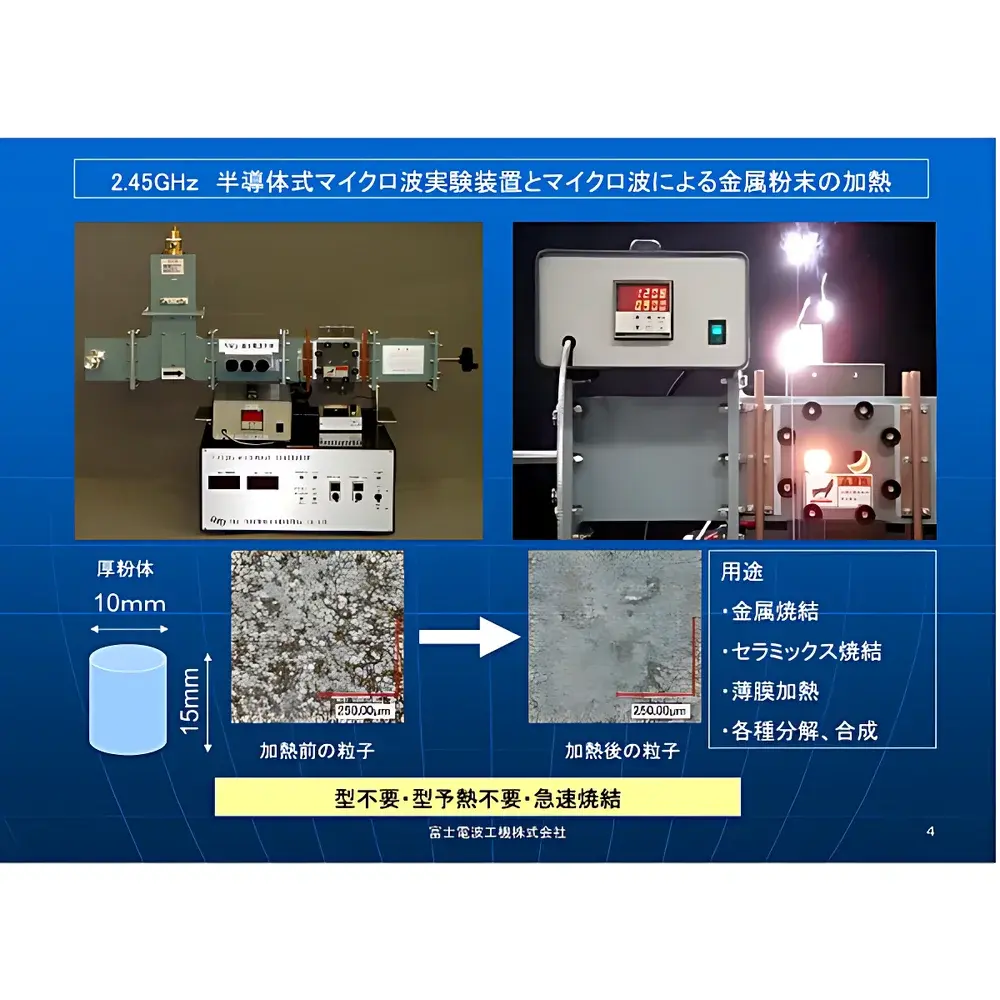
Fuji Denpa MW-2450 Continuous Microwave Sintering System
| Origin | Japan |
|---|---|
| Manufacturer Type | Authorized Distributor |
| Origin Category | Imported |
| Frequency | 2.45 GHz |
| Pricing | Upon Request |
Overview
The Fuji Denpa MW-2450 Continuous Microwave Sintering System is an advanced, dual-mode thermal processing platform engineered for precise, controllable sintering of metallic and magnetic nanomaterials under inert or reactive atmospheres. Unlike conventional resistive or single-mode microwave furnaces, the MW-2450 integrates two orthogonal electromagnetic excitation mechanisms—radiofrequency (RF) alternating electric field heating and alternating magnetic field induction—within a single quartz-tube reaction chamber. This architecture enables fundamental studies of nanoparticle behavior near Curie temperatures, catalytic activation, surface functionalization, and phase evolution in materials critical to fuel cell electrodes, EMI shielding composites (e.g., Ni–Fe nanocomposites), and next-generation battery anodes. The system operates at the industrial standard frequency of 2.45 GHz and is designed for laboratory-scale R&D as well as pilot-line process development.
Key Features
- Dual-Mode Electromagnetic Excitation: Simultaneous or independent operation of RF electric field (E-field) coupling and AC magnetic field (H-field) induction—enabling selective energy deposition based on material dielectric loss (tan δ) or magnetic loss (μ″) characteristics.
- Flexible Heating Regimes: Supports both continuous-wave (CW) and pulsed microwave irradiation with adjustable duty cycle and peak power, facilitating thermal shock mitigation and kinetic control during nucleation and grain growth.
- Atmosphere-Controlled Quartz Reactor: Vertical quartz tube chamber (chemically inert up to 1200 °C) accommodates gas purging with Ar, N₂, H₂, NH₃, or forming gas; compatible with vacuum pre-evacuation and dynamic flow control via mass flow controllers (MFCs).
- Multi-Format Sample Handling: Accommodates pressed cylindrical compacts (on alumina/ceramic trays), loose powders (≤10 g in quartz crucibles), or colloidal suspensions (e.g., Ni–Fe nanoparticles dispersed in acetone) with integrated solvent reflux/evaporation management during in-situ heating.
- Integrated RF Plasma Capability: Optional 13.56 MHz RF plasma generation inside the quartz tube enables surface etching, oxide removal, and functional group modification prior to sintering—ensuring high surface reactivity and interfacial homogeneity.
- Curie-Point-Limited Magnetic Heating Mode: When operated in AC magnetic field mode, temperature rise is intrinsically self-regulated by the material’s ferromagnetic-to-paramagnetic transition, providing inherent thermal safety and reproducible endpoint control for catalyst synthesis and magnetic nanoparticle engineering.
Sample Compatibility & Compliance
The MW-2450 is optimized for conductive and semi-conductive nanoscale powders—including transition metal alloys (Ni–Fe, Co–Fe), oxides (NiO, Fe₃O₄), carbides, and composite precursors—where conventional sintering yields excessive grain coarsening or interfacial segregation. Its quartz-based architecture avoids metallic contamination and corrosion issues associated with stainless-steel reactors, ensuring long-term stability during halogen- or sulfur-containing atmosphere processing. The system complies with IEC 61000-6-3 (EMC emission limits) and IEC 61000-6-4 (industrial immunity), and supports integration into GLP-compliant workflows through optional audit-trail-enabled temperature logging (±0.5 °C accuracy) and gas flow record retention.
Software & Data Management
Control is executed via Fuji Denpa’s proprietary LabSinter™ software suite running on Windows OS, offering real-time monitoring of microwave power (forward/reflected), chamber temperature (via dual-wavelength pyrometer), gas flow rates, and plasma impedance. All operational parameters—including mode selection, ramp profiles, dwell times, and atmosphere sequences—are programmable and exportable in CSV/Excel format. The software includes built-in validation protocols for IQ/OQ documentation and supports 21 CFR Part 11-compliant electronic signatures when deployed with networked authentication servers.
Applications
- Fuel cell catalyst layer fabrication (e.g., Pt–Ni/C, Fe–N–C) with controlled metal dispersion and carbon support graphitization.
- GHz-range electromagnetic interference (EMI) shielding fillers: rapid synthesis of core–shell Ni–Fe@SiO₂ or Ni–Fe–graphene hybrids with tunable permeability/permittivity balance.
- Magnetic hyperthermia agent development requiring narrow size distribution and crystallinity control below Curie threshold.
- In-situ reduction of metal oxide precursors (e.g., NiO → Ni⁰) under reducing atmospheres with concurrent carbon coating.
- Surface-activated powder metallurgy feedstocks for additive manufacturing pre-processing.
FAQ
What types of nanomaterials are most suitable for processing in the MW-2450?
Metallic, ferrimagnetic, and polarizable ceramic nanoparticles—particularly those exhibiting significant dielectric loss (e.g., Ni, Fe₃O₄, TiO₂) or magnetic hysteresis (e.g., Ni–Fe alloys)—demonstrate efficient and uniform coupling under both E-field and H-field modes.
Can the system operate under vacuum conditions?
Yes—the quartz reactor supports base pressures down to 10⁻² mbar via optional turbomolecular pumping; however, optimal microwave coupling requires minimum gas density, so low-pressure inert sweeps (e.g., 10–100 sccm Ar) are recommended for most sintering protocols.
Is RF plasma operation compatible with all sample geometries?
Plasma generation is most effective with free-standing powder beds or thin-layer deposits; dense pellets may shield underlying regions from uniform plasma exposure—sample configuration should be validated per application.
Does the system include temperature calibration traceability?
Each unit ships with NIST-traceable pyrometer calibration certificate; optional on-site verification using reference blackbody sources is available upon installation.
What safety interlocks are implemented?
Hardware-enforced door interlock, reflected-power cutoff (>30% reflection), overtemperature shutdown (dual redundant sensors), and real-time arc detection with automatic microwave termination.



