
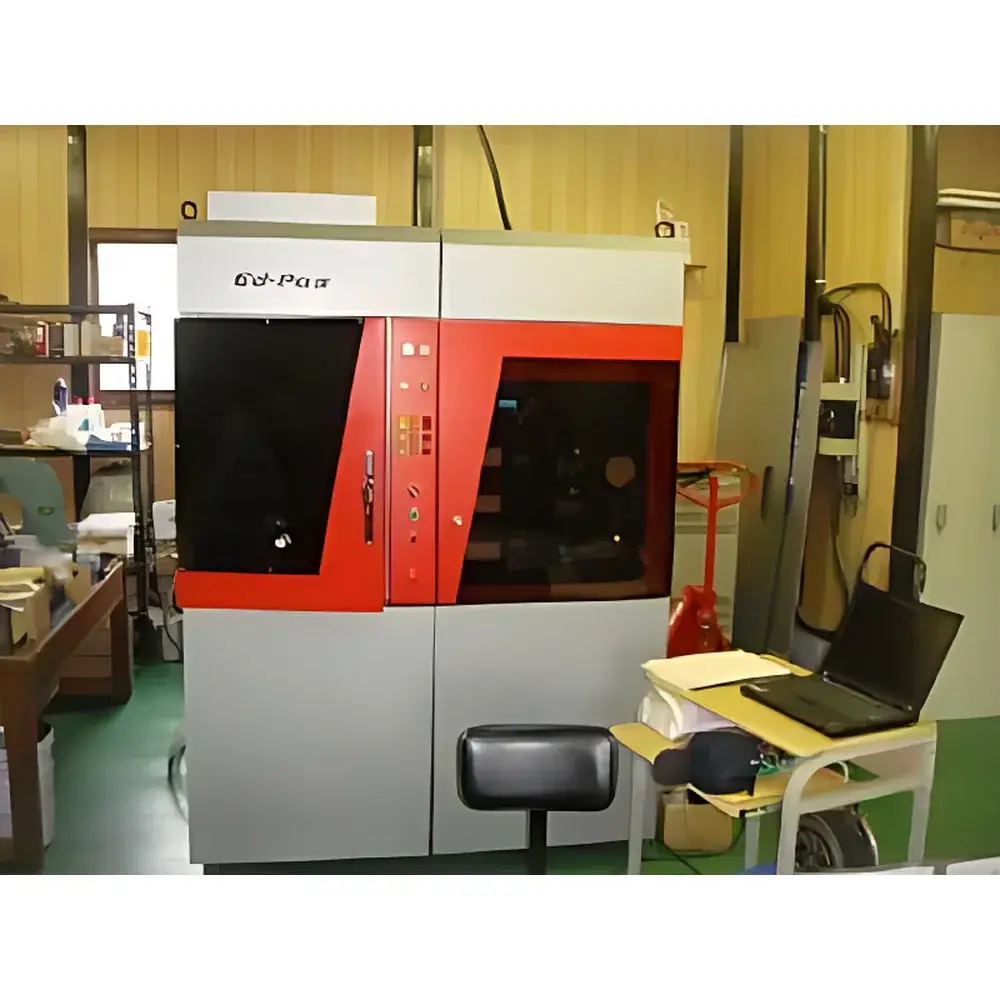
Ed-PAS High-Frequency Sawtooth Pulse Electric Current Sintering Furnace
| Origin | Japan |
|---|---|
| Manufacturer Type | Authorized Distributor |
| Origin Category | Imported |
| Model | Ed-PAS |
| Instrument Type | Graphite Crucible Furnace |
| Max. Pressure | 50–300 kN |
| Pulse Current | 800–2,000 A |
| Max. Output Current | 2,000–15,000 A |
| Max. Input Power | 19–315 kVA |
| Max. Operating Temperature | 1,200–2,800 °C |
| Ram Stroke | 70–200 mm |
| Cooling Water Requirement | 0.2–0.3 MPa, ≥20 L/min |
| Sintering Atmosphere | Ambient Air, Vacuum, or Controlled Gas (e.g., Ar, N₂, H₂) |
Overview
The Ed-PAS High-Frequency Sawtooth Pulse Electric Current Sintering Furnace is an advanced laboratory-scale sintering system engineered for rapid, low-temperature consolidation of conductive and semi-conductive powders via electric current-activated sintering (ECAS). Unlike conventional resistance heating furnaces or spark plasma sintering (SPS) systems relying on square-wave or DC-biased pulses, the Ed-PAS employs a proprietary high-frequency sawtooth-shaped pulse waveform—delivered through its custom PAS power supply—to induce localized micro-plasma discharges at particle contacts. This transient plasma generation ruptures native oxide layers (e.g., Al₂O₃ on aluminum, TiO₂ on titanium, BeO on beryllium), exposing reactive metallic surfaces while simultaneously enabling Joule heating, thermal diffusion, and electromigration-driven mass transport. The result is densification under ambient atmospheric conditions without vacuum or inert gas shielding—eliminating process complexity while preserving metastable phases, nanocrystalline structures, and amorphous fractions that would otherwise degrade under prolonged high-temperature exposure.
Key Features
- Proprietary high-frequency sawtooth pulse power supply (PAS unit) generating controllable, non-sinusoidal current waveforms with rise times <10 µs and repetition frequencies up to 5 kHz—enabling precise energy deposition at interparticle junctions.
- Integrated automatic uniaxial pressure control system with closed-loop hydraulic actuation (50–300 kN range) and real-time position feedback via high-resolution linear displacement sensors.
- Dual-mode thermal management: water-cooled vacuum chamber (operable down to 10⁻³ Pa) combined with high-flow forced cooling (≥20 L/min at 0.2–0.3 MPa) for graphite die and electrode assemblies.
- Multi-channel temperature monitoring with Type C (W–Re 5/26) thermocouples embedded in the die and sample holder, coupled with PID-based temperature regulation (±2 °C stability over full operating range).
- Modular atmosphere compatibility: seamless transition between air, inert (Ar/N₂), reducing (H₂/N₂), or vacuum environments without hardware reconfiguration.
Sample Compatibility & Compliance
The Ed-PAS accommodates a broad spectrum of powder feedstocks—including elemental metals (Al, Ti, Be, Mg, Cu), intermetallics, ceramics (SiC, B₄C, TiB₂), and composite systems—without requiring pre-alloying, surface activation, or organic binders. Its ability to sinter oxide-coated powders in air satisfies ASTM B961 (Standard Guide for Powder Metallurgy Process Control) and aligns with ISO 2738-1:2019 (Sintered Metal Materials – Specifications) for density and microstructural integrity assessment. All electrical and mechanical subsystems conform to IEC 61000-6-4 (EMC emission limits) and IEC 60204-1 (Safety of Machinery – Electrical Equipment). Data acquisition and parameter logging comply with GLP audit requirements per OECD Principles of Good Laboratory Practice.
Software & Data Management
The Ed-PAS operates via a dedicated Windows-based control interface with synchronized acquisition of current, voltage, pressure, displacement, and temperature at ≥1 kHz sampling rate. Raw time-series data are stored in HDF5 format with embedded metadata (user ID, timestamp, protocol version, calibration certificates). The software supports user-defined sintering profiles with multi-segment ramp/hold steps, real-time deviation alerts, and post-run thermal–mechanical–electrical correlation analysis. Audit trails—including operator actions, parameter modifications, and system error logs—are retained for ≥36 months and meet FDA 21 CFR Part 11 requirements for electronic records and signatures when configured with network authentication and role-based access control.
Applications
- Rapid prototyping of lightweight Al- and Ti-based alloys for aerospace structural components where oxide-layer tolerance and grain-size retention are critical.
- Consolidation of nanostructured Fe–Cr–Al ODS (oxide dispersion strengthened) steels without coarsening of Y₂O₃ dispersoids.
- Atmospheric sintering of beryllium metal compacts for neutron reflector applications—bypassing costly glovebox handling and He-purged furnaces.
- Low-temperature densification of ZnO varistor ceramics preserving nonlinear coefficient (α) and leakage current stability.
- Processing of metastable amorphous Ni–P–B alloys for soft magnetic cores, maintaining >90% amorphous fraction post-sintering at ≤800 °C.
FAQ
What distinguishes the Ed-PAS sawtooth pulse waveform from conventional SPS square-wave pulses?
The sawtooth profile delivers asymmetric current rise/fall characteristics, enhancing electron avalanche probability at particle necks and promoting more uniform plasma initiation across heterogeneous powder beds—particularly beneficial for high-resistivity or passivated materials.
Can the Ed-PAS perform sintering in air without oxidation degradation?
Yes. Micro-plasma discharge at contact points transiently removes surface oxides (<100 ns duration), enabling metallic bonding before bulk oxidation occurs—validated for Al, Ti, and Be powders per ASTM E1557 phase analysis.
Is vacuum required for high-temperature operation above 2000 °C?
No. The furnace achieves stable operation up to 2800 °C in inert gas or vacuum, but atmospheric sintering remains viable up to 1600 °C for most conductive systems due to the self-limiting nature of plasma formation.
How is traceability ensured during GLP-compliant experiments?
All hardware calibrations (load cell, thermocouple, current shunt) are traceable to NIST standards; software enforces electronic signature capture for method validation, run initiation, and report generation.
What maintenance intervals are recommended for the PAS power unit?
Capacitor bank and IGBT modules undergo preventive inspection every 500 operational hours; full recalibration is advised annually or after 2000 sintering cycles, whichever occurs first.



