
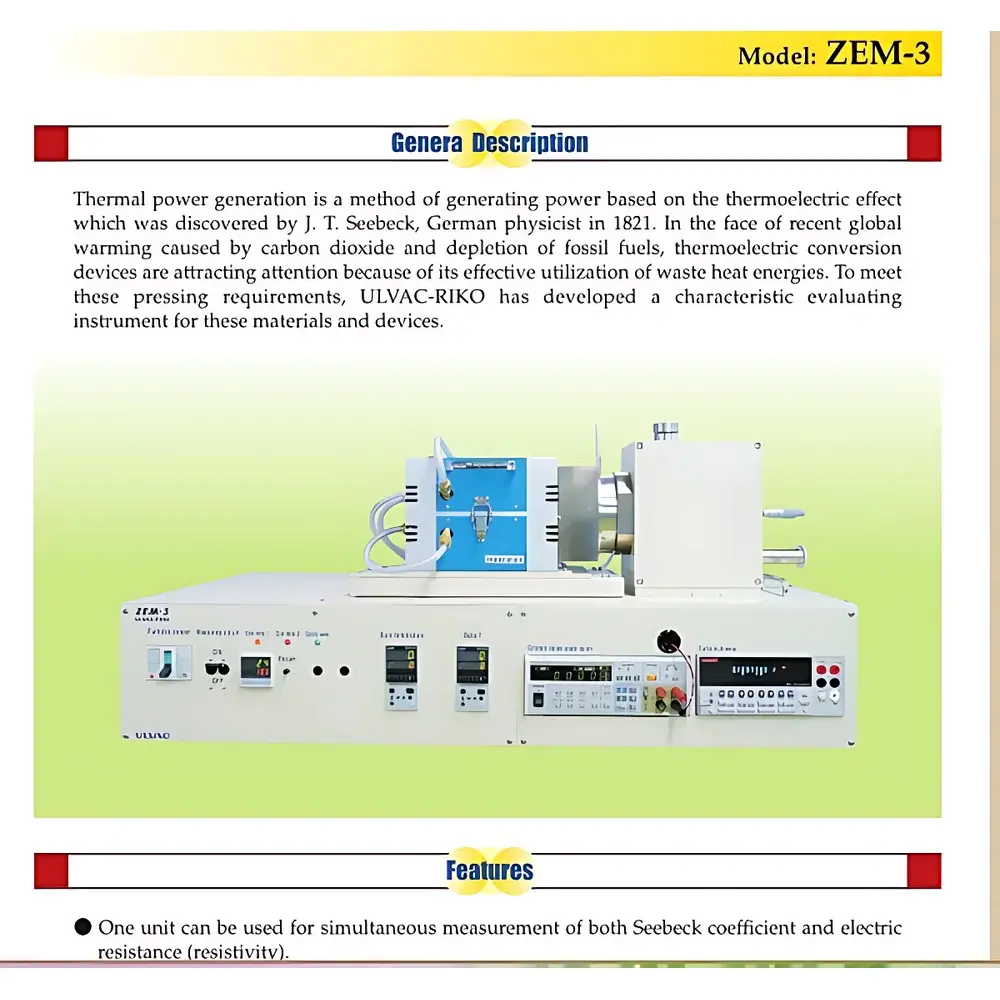
ZEM-3 Thermoelectric Property Evaluation System
| Origin | Japan |
|---|---|
| Manufacturer Type | Authorized Distributor |
| Origin Category | Imported Instrument |
| Model | ZEM-3 |
| Pricing | Available Upon Request |
Overview
The ZEM-3 Thermoelectric Property Evaluation System is a precision benchtop instrument engineered for the simultaneous, high-reproducibility measurement of Seebeck coefficient (S), electrical conductivity (σ), and electrical resistivity (ρ) of thermoelectric materials under controlled temperature conditions. Designed and manufactured in Japan, the ZEM-3 operates on the established principles of the four-probe DC method for resistivity/conductivity and the differential thermoelectric voltage method for Seebeck coefficient determination—both compliant with ASTM E1588–22 (Standard Test Methods for Seebeck Coefficient and Electrical Conductivity of Thermoelectric Materials). The system integrates a high-stability infrared gold-mirror furnace with programmable PID temperature control (±0.1 °C stability over 30–1000 °C range), enabling precise thermal gradient establishment across the sample. Its architecture supports direct correlation between thermoelectric transport properties and microstructural evolution across phase transitions, making it a foundational tool for R&D laboratories focused on Bi₂Te₃, PbTe, skutterudites, half-Heuslers, and emerging oxide-based thermoelectrics.
Key Features
- Integrated dual-mode measurement platform: simultaneous acquisition of Seebeck coefficient and electrical conductivity within a single thermal cycle
- Infrared gold-mirror heating furnace with uniform radiant heat distribution and rapid thermal response (≤10 °C/min ramp rate)
- PID-controlled miniature heater assembly for fine-tuned thermal gradient stabilization (ΔT = 1–5 K typical)
- Automatic contact integrity verification: real-time detection of open-circuit or high-resistance probe–sample interfaces via V-1 diagnostic circuitry
- Modular sample holder design accommodating rectangular bars (1–4 mm × 1–4 mm × 10–25 mm) and thin-film substrates with integrated thermocouple alignment fixtures
- Low-noise, high-resolution analog front-end: <10 nV sensitivity for thermovoltage, <10 µΩ resolution for resistance
Sample Compatibility & Compliance
The ZEM-3 accommodates bulk polycrystalline and single-crystal specimens—including chalcogenides (BiTe, SbTe), tellurides (PbTe, SnTe), pnictides (Mg₃Sb₂), clathrates, and conductive oxides—without requiring metallization or electrode patterning for standard measurements. Sample mounting follows ISO 13761:2021 guidelines for thermoelectric property testing geometry. All electronic subsystems meet IEC 61000-6-3 (EMC emission) and IEC 61010-1 (safety) standards. Data acquisition protocols support audit-ready traceability per GLP and GMP requirements; raw voltage, current, and temperature logs are timestamped and exportable in CSV/ASCII format for external validation.
Software & Data Management
The proprietary ZEM-3 Control Suite (v4.x) provides full instrument orchestration via USB 2.0 interface. It enables automated multi-point temperature sweeps (25–1000 °C), real-time calculation of power factor (S²σ), and optional integration with third-party thermal diffusivity data (e.g., from laser flash analyzers) to derive full ZT values. Software features include configurable measurement sequences, automatic zero-offset compensation, statistical outlier rejection (3σ rule), and built-in uncertainty propagation per GUM (JCGM 100:2008). Audit trail functionality records operator ID, parameter changes, calibration events, and firmware versions—fully compliant with FDA 21 CFR Part 11 when deployed with network authentication and electronic signature modules.
Applications
- High-throughput screening of thermoelectric material libraries during composition optimization
- Correlation studies between doping concentration, grain boundary engineering, and carrier scattering mechanisms
- Thermal stability assessment of nanostructured composites under repeated thermal cycling
- Validation of theoretical models (e.g., Boltzmann transport equation simulations) against experimental S(T) and σ(T) curves
- Quality assurance in pilot-scale synthesis of thermoelectric modules for waste-heat recovery systems
FAQ
What temperature range is supported for Seebeck and conductivity measurements?
The ZEM-3 operates from ambient +30 °C up to 1000 °C, with stable thermal gradients maintained between 1 K and 5 K across the sample length.
Does the system require vacuum or inert gas environments?
Yes—measurements above 300 °C must be conducted under flowing Ar or N₂ (≤10 ppm O₂) to prevent oxidation of sensitive chalcogenide samples; optional vacuum chamber integration (10⁻³ Pa base pressure) is available.
Can the ZEM-3 measure thin films or nanostructured powders?
Bulk-dense sintered pellets (≥85% theoretical density) and freestanding films ≥20 µm thick are compatible; nanopowders require cold-pressing into pellets with binder-free processing to avoid interfacial artifacts.
Is calibration traceable to national standards?
Electrical calibration is performed using NIST-traceable reference resistors (±0.01% tolerance) and certified thermocouples (ITS-90); annual recalibration services include certificate of conformance per ISO/IEC 17025.
What data output formats are supported?
Raw sensor outputs (V, A, °C), calculated S (µV/K), σ (S/m), ρ (µΩ·m), and derived parameters (power factor, carrier concentration estimates) export natively to CSV, Excel (.xlsx), and HDF5 for MATLAB/Python interoperability.



