
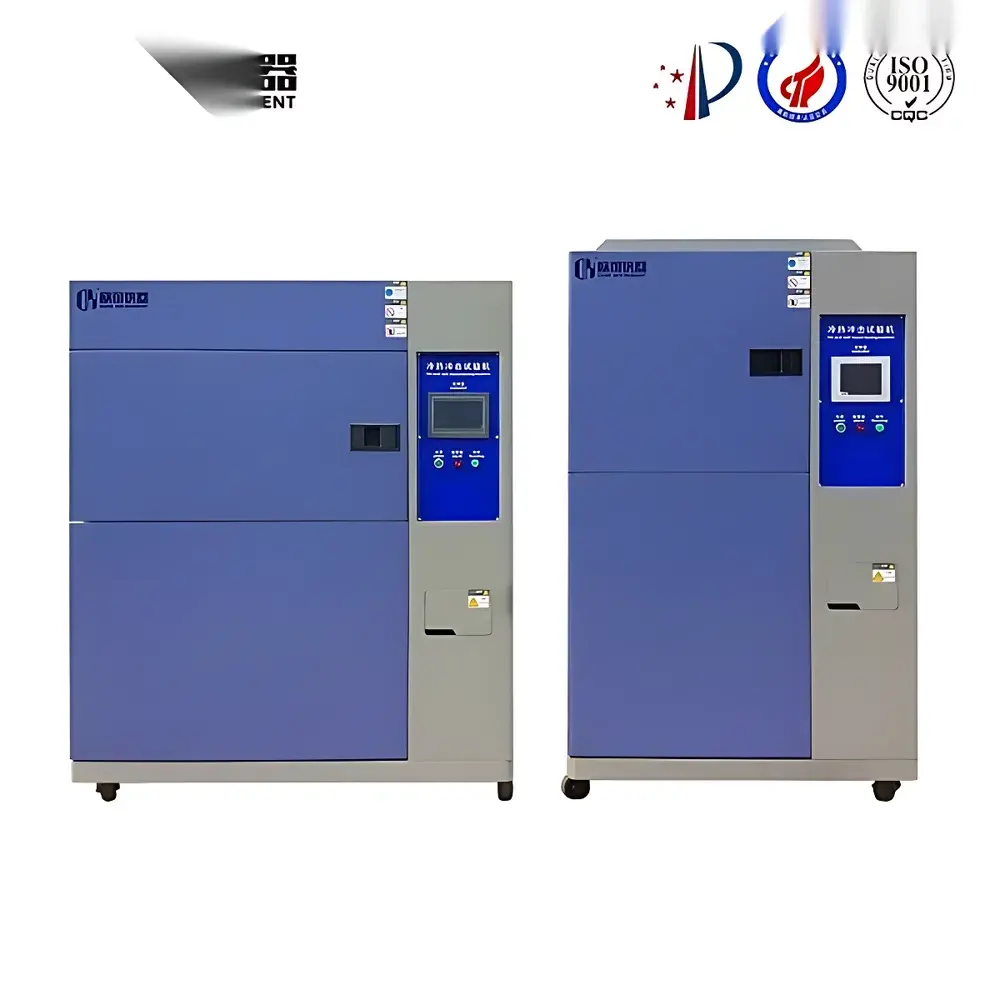
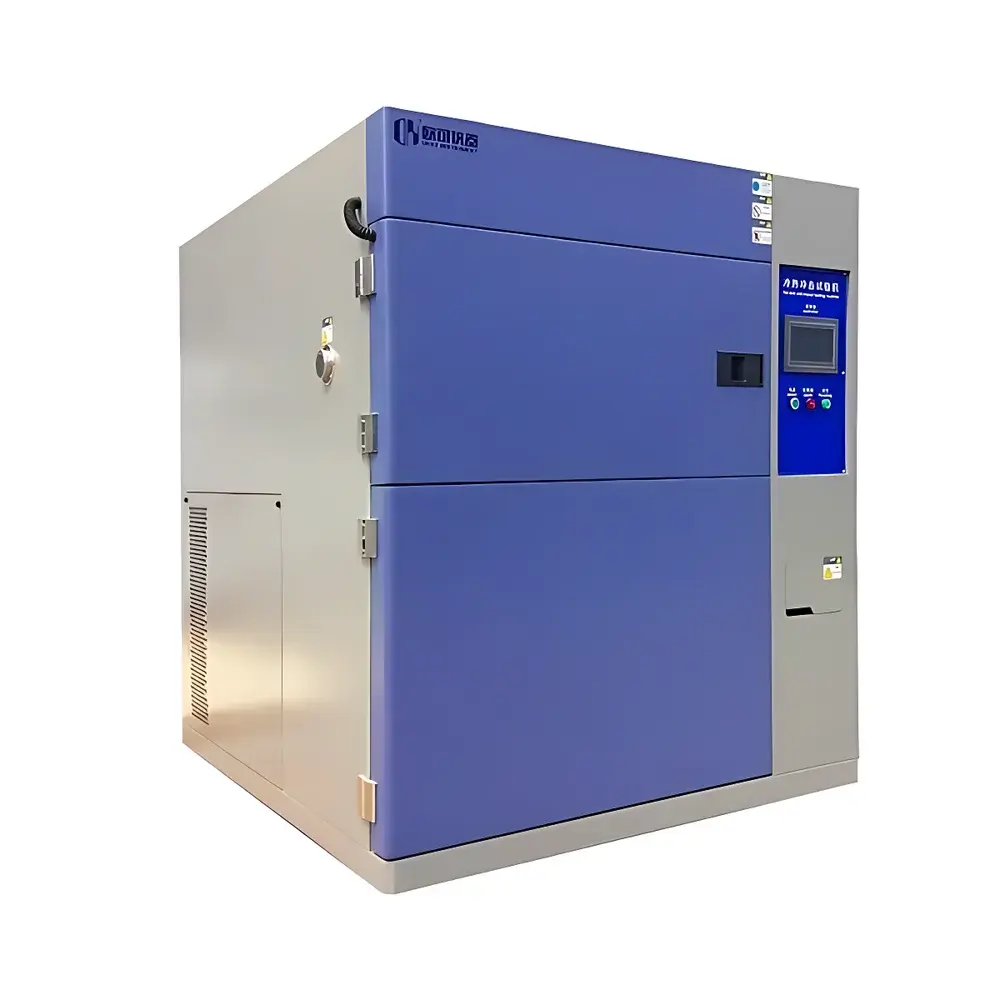
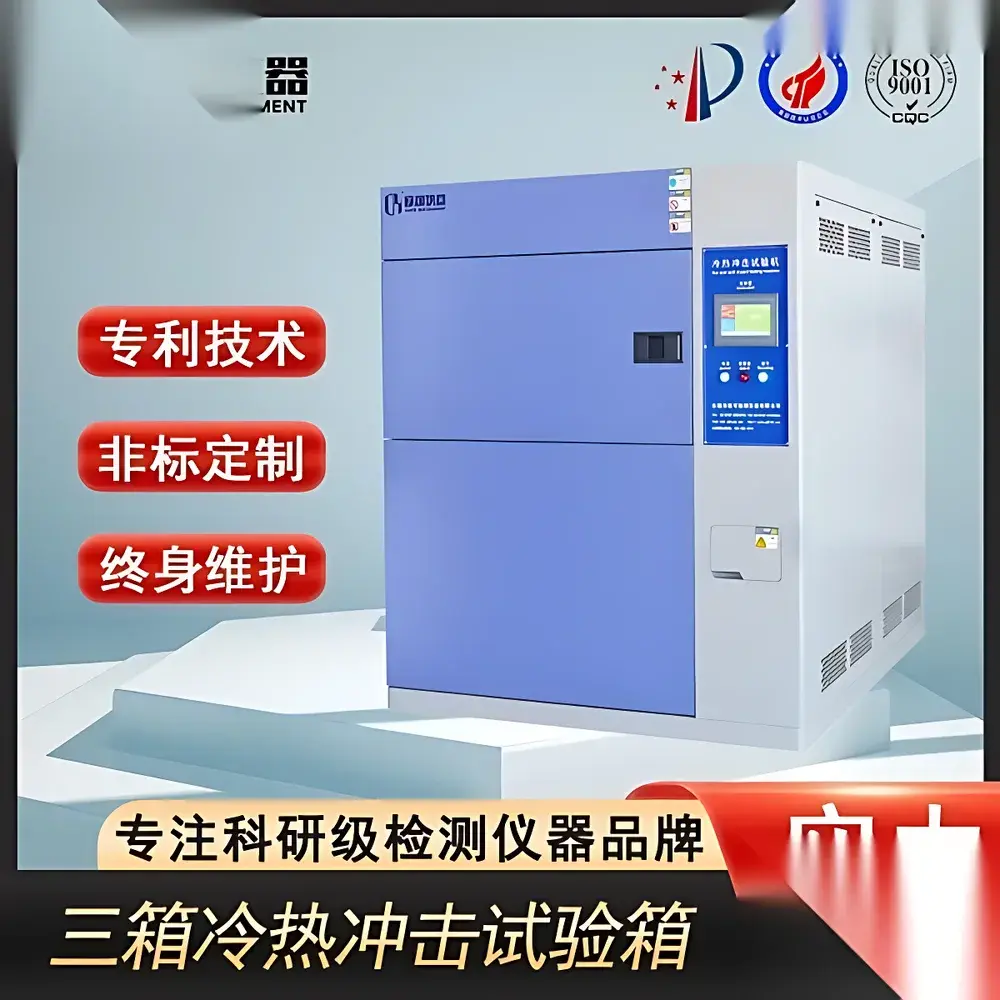
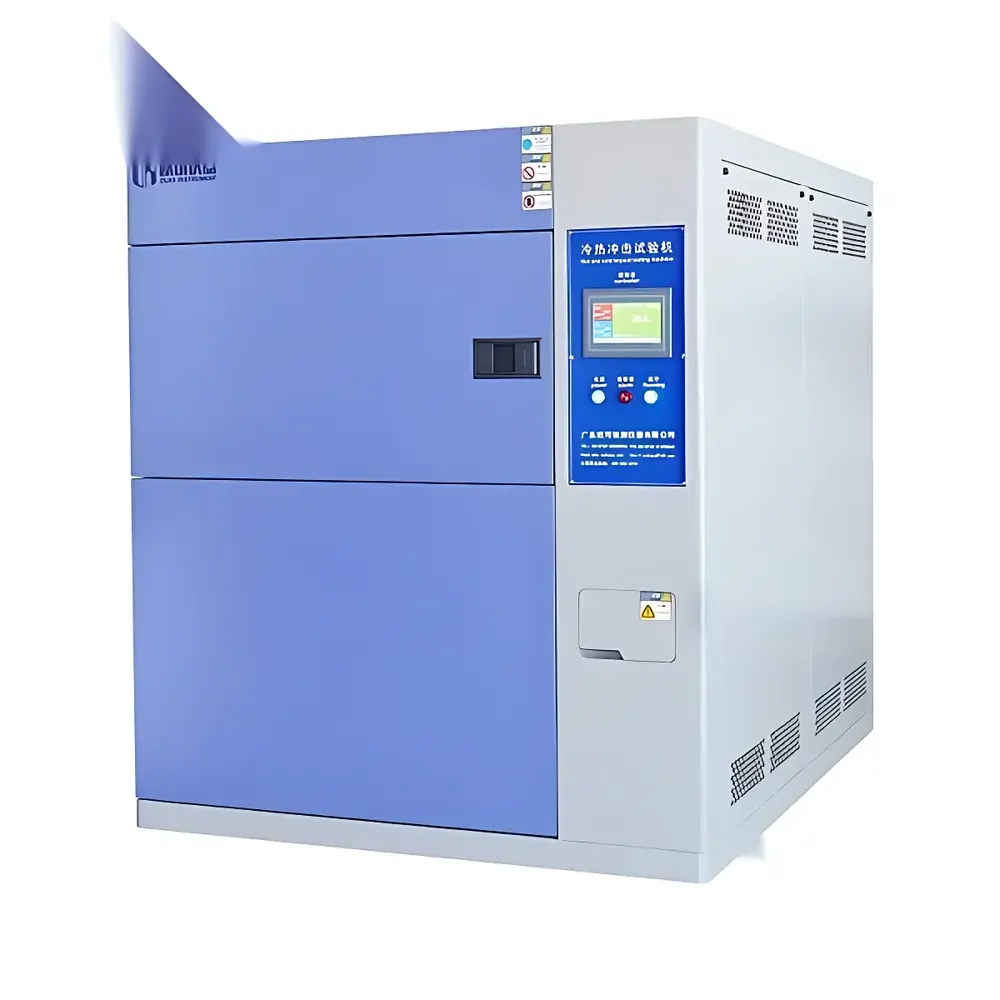
Thermal Shock Test Chamber – Industrial-Grade Three-Zone or Two-Zone Environmental Test System
| Brand | OEM / Custom-Built |
|---|---|
| Origin | Imported (Germany/USA/Japan-sourced Components) |
| Manufacturer Type | Authorized Distributor & Integration Partner |
| Compliance | GB/T 2423.1–2, GB/T 2423.22, GJB 150.3–5, IEC 60068-2-14, SJ/T 10186–10187, QC/T 17, EIA-364-32 |
| Cooling Capacity | Dual-Stage Cascade Refrigeration System with Imported Semi-Hermetic Compressors |
| Cooling Water Requirement | External 10 m³/h Recirculating Cooling Tower (User-Supplied) |
| Temperature Range | –65°C to +180°C (Typical Configuration) |
| Transition Time | ≤15 s (Between Chambers, Two-Zone), ≤30 s (Three-Zone Transfer Mechanism) |
| Internal Volume Options | 50 L to 1000 L |
Overview
The Thermal Shock Test Chamber is an industrial-grade environmental test system engineered for rapid, repeatable thermal cycling between extreme temperature extremes. It operates on the principle of accelerated thermal stress exposure—subjecting specimens to abrupt transitions between high-temperature and low-temperature environments to evaluate material integrity, interfacial adhesion, solder joint reliability, and dimensional stability under thermally induced mechanical strain. Designed in accordance with international standards including IEC 60068-2-14 (Test N: Change of Temperature), MIL-STD-810G Method 503.5, and GJB 150.3–5, this chamber supports both two-zone (hot/cold) and three-zone (hot/cold/test) configurations. In the two-zone variant, a motor-driven basket transfers test samples between isolated chambers; in the three-zone design, the specimen remains stationary in the test chamber while thermal energy is actively exchanged via evaporative condensers between dedicated storage zones. This architecture minimizes thermal inertia, enabling sub-30-second transition times and high reproducibility across thousands of cycles.
Key Features
- Dual-stage cascade refrigeration system utilizing imported semi-hermetic compressors (Germany-sourced), optimized for stable operation at –65°C and rapid recovery after thermal shock events
- Evaporative condenser-based energy transfer architecture ensures precise thermal coupling between hot and cold reservoirs without direct air mixing
- Stainless steel 304 interior chamber with reinforced insulation (polyurethane foam, ≥150 mm thickness) and double-glazed observation window with anti-fog heating
- Programmable controller with Ethernet interface supporting RS-485 Modbus RTU and optional Profibus DP integration for factory automation systems
- Independent safety circuits: over-temperature cutoff, compressor high-pressure lockout, door interlock, and cooling water flow monitoring
- Compliance-ready configuration: pre-wired for optional data logging, audit trail generation, and 21 CFR Part 11–compliant electronic signatures (via third-party software integration)
Sample Compatibility & Compliance
This chamber accommodates rigid and semi-rigid specimens up to 40 kg per cycle, including PCB assemblies, automotive ECUs, aerospace composite panels, and hermetically sealed optoelectronic modules. Chamber internal dimensions are configurable from 300 × 300 × 300 mm (50 L) to 1000 × 1000 × 1000 mm (1000 L), with custom fixtures available for DUT mounting and thermal mass compensation. The system meets structural and operational requirements of GB/T 2423.22–2002 (Temperature Change), GJB 360.7–87 (Military Electronics), and EIA-364-32 (Connector Thermal Shock). Calibration traceability follows ISO/IEC 17025 guidelines, with optional NIST-traceable sensor verification reports available upon request. All control firmware and documentation support GLP/GMP-aligned validation protocols (IQ/OQ/PQ).
Software & Data Management
Built-in controller firmware provides real-time graphing, alarm history (with timestamped event logs), and cycle counter tracking. Export formats include CSV and XML for integration into LIMS or MES platforms. Optional PC-based software enables remote monitoring, multi-chamber synchronization, and automated report generation compliant with ASTM E2927–22 (Standard Practice for Reporting Thermal Shock Test Results). Audit trails record all parameter modifications, user logins, and calibration interventions—supporting FDA 21 CFR Part 11 compliance when deployed with validated electronic signature modules. Data encryption (AES-256) and role-based access control (RBAC) are available as add-on security packages.
Applications
- Qualification testing of printed circuit board assemblies (PCBAs) per IPC-J-STD-004 and IPC-A-610
- Validation of adhesive bond strength in multi-material automotive components (e.g., battery module housings, sensor mounts)
- Reliability screening of MEMS devices, ceramic capacitors, and wafer-level packaged ICs
- Accelerated aging assessment of polymer encapsulants and conformal coatings used in avionics
- Thermal fatigue evaluation of solder joints in high-reliability electronics per JEDEC JESD22-A104
- Material compatibility testing for cryogenic-to-hypersonic thermal cycling in space hardware development
FAQ
What is the difference between two-zone and three-zone thermal shock configurations?
The two-zone system uses a moving basket to shuttle samples between hot and cold chambers, minimizing chamber volume but requiring mechanical actuation. The three-zone design keeps the sample stationary in a central test chamber, using separate hot/cold storage zones and evaporative condensers for energy transfer—reducing mechanical wear and improving repeatability.
Is external cooling water mandatory?
Yes. The dual-stage cascade refrigeration system requires a continuous supply of recirculated cooling water at 10 m³/h and ≤32°C inlet temperature. A dedicated cooling tower must be installed externally by the end user.
Can the chamber be validated for GxP environments?
Yes. With optional validation support package—including IQ/OQ documentation templates, sensor mapping reports, and alarm response verification—the system meets baseline requirements for GLP, GMP, and ISO 13485 environments.
What maintenance intervals are recommended?
Compressor oil analysis every 2,000 operating hours; refrigerant leak check every 6 months; door gasket inspection and cleaning quarterly; full system calibration annually or per internal quality schedule.
Are custom temperature ranges supported?
Standard configurations cover –65°C to +180°C. Extended ranges (e.g., –75°C or +225°C) are available with modified refrigerant blends and heater upgrades—subject to engineering review and additional lead time.



