
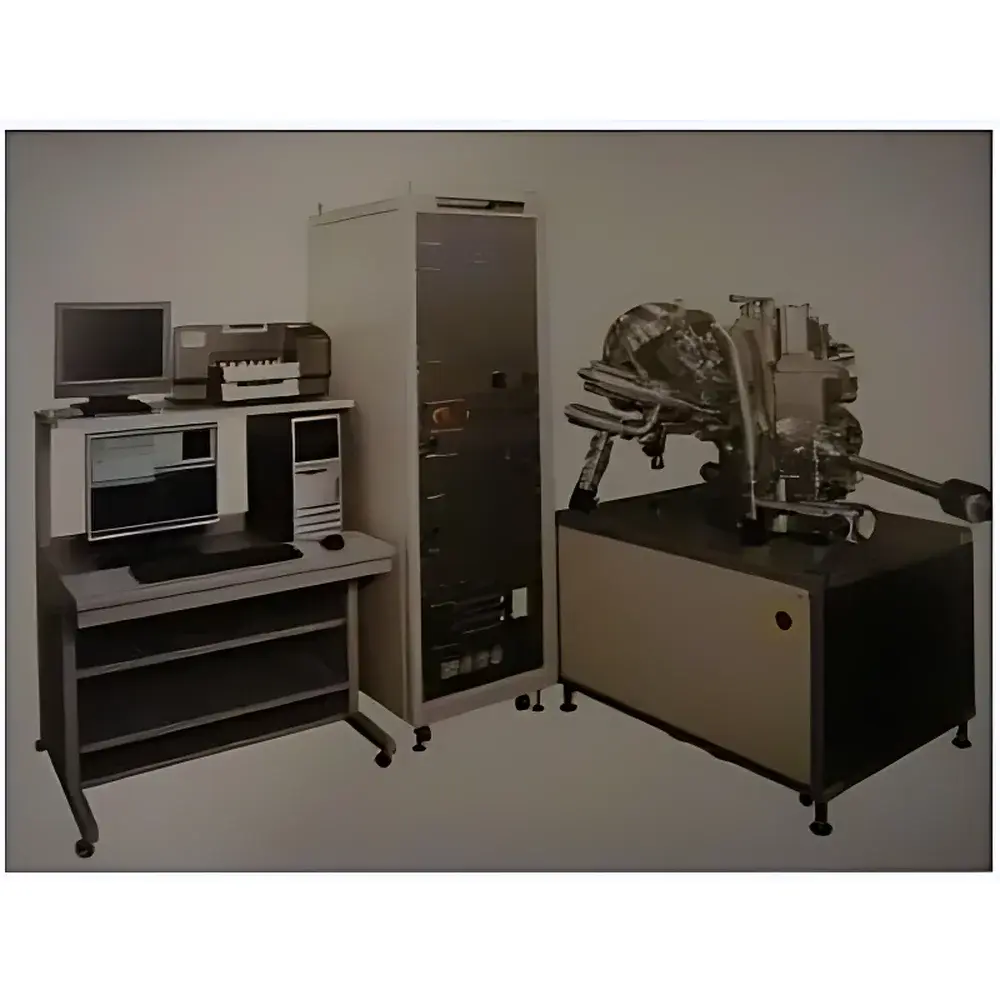
PHI VersaProbe III Multi-Functional Platform Scanning Microfocus X-Ray Photoelectron Spectrometer
| Origin | Japan |
|---|---|
| Manufacturer Type | Authorized Distributor |
| Origin Category | Imported |
| Model | VersaProbe III |
| Price | USD 950,000 (FOB Yokohama) |
Overview
The PHI VersaProbe III is a high-performance, multi-functional scanning microfocus X-ray photoelectron spectrometer (XPS) engineered for nanoscale surface chemical analysis with spatially resolved elemental composition, chemical state identification, and depth profiling capabilities. Based on the core principle of photoemission—where monochromatic or dual-anode X-rays eject core-level electrons from sample surfaces—the instrument measures kinetic energy distributions to determine binding energies with sub-eV resolution. Its defining innovation lies in the world’s first commercially deployed scanning microfocus Al Kα X-ray source (spot size down to 10 µm), enabling true micro-area XPS, high-resolution XPS imaging (SXI), and correlated secondary electron imaging—all within a single ultra-high vacuum (UHV) platform. Designed for rigorous academic and industrial R&D environments—including university surface science labs, national research centers, and semiconductor process development groups—the VersaProbe III meets stringent requirements for quantitative surface analysis under ASTM E1526, ISO 18118, and ISO 21365 standards.
Key Features
- Scanning microfocus monochromated Al Kα X-ray source (≤10 µm spot size) delivering high-brightness, low-background excitation for superior signal-to-noise ratio in micro-area analysis.
- Dual-anode Mg/Al Kα source for complementary excitation energies and charge compensation optimization on insulating materials.
- Integrated ultraviolet photoelectron spectroscopy (UPS) module with He I/He II lamp (3:1 ratio), enabling valence band structure analysis with ≤120 meV resolution at the Ag Fermi edge.
- High-pressure quartz reaction cell capable of in situ/operando studies up to 760 Torr and 600 °C, featuring programmable temperature control, gas mixing manifold with calibrated mass flow controllers, and Byton® O-ring sealing.
- 5-axis motorized sample stage with ±90° tilt, sub-micron step resolution (<1 µm), and integrated cryo/thermal stage (170–600 K) with PID-controlled heating and real-time temperature monitoring.
- Focused Ar+ ion gun (100 eV–5 keV, continuously variable) optimized for depth profiling with beam diameters ≤150 µm at 30 mm working distance and ≥0.5 mA/cm² current density.
- Double-flood charge neutralization system (low-energy electron + Ar+ ion sources) for stable, artifact-free analysis of dielectrics, polymers, and oxides.
- 180° hemispherical electron energy analyzer with 16-channel detection, energy range 0–1600 eV (XPS) and 0–320 eV (UPS), and pass energy settings down to 25 meV (XPS) and 5 meV (UPS).
Sample Compatibility & Compliance
The VersaProbe III accommodates diverse sample geometries—including wafers (up to 4″), powders (via conductive mounting), thin films, catalysts, battery electrodes, and biological interfaces—without requiring conductive coating in most cases due to its advanced charge compensation architecture. All UHV chambers (analysis chamber: <6.7×10⁻¹⁰ mbar; load-lock chamber: <6.7×10⁻⁹ mbar) comply with ISO 20000-1 vacuum integrity specifications and are constructed from electropolished SUS316 stainless steel with baked-out internal surfaces. The system supports GLP/GMP-aligned workflows via audit-trail-enabled software, electronic signatures per FDA 21 CFR Part 11, and traceable calibration using certified reference materials (e.g., Ag 3d5/2, Cu 2p3/2, Au 4f7/2). Full compliance with JEIDA, JIS Z 8103, and IEC 61000-6-3 EMC standards is documented in the CE technical file.
Software & Data Management
Acquisition and processing are executed via PHI’s proprietary MultiPak™ v9.x software suite, running on a dedicated Windows-based workstation (Intel Core i7, 16 GB RAM, 1 TB SSD, 24″ color-calibrated display). The software provides real-time spectral acquisition, automated peak fitting with Shirley/Tougaard background subtraction, chemical state mapping (XPS imaging), depth profile reconstruction with sputter rate calibration, and quantification using Scofield sensitivity factors. Integrated database support includes NIST XPS Database (Version 4.1), CasaXPS-compatible libraries, and user-defined compound libraries. Raw data is stored in vendor-neutral .vms format with embedded metadata (instrument parameters, calibration logs, operator ID, timestamp), ensuring FAIR (Findable, Accessible, Interoperable, Reusable) data principles. Export options include ASCII, CSV, and CIF formats compatible with third-party tools such as Igor Pro, MATLAB, and Python-based analysis pipelines.
Applications
The VersaProbe III serves critical roles across multiple domains: in semiconductor R&D, it characterizes gate oxide interfacial chemistry, metal silicide formation, and EUV resist degradation mechanisms; in catalysis, it maps active site oxidation states before/after reaction cycles inside the high-pressure cell; in battery research, it profiles SEI layer evolution on cycled anodes with <2 nm depth resolution; in corrosion science, it identifies passive film composition gradients across localized pitting sites; and in biomaterials, it verifies surface functionalization uniformity on plasma-treated implants. Its microfocus capability enables targeted analysis of lithographically defined features, grain boundaries in polycrystalline thin films, and heterogeneous catalyst nanoparticles—delivering statistically robust chemistry data where conventional broad-beam XPS lacks spatial discrimination.
FAQ
What is the smallest analysis area achievable with monochromated Al Kα?
The minimum analysis area is 10 µm × 10 µm, with Ag 3d5/2 full-width at half-maximum (FWHM) ≤0.60 eV and sensitivity ≥4,000 cps under standard operating conditions.
Can the system perform angle-resolved XPS (ARXPS)?
Yes—the 5-axis sample stage enables precise emission angle control from 0° to 90° relative to the analyzer axis, supporting non-destructive depth-sensitive compositional profiling with depth resolution down to ~1 nm.
Is UPS data acquisition fully integrated with XPS hardware?
Yes—UPS uses the same hemispherical analyzer and detector array; switching between XPS and UPS modes is software-controlled without mechanical reconfiguration.
How is vacuum integrity maintained during high-pressure reaction experiments?
The quartz reaction cell is isolated from the main UHV analysis chamber by a differential pumping valve; pressure differentials up to 109:1 are sustained without compromising base vacuum in the analyzer region.
Does the system support automated batch analysis for quality control applications?
MultiPak™ includes script-driven automation for unattended multi-sample runs, including auto-alignment, charge neutralization optimization, and report generation compliant with ISO/IEC 17025 documentation requirements.







