
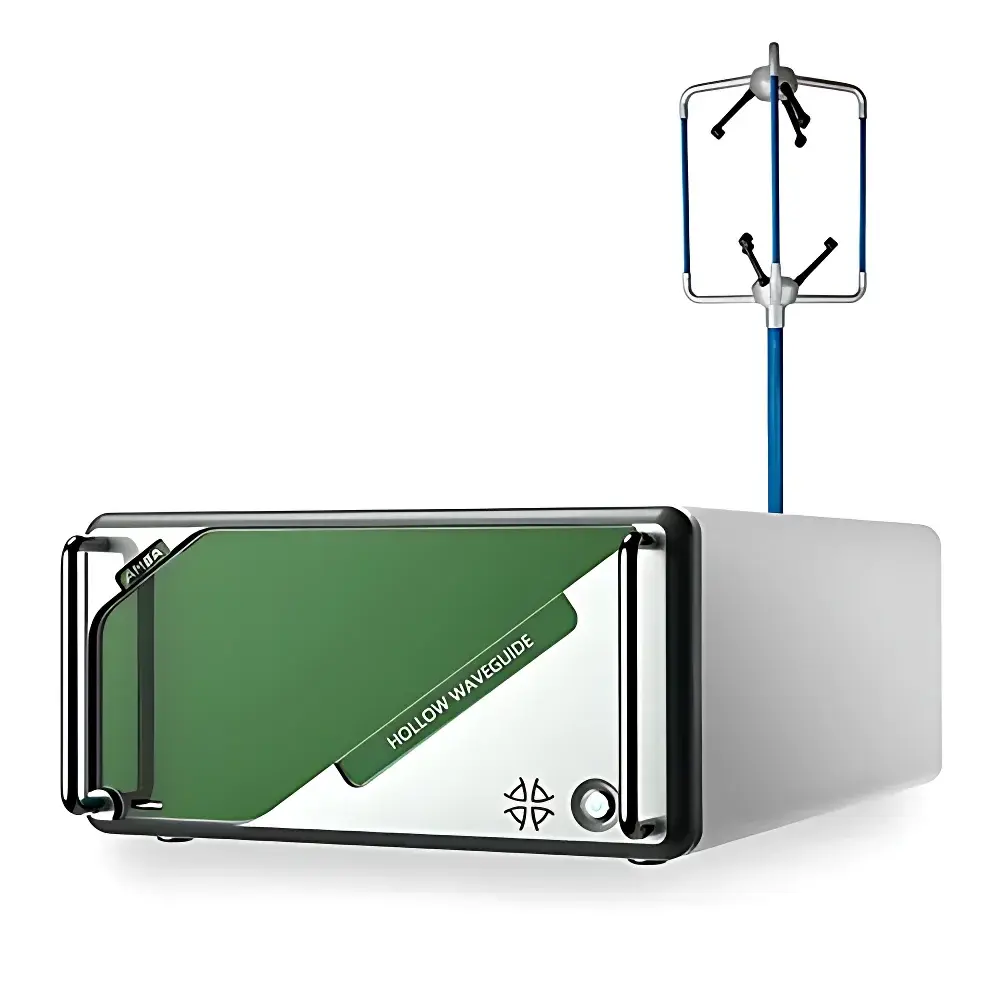
AMBA I3211E CO₂ Isotope Eddy Covariance Measurement System
| Origin | Netherlands |
|---|---|
| Manufacturer Type | Authorized Distributor |
| Origin Category | Imported |
| Model | I3211E |
| Pricing | Available Upon Request |
Overview
The AMBA I3211E CO₂ Isotope Eddy Covariance Measurement System is a field-deployable, closed-path, high-temporal-resolution instrument engineered for continuous, autonomous measurement of atmospheric CO₂ concentration ([CO₂]) and stable carbon isotope ratio (δ¹³C) in eddy covariance (EC) flux studies. It employs mid-infrared hollow-waveguide absorption spectroscopy — a robust, calibration-stable optical technique that enables precise isotopic quantification without cryogenic cooling or high-vacuum pumping. Unlike open-path EC systems, the I3211E’s sealed sample path eliminates sensitivity to precipitation, fog, snow, dust, and aerosol scattering, ensuring data integrity across diverse meteorological conditions. Its ultra-small optical cell volume (~0.1 mL) permits full sample turnover at 10 Hz with only 50 mL/min sample flow — matching the temporal resolution required for high-fidelity turbulent flux partitioning while minimizing power demand and consumables use. The system integrates a co-located 3D ultrasonic anemometer, enabling fully synchronized, time-aligned acquisition of scalar and vector turbulence data within a single embedded processing unit.
Key Features
- Mid-infrared hollow-waveguide spectroscopy: Enables high-sensitivity δ¹³C detection without liquid nitrogen, vacuum pumps, or external chiller units.
- Closed-path architecture: Immune to environmental interference from rain, fog, snow, or particulate deposition; supports unattended operation in remote or harsh field sites.
- 10 Hz simultaneous [CO₂] and δ¹³C output: Achieved via rapid gas exchange in a 0.1 mL optical cavity, optimized for eddy covariance covariance statistics and spectral analysis.
- Low-flow operation (50 mL/min @ 10 Hz): Reduces compressor load, extends maintenance intervals, and lowers total cost of ownership over multi-season deployments.
- Integrated 3D ultrasonic anemometer: Co-located and hardware-synchronized with gas analyzer; supports time-stamped, latency-matched data streams for flux computation.
- Automated in situ calibration: Onboard reference gas delivery and valve sequencing enable daily or event-triggered recalibration without manual intervention.
- Wide operational envelope: Functional from –10 °C to +45 °C ambient temperature and 50–133 kPa pressure; tolerates up to 99% RH at 40 °C without condensation or drying requirements.
Sample Compatibility & Compliance
The I3211E is designed for ambient air sampling in terrestrial and aquatic boundary layer research. It accommodates natural variability in CO₂ mixing ratios (0–10,000 ppm) and delivers isotopic precision compliant with best practices for ecosystem-scale carbon flux attribution. Its closed-path configuration meets ISO 17025 traceability requirements when paired with NIST-traceable reference gases. The system supports GLP-compliant audit trails via timestamped calibration logs and error registers. Data formats and metadata tagging align with FluxNet, ICOS, and AmeriFlux standards. No sample drying or chemical scrubbing is required — eliminating bias from water vapor cross-sensitivity or CO₂ loss during conditioning.
Software & Data Management
Data acquisition, synchronization, and real-time post-processing are handled by the onboard Linux-based controller. Raw analog and digital inputs (anemometer, pressure, temperature, humidity) are time-stamped with microsecond resolution using GPS-disciplined PPS. Outputs include RS-232 serial, 10/100/1000BASE-T Ethernet, and USB 2.0 interfaces. Remote access is supported via secure SSH and HTTP(S) APIs. Firmware includes automated fault detection (e.g., flow deviation, pressure drift, signal saturation), with email/SNMP alerts and configurable logging thresholds. All calibration events, system errors, and configuration changes are recorded in immutable binary logs compliant with FDA 21 CFR Part 11 electronic record requirements.
Applications
- Long-term eddy covariance monitoring of net ecosystem exchange (NEE) and isotopic flux partitioning (e.g., autotrophic vs. heterotrophic respiration).
- Soil–atmosphere CO₂ isotope exchange studies under controlled or field conditions.
- Validation of atmospheric transport models and satellite-derived δ¹³C products (e.g., OCO-2/3, GOSAT).
- Urban carbon cycle investigations where high-frequency isotopic signatures inform source apportionment.
- Carbon sequestration verification in afforestation/reforestation projects requiring isotopic fingerprinting.
- Integration into integrated observatory networks (e.g., NEON, LTER) requiring interoperable, standards-aligned instrumentation.
FAQ
Does the I3211E require external drying or scrubbing of sampled air?
No. The optical design is intrinsically insensitive to water vapor interference, and the system operates reliably at up to 99% RH without condensation at 40 °C.
How is time synchronization achieved between the anemometer and gas analyzer?
Hardware-level PPS synchronization via GPS module ensures sub-millisecond alignment of all sensor timestamps.
What calibration gases are needed for routine operation?
Two-point calibration requires certified CO₂-in-air standards spanning ambient and elevated concentrations, traceable to NIST SRM 1610 or equivalent.
Can the system operate on solar power in off-grid locations?
Yes — with appropriate battery buffer and charge controller, its steady-state draw of 200 W (and peak <350 W at startup) is compatible with renewable energy systems.
Is remote firmware update supported?
Yes, over secure HTTPS or SCP; updates preserve existing configuration and calibration history.





