
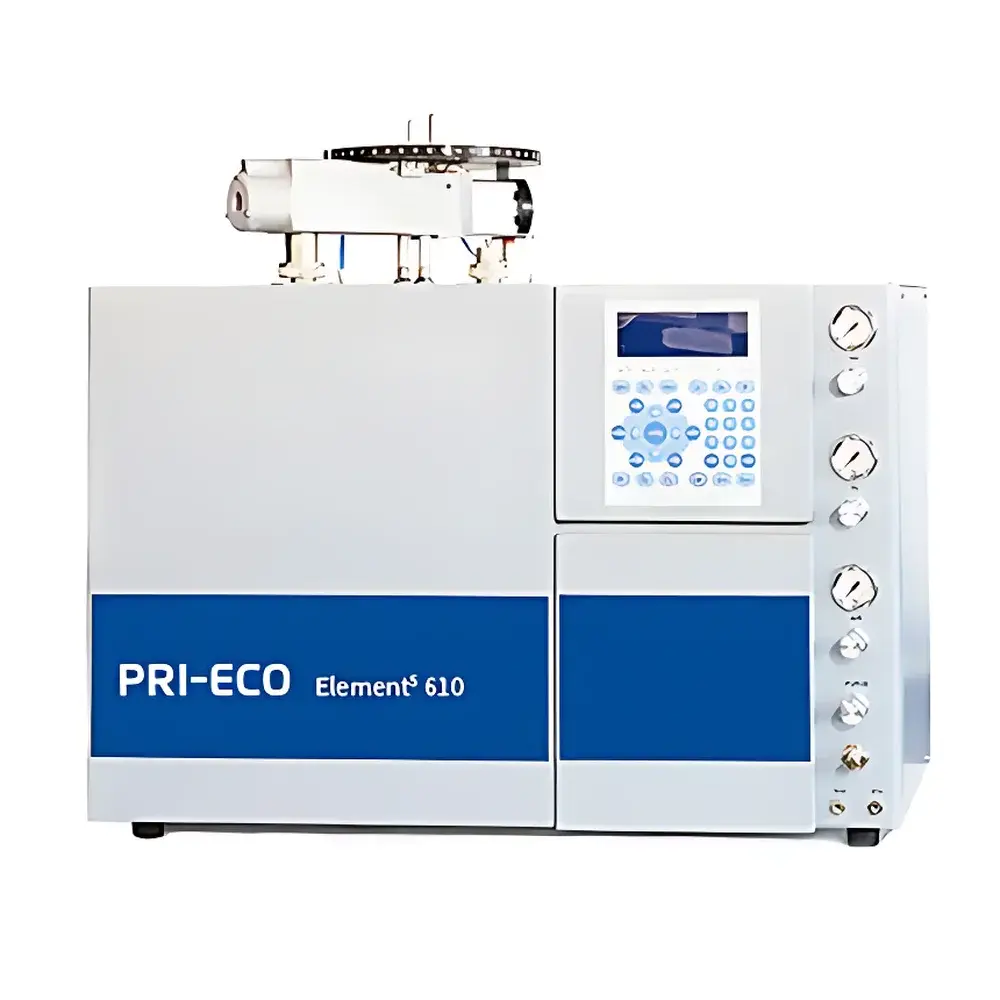
Pri-eco Element5 610 CHNSO Organic Elemental Analyzer
| Brand | Pri-eco |
|---|---|
| Origin | Beijing, China |
| Manufacturer Type | Manufacturer |
| Model | Element5 610 |
| Detection Elements | C, H, N, S, O |
| Principle | Dumas Flash Combustion + Gas Chromatographic Separation |
| Furnace Configuration | Dual-Furnace (Oxidation + Reduction) |
| Detector | Self-Calibrating TCD |
| Sample Mass Range | 0.01–100 mg |
| Detection Range | 200 ppm – 100% |
| Accuracy | < 0.2% (vs. certified reference materials) |
| Precision | < 0.1% RSD (vs. certified reference materials) |
| LOD/LOQ | 1–5 µg |
| Oxidation Temp | 800–1100 °C |
| Reduction Temp | 600–1100 °C |
| Analysis Time (CHNS) | ~15 min |
| GC Column | 2 m packed column (CN separation) |
| Calibration Models | Linear, Quadratic, Cubic |
| Software | EAS CLARITY |
| Carrier Gas | Helium (99.999%, 3–5 bar) |
| Oxygen Supply | Ultra-High-Purity O₂ (99.999%, 3–5 bar) |
| Power | 230 VAC ±10%, 1–10 A |
| Dimensions (L×W×H) | 760 × 350 × 700 mm |
Overview
The Pri-eco Element5 610 CHNSO Organic Elemental Analyzer is a dual-furnace combustion-based instrument engineered for precise, trace-to-bulk quantification of carbon, hydrogen, nitrogen, sulfur, and oxygen in organic matrices. It implements the Dumas flash combustion principle—where samples are rapidly oxidized in a high-temperature oxygen-rich environment—followed by selective gas-phase separation via packed-column gas chromatography (GC) and thermal conductivity detection (TCD). This architecture ensures robust speciation of evolved gases (CO₂, H₂O, N₂, SO₂, CO) without cross-interference, enabling simultaneous or sequential CHNS and O determination within a single analytical workflow. Designed for laboratories requiring regulatory-compliant elemental data, the Element5 610 meets foundational requirements for method validation under ISO 17025, ASTM D5291, ASTM D7622, and USP <231>, supporting GLP/GMP-aligned reporting when integrated with audit-trail-enabled software configurations.
Key Features
- Dual independent high-temperature furnaces: oxidation furnace (800–1100 °C) and reduction furnace (600–1100 °C), eliminating thermal carryover and enabling true orthogonal CHNS/O analysis
- Self-calibrating TCD detector with no requirement for reference gas streams—reducing operational complexity and consumable dependency
- Modular reactor system with interchangeable oxidation/reduction tubes (multiple diameters available) to optimize combustion efficiency across sample types (e.g., soils, pharmaceuticals, polymers, marine sediments) and carbon load ranges (1 µg–100 mg)
- Configurable gas delivery: programmable O₂ dosing per sample mass to minimize gas consumption while maintaining complete combustion stoichiometry
- Flexible sampling interface: supports manual single-sample introduction or automated loading via pneumatic or electronic autosamplers (32-, 50-, or 100-position rotating trays; up to 147 positions with stacked pneumatic modules)
- Integrated combustion visualization port for real-time monitoring of sample ignition and ash residue formation—critical for method development and troubleshooting
- Direct coupling capability to isotope-ratio mass spectrometers (IRMS) or Fourier-transform infrared (FTIR) detectors for δ¹³C, δ¹⁵N, δ³⁴S, or δ¹⁸O applications
Sample Compatibility & Compliance
The Element5 610 accommodates solid, liquid, and homogenized biological specimens—including plant tissues, feedstuffs, activated carbons, petrochemical fractions, pharmaceutical intermediates, and environmental filter extracts. Sample mass flexibility (0.01–100 mg) and adaptive oxygen dosing allow consistent performance across low-C biomass (e.g., algae, leaf litter) and high-C synthetic compounds (e.g., polyethylene, coal derivatives). All hardware and firmware comply with CE marking directives (2014/30/EU EMC, 2014/35/EU LVD), and software operation adheres to FDA 21 CFR Part 11 principles when deployed with EAS CLARITY’s optional electronic signature and audit-trail modules. Method documentation aligns with ISO 11261 (soil C/N), ISO 14852 (biodegradability), and AOAC 992.23 (protein nitrogen), facilitating third-party accreditation.
Software & Data Management
EAS CLARITY is a Windows-based acquisition and evaluation platform offering full control over combustion parameters, GC timing, peak integration, and calibration model selection (linear, quadratic, or cubic). It supports multi-point calibration with certified reference materials (e.g., sulfanilamide, EDTA, benzoic acid), automatic baseline correction, and dynamic retention time alignment. Raw chromatograms, integrated peak areas, elemental percentages, and uncertainty estimates (based on replicate standard deviation) are stored in structured .csv and .xlsx formats. Audit trails record user actions, method changes, and instrument status events with timestamps and operator IDs—enabling full traceability during internal audits or regulatory inspections. Data export is compatible with LIMS environments via ODBC or direct API integration.
Applications
- Ecological research: C/N/S ratios in soil organic matter, sediment diagenesis studies, and greenhouse gas precursor profiling
- Agricultural science: Protein content verification in feed and grain, fertilizer efficacy assessment, and compost maturity indexing
- Pharmaceutical QA/QC: Assay purity confirmation of active pharmaceutical ingredients (APIs), excipient elemental screening per ICH Q3D guidelines
- Marine biogeochemistry: Particulate organic carbon (POC) and nitrogen (PON) quantification in plankton nets and filtration residues
- Food safety: Authenticity testing of dairy proteins, detection of adulterants via anomalous N/C signatures, and nutritional labeling compliance
- Petrochemical analysis: Sulfur speciation in fuels per ISO 20846, carbon distribution in heavy crudes, and catalyst poisoning assessment
FAQ
What combustion principle does the Element5 610 employ?
It uses high-temperature Dumas flash combustion followed by gas chromatographic separation and TCD detection—ensuring quantitative recovery of all target elements without catalytic interference.
Can the instrument measure oxygen independently from CHNS?
Yes. Oxygen is determined via high-temperature pyrolytic reduction in the dedicated reduction furnace, producing CO that is separated and detected separately from CHNS-derived gases.
Is the TCD detector truly reference-gas-free?
Yes. The detector incorporates an embedded thermal reference element and real-time drift compensation algorithm, eliminating the need for periodic zero/span with external reference gas.
What sample throughput can be achieved with the autosampler?
With the 100-position electronic autosampler and optimized 15-minute CHNS cycle, up to 96 samples can be processed unattended in a 24-hour period.
Does the system support isotopic analysis?
Yes—via standardized GC-IRMS interface ports and compatible flow-splitting hardware, enabling offline or online δ¹³C, δ¹⁵N, and δ³⁴S measurements.
How is method validation supported?
The platform includes built-in tools for limit-of-quantitation (LOQ) determination (1–5 µg), repeatability assessment (RSD < 0.1%), and accuracy verification against CRM libraries—fully documented in accordance with ISO/IEC 17025 clause 7.2.2.
Related Products




