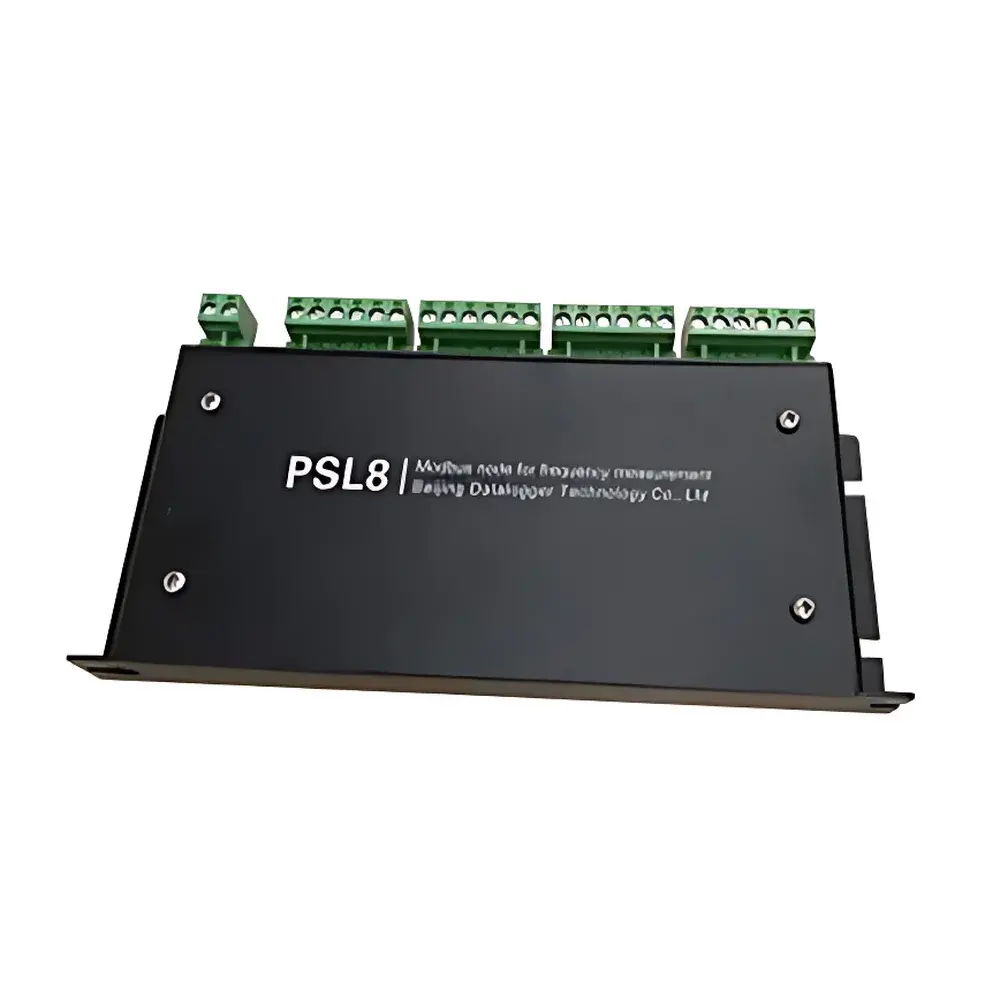
PSL8 MODBUS Eight-Channel Frequency Measurement Module
| Origin | Beijing |
|---|---|
| Manufacturer Type | Distributor |
| Origin Category | Domestic (China) |
| Model | PSL8 MODBUS |
| Price | Upon Request |
| Operating Voltage | 6–16 VDC |
| Current Consumption | 13–20 mA (active), 400 µA (standby) |
| Operating Temperature Range | −40 to +80 °C |
| Square Wave Input Frequency Range | 1 Hz – 35 kHz |
| Low-Frequency AC Input Sensitivity | 20 mV RMS (min. for 1–20 Hz), 200 mV RMS (min. for 0.5–200 Hz), 2000 mV RMS (min. for 0.3–10 kHz), 5000 mV RMS (min. for 0.3–20 kHz) |
| Output Signal | Modbus RTU over RS-485 (2-wire or 4-wire) |
Overview
The PSL8 MODBUS Eight-Channel Frequency Measurement Module is a precision industrial-grade signal conditioning and frequency acquisition device engineered for integration into distributed environmental, geotechnical, and industrial monitoring systems. It operates on the principle of digital edge detection and high-resolution timer-based frequency counting, enabling accurate measurement of periodic signals—including low-frequency AC waveforms, TTL/CMOS-compatible square waves, and contact closure events—across eight independent input channels. Designed specifically for compatibility with Campbell Scientific data loggers (CR300, CR1000X, CR6, DL1000, and DL3000 series), the module communicates via standard Modbus RTU protocol over RS-485, supporting multi-drop network configurations with individually configurable slave addresses. Its ultra-low standby current (400 µA) and wide operating temperature range (−40 to +80 °C) make it suitable for unattended, long-term deployments in remote or harsh environments, including weather stations, structural health monitoring nodes, pump station telemetry, and hydrological sensor networks.
Key Features
- Eight isolated frequency input channels with independent signal conditioning circuitry per channel
- Support for multiple signal types: zero-crossing detection for low-frequency AC (0.3 Hz to 200 Hz), digital edge-triggered counting for square waves (1 Hz to 35 kHz), and pulse accumulation for mechanical switch or relay contact closures
- Modbus RTU communication interface compliant with RS-485 physical layer (2-wire and 4-wire modes supported)
- Configurable Modbus slave address (0x01–0xFF) allowing up to 247 modules on a single RS-485 bus
- Wide DC supply range (6–16 VDC) with reverse-polarity protection and transient surge suppression
- Low-power design: typical active current draw of 13–20 mA; standby current ≤400 µA for battery-powered applications
- Industrial-grade PCB layout with conformal coating option for enhanced moisture and dust resistance
Sample Compatibility & Compliance
The PSL8 interfaces directly with analog and digital sensors producing frequency-modulated outputs—such as turbine flow meters, anemometers, vibrating-wire piezometers, magnetic pickup tachometers, and proximity switches—without requiring external signal amplification or level-shifting. Input impedance exceeds 1 MΩ for AC inputs and 10 kΩ for digital inputs, minimizing loading effects on source devices. The module complies with IEC 61000-4 electromagnetic compatibility (EMC) standards for electrostatic discharge (ESD), radiated immunity, and fast transient burst testing. While not certified to UL/CE for safety-critical control applications, it meets functional safety requirements for data acquisition in non-safety-related monitoring systems under ISO 13849-1 PL c / Category 2 architecture when used within validated system configurations.
Software & Data Management
Data from the PSL8 is accessed exclusively through Modbus register mapping, enabling seamless integration into Campbell Scientific’s LoggerNet, PC400, and RTDAQ software environments. Each channel’s instantaneous frequency (Hz), accumulated pulse count, and status flags are mapped to discrete 16-bit holding registers and input registers, supporting both polled and event-driven read operations. Configuration parameters—including channel enable/disable state, input type selection (AC/square wave/switch), debounce time (0–255 ms), and scaling factors—are stored in non-volatile memory and accessible via standard Modbus function codes (0x03, 0x06, 0x10). All register access supports full audit trail logging when deployed with LoggerNet’s security-enabled configuration mode, satisfying basic GLP/GMP documentation requirements for field-deployed metrology instrumentation.
Applications
- Hydrological monitoring: measuring rotational speed of propeller-type flow meters and vortex shedding frequencies from ultrasonic flow transducers
- Wind energy assessment: capturing wind speed via cup anemometer pulse output across multiple mast levels
- Geotechnical instrumentation: reading frequency shifts from vibrating-wire strain gauges and piezometers using demodulation-capable data loggers
- Industrial process control: monitoring motor RPM, conveyor belt speed, and pump cycle counts in SCADA-integrated facilities
- Structural dynamics: acquiring low-frequency resonance signatures from accelerometers conditioned through charge-to-frequency converters
- Environmental research: logging rainfall intensity via tipping-bucket rain gauge pulses across distributed sensor arrays
FAQ
Can the PSL8 measure true RMS AC frequency below 1 Hz?
No. The module’s AC input path is optimized for zero-crossing detection between 0.3 Hz and 200 Hz. Signals below 0.3 Hz fall outside its specified sensitivity envelope and require external signal conditioning or alternative measurement methods.
Is galvanic isolation provided between input channels and the RS-485 bus?
The standard PSL8 variant does not include channel-to-bus galvanic isolation. Optional isolation kits (PSL8-ISOL) are available for applications requiring >1 kV channel-to-ground or channel-to-channel isolation.
Does the module support Modbus TCP or only Modbus RTU?
The PSL8 implements Modbus RTU exclusively over RS-485. Integration with Ethernet-based SCADA systems requires an RS-485-to-TCP gateway device configured in bridge mode.
How is calibration traceability maintained for field-deployed units?
Each unit ships with a factory calibration report referencing NIST-traceable frequency standards. Field recalibration is performed using a calibrated function generator and verified against known reference frequencies stored in internal diagnostic registers.
What happens during power interruption or brownout conditions?
The module incorporates brownout detection and automatic reset circuitry. Pulse counters retain accumulated values in volatile RAM during brief interruptions (<100 ms); extended outages result in counter reset unless paired with a data logger that performs periodic register reads and stores values externally.