
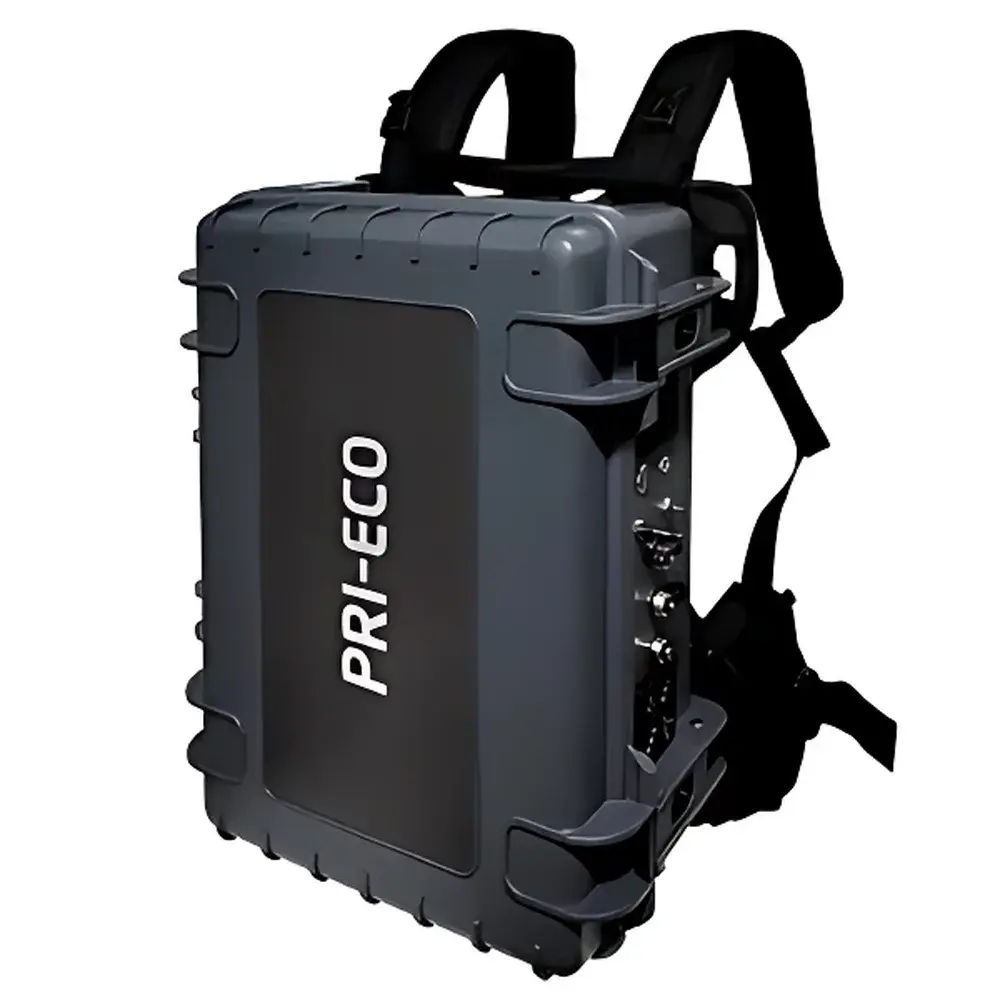
Pri-eco PRI-8620 Portable CO₂/CH₄/H₂O Soil Respiration Measurement System
| Brand | Pri-eco |
|---|---|
| Origin | Beijing, China |
| Manufacturer Type | Manufacturer |
| Country of Origin | China |
| Model | PRI-8620 |
| Instrument Type | Multi-gas Soil Respiration Analyzer |
| Power Consumption (Steady State) | < 28 W |
| Power Supply | 12 V Lithium Battery |
| Dimensions | 475 × 372 × 192 mm |
| CO₂ Precision (5 min) | 0.6 ppm |
| CH₄ Precision (5 min) | 0.2 ppb |
| H₂O Precision (5 min) | 10 ppm |
| CO₂ Range | 0–2000 ppm |
| CH₄ Range | 0–500 ppm |
| H₂O Range | 0–3 % |
| Sample Flow Rate | 800 mL/min (adjustable) |
| Ambient Humidity Tolerance | < 99 % RH (non-condensing) |
| Air Pressure Range (Chamber) | 150–1150 mbar |
| Air Pressure Accuracy | ±2 mbar |
| Chamber Diameter | 220 mm |
| Chamber Height | 120 mm |
| Chamber Volume | 3718 cm³ |
| Soil Temperature Range | −20 to +85 °C |
| Soil Temperature Accuracy | ±0.2 °C |
| Soil Moisture Range | 0–100 % |
| Soil Moisture Accuracy | ±3 % |
| Soil Collar Area | 314 cm² |
| Chamber Weight | 1.8 kg |
| System Weight | 13 kg |
| Dynamic Pressure Compensation | Yes (Patent No. ZL201420354126.4) |
Overview
The Pri-eco PRI-8620 Portable CO₂/CH₄/H₂O Soil Respiration Measurement System is a field-deployable, dual-carbon greenhouse gas flux analyzer engineered for high-fidelity quantification of soil-atmosphere exchange dynamics. It employs non-dispersive infrared (NDIR) absorption spectroscopy for simultaneous, real-time detection of carbon dioxide (CO₂) and methane (CH₄), complemented by tunable diode laser absorption spectroscopy (TDLAS) or high-stability capacitive sensing for water vapor (H₂O) — ensuring trace-level sensitivity and long-term baseline stability under variable ambient conditions. The system integrates a precision-controlled gas analysis unit with active temperature and pressure regulation, minimizing drift and environmental interference. Its core measurement principle follows the closed-chamber accumulation method, where temporal concentration gradients are resolved via high-resolution time-series sampling (1 Hz default), enabling robust flux calculation using linear or nonlinear regression models (e.g., Heskel, exponential, or polynomial fitting). Designed for ecological carbon cycle research, climate change monitoring, and agricultural GHG mitigation studies, the PRI-8620 delivers laboratory-grade data quality in a rugged, battery-operated platform optimized for remote deployment across diverse edaphic and climatic settings.
Key Features
- Simultaneous, co-located measurement of CO₂, CH₄, and H₂O concentrations with sub-ppm and sub-ppt resolution
- Dual-compartment design: integrated gas analyzer unit and mechanically stabilized soil chamber with patented dynamic pressure compensation (ZL201420354126.4) to eliminate barometric artifacts during flux estimation
- Active thermal management of optical path and detector housing ensures consistent spectral response across −10 to +45 °C ambient operating range
- Field-calibratable NDIR/TDLAS sensors with factory-traceable calibration certificates compliant with ISO/IEC 17025 practices
- Modular architecture supporting future expansion to nitrous oxide (N₂O) detection and automated chamber deployment systems
- Ergonomic handheld tablet interface with offline operation capability, intuitive workflow navigation, and on-device flux computation (linear, quadratic, and exponential algorithms)
- Low-power embedded electronics (8 hours of continuous operation on a single 12 V lithium battery charge
Sample Compatibility & Compliance
The PRI-8620 is validated for use across mineral soils, organic peats, agricultural fields, forest floors, wetlands, and restored ecosystems. Its 220 mm diameter × 120 mm height chamber (3718 cm³ volume) accommodates standard 314 cm² collars (10 cm radius), conforming to established protocols in IPCC Tier 1–2 reporting frameworks. Soil temperature and volumetric water content are measured in situ using integrated Pt100 RTD and calibrated capacitance probes, meeting ASTM D5859-18 and ISO 11276:2018 requirements for soil physical property characterization. All gas concentration outputs are referenced to dry air and corrected for water vapor dilution per ISO 14034:2016 Annex B. Data logging complies with GLP principles, including timestamped metadata (GPS coordinates, atmospheric pressure, chamber closure time, soil T/WC), audit-ready file export (CSV/NetCDF), and optional 21 CFR Part 11–compliant electronic signature modules for regulated environmental monitoring programs.
Software & Data Management
The embedded Android-based control software provides full instrument configuration, real-time waveform visualization, and post-acquisition flux modeling without external PC dependency. Raw sensor data (CO₂, CH₄, H₂O, T, P, soil T, soil θᵥ) are stored at 1 Hz with millisecond-accurate UTC timestamps synchronized via internal RTC. Export formats include comma-separated values (CSV) with header metadata, CF-compliant NetCDF4 for interoperability with R/Python-based flux processing pipelines (e.g., EddyPro, FluxTool), and PDF summary reports with QA/QC flags. Firmware updates are delivered via secure OTA protocol; version history and calibration logs are retained locally for traceability. Optional cloud synchronization enables centralized project-level data aggregation, cross-site comparison, and automated anomaly detection using configurable thresholds.
Applications
- Quantifying net ecosystem exchange (NEE) components in terrestrial carbon budgets
- Evaluating agronomic practices (tillage, cover cropping, fertilizer type) on CH₄ and CO₂ emissions from rice paddies and croplands
- Assessing permafrost thaw feedbacks through seasonal CH₄ pulse detection in Arctic tundra
- Validating satellite-derived land surface models (e.g., OCO-2, GOSAT) at ground truth sites
- Supporting national GHG inventories under UNFCCC reporting guidelines (IPCC 2006 Guidelines, Chapter 4)
- Long-term eddy covariance tower footprint validation and gap-filling
- Soil microbiome–gas flux coupling studies requiring concurrent H₂O, T, and θᵥ contextualization
FAQ
What calibration standards are required for field operation?
Factory-installed span gases (certified CO₂ and CH₄ mixtures in N₂) are provided with each unit. Zero gas (synthetic air) and span verification are recommended before each intensive campaign. Field recalibration is not mandatory between deployments if drift remains within ±0.5 ppm CO₂ and ±0.1 ppb CH₄ over 24 h.
Can the system operate unattended for extended periods?
Yes — when paired with an external solar charging kit and weatherproof enclosure, the PRI-8620 supports autonomous 72-hour measurement cycles with programmable chamber sealing intervals and sleep-mode power management.
Is the dynamic pressure compensation system compatible with windy field conditions?
The patented vented equalization manifold actively maintains chamber pressure within ±1 mbar of ambient across wind speeds up to 8 m/s (Beaufort scale 5), as verified in independent wind tunnel testing per IEC 60068-2-5.
How is soil moisture measured, and what is its role in flux interpretation?
Volumetric water content is derived from a calibrated dielectric probe inserted adjacent to the collar base. It serves as a critical covariate in generalized additive models (GAMs) linking diffusion-limited gas transport to pore saturation state, particularly for CH₄ oxidation/reduction thresholds.
Does the system support third-party data integration (e.g., CR1000, Campbell Scientific loggers)?
Yes — analog voltage outputs (0–5 V) and RS-485 Modbus RTU interface enable seamless integration into existing environmental monitoring networks for synchronized meteorological and biogeochemical data acquisition.







