
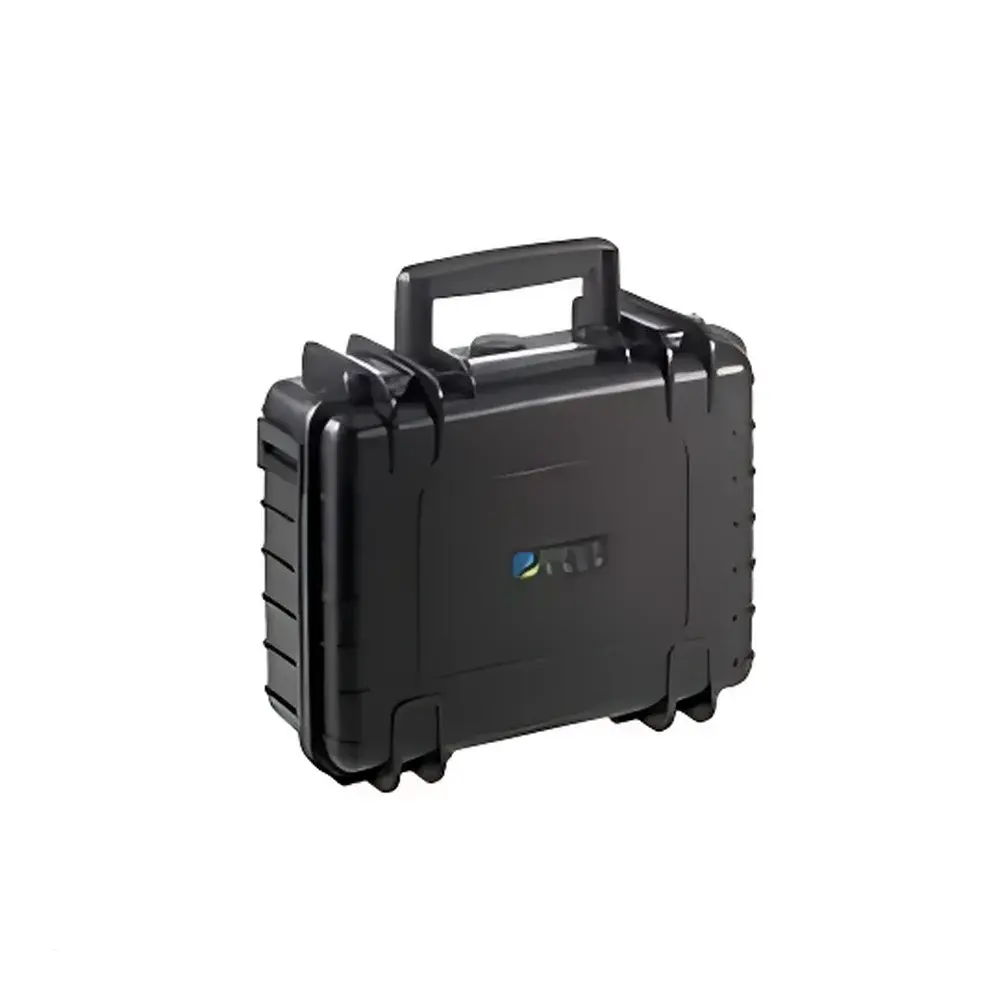
Pri-eco PRI-502 CH₄/H₂O Dual-Wavelength NDIR Gas Analyzer
| Brand | Pri-eco |
|---|---|
| Origin | Beijing, China |
| Manufacturer Type | Original Equipment Manufacturer (OEM) |
| Country of Origin | China |
| Model | PRI-502 |
| Detection Principle | Dual-Wavelength Non-Dispersive Infrared (Dual-NDIR) |
| Measurable Gases | CH₄ (0–50,000 ppm), H₂O (0–6% vol) |
| Accuracy | ±2% FS (CH₄), ±2% FS (H₂O) |
| Zero Stability (CH₄) | ±2% FS over >12 months |
| Repeatability (CH₄) | ±0.3% FS at zero, ±1.5% FS at span |
| Temperature Drift (CH₄) | ±0.03% FS/°C (ambient), ±2% FS/year (thermostated) |
| Operating Temperature | −20 to +45 °C |
| Operating Pressure | 800–1150 mbar |
| Sample Flow Rate | 1 L/min (adjustable) |
| T90 Response Time | 10 s (adjustable) |
| Warm-up Time | 1 min |
| Humidity Range | <99% RH, non-condensing |
| Output Interfaces | RS-232, analog (4–20 mA / 0–10 V) |
| Dimensions | 250 × 160 × 90 mm |
| Weight | 1.2 kg |
| Power Supply | 7–28 V DC |
Overview
The Pri-eco PRI-502 CH₄/H₂O Dual-Wavelength NDIR Gas Analyzer is an engineered solution for continuous, field-deployable measurement of methane (CH₄) and water vapor (H₂O) concentrations in ambient air, stack emissions, soil flux chambers, and eddy covariance systems. It employs dual-wavelength non-dispersive infrared (Dual-NDIR) spectroscopy — a mature, interference-resistant optical technique that leverages two discrete infrared absorption bands: one centered at the fundamental C–H stretch vibration of methane (~3.3 µm), and another optimized for rotational-vibrational transitions of water vapor (~2.7 µm). Unlike single-beam NDIR architectures, the PRI-502 implements a silicon wafer-based dual-emitter source with matched reference and analytical channels, enabling real-time ratiometric correction for source intensity drift, optical fouling, and detector responsivity variation. This architecture eliminates reliance on mechanical choppers or external calibration gases during routine operation, supporting high reproducibility under uncontrolled environmental conditions.
Key Features
- Integrated dual-channel silicon wafer infrared emitter with spectral stability across −20 °C to +45 °C ambient range
- Onboard temperature and barometric pressure sensors enabling automatic physical property compensation per ISO 12039 and ASTM D6522
- High-speed ARM Cortex-M7 microcontroller executing real-time signal processing, baseline correction, and linearization algorithms
- Zero-drift mitigation via dynamic offset tracking and thermal equilibrium management of optical path components
- Compact form factor (250 × 160 × 90 mm; 1.2 kg) suitable for mobile platforms, UAV-mounted payloads, and permanent station integration
- Low-power design compatible with solar-battery hybrid power systems (7–28 V DC input)
- T90 response time ≤10 s at 1 L/min sample flow, configurable for fast-flux or high-precision averaging modes
Sample Compatibility & Compliance
The PRI-502 accepts untreated, particulate-filtered (≤1 µm) gas streams without chemical scrubbing or drying — critical for maintaining native H₂O–CH₄ co-variability in atmospheric boundary layer studies. Its optical cell is constructed from corrosion-resistant stainless steel with gold-coated internal surfaces to minimize adsorption hysteresis. The analyzer meets IEC 61326-1 (EMC for industrial environments) and complies with CE marking requirements for environmental monitoring instrumentation. While not certified for safety-critical hazardous area deployment (e.g., ATEX/IECEx), it is routinely deployed in Class II, Division 2 zones when installed with appropriate sample conditioning. Data integrity protocols align with GLP-compliant workflows: all raw absorbance values, compensated concentration outputs, sensor diagnostics, and timestamped environmental metadata are logged internally and exportable for audit trail reconstruction.
Software & Data Management
Device configuration, real-time monitoring, and data retrieval are managed via ASCII-command protocol over RS-232 serial interface — fully compatible with industry-standard SCADA platforms (e.g., Campbell Scientific CR series, Siemens Desigo, Ignition SCADA). Analog outputs (4–20 mA or 0–10 V) support direct integration into PLC-based control loops for emission abatement feedback. Firmware supports user-defined averaging intervals (1 s to 3600 s), alarm thresholds, and diagnostic reporting (e.g., lamp intensity decay rate, pressure sensor deviation). All firmware updates and calibration parameter uploads require authenticated command sequences, ensuring traceability per FDA 21 CFR Part 11 Annex 11 principles where applicable. No proprietary software installation is required; terminal emulators (e.g., PuTTY, Tera Term) suffice for full operational control.
Applications
- Atmospheric methane monitoring networks (e.g., ICOS, NOAA GML, regional air quality observatories)
- Soil–atmosphere CH₄ flux quantification using static/dynamic chambers and automated chamber systems
- Landfill gas migration studies and biogas upgrading process control
- Eddy covariance towers requiring simultaneous H₂O and CH₄ eddy flux computation (e.g., FLUXNET Tier 1 sites)
- Mobile surveys (vehicle-, drone-, or backpack-mounted) for fugitive emission detection and hotspot localization
- Calibration transfer verification against CRDS or OA-ICOS reference analyzers in intercomparison campaigns
FAQ
Does the PRI-502 require daily zero/span calibration?
No. With factory calibration and annual verification, the unit maintains ±2% FS accuracy for CH₄ over 12 months under typical field conditions. Optional automated zero checks using synthetic nitrogen can be scheduled weekly.
Can the analyzer operate unattended for extended periods?
Yes. Designed for remote deployment, it features watchdog timers, brown-out protection, and non-volatile memory for fault logging. Field units have demonstrated >6-month continuous operation with solar charging.
Is cross-sensitivity to CO₂ or other hydrocarbons compensated?
The dual-wavelength algorithm inherently suppresses CO₂ interference due to spectral separation. Ethane (C₂H₆) exhibits minor overlap but contributes <0.2% FS error at 100 ppm C₂H₆ in 5000 ppm CH₄ background — within stated accuracy limits.
What maintenance is required beyond annual calibration?
Only periodic inlet particulate filter replacement (every 3–6 months depending on site dust loading) and visual inspection of optical windows for condensation or deposition.
How is humidity handled during CH₄ measurement?
H₂O is measured simultaneously and used as a co-variable in the NDIR signal model; no external dryer is needed. The algorithm applies empirically derived H₂O-dependent correction coefficients validated across 0–6% RH.
Related Products







