
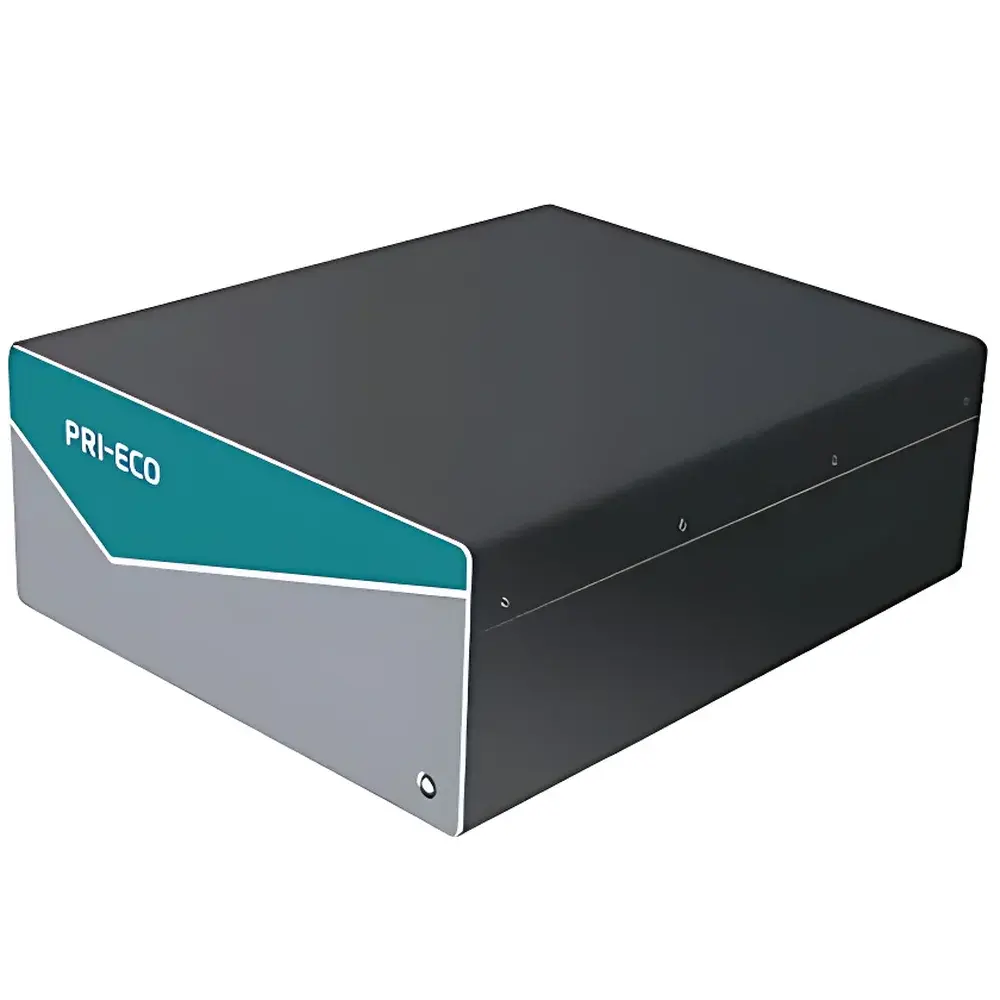
Pri-eco PRI-701 Ammonia (NH₃) Analyzer
| Brand | Pri-eco |
|---|---|
| Origin | Beijing, China |
| Manufacturer Type | Manufacturer |
| Country of Origin | Domestic (China) |
| Model | PRI-701 |
| Detection Principle | Mid-infrared Quantum Cascade Laser (QCL) coupled with Photoacoustic Spectroscopy (PAS) |
| Target Gas | NH₃ |
| Detection Limit (3σ, 60 s) | 0.1 ppm |
| Repeatability | <2% of reading or LOD |
| Accuracy | <2% of reading or LOD |
| Response Time (10–90%) | <130 s |
| Maximum Measurement Rate | >10 Hz |
| Measurement Range | 0–100 ppm (customizable) |
| Sample Cell Volume | 1 mL |
| Gas Consumption | <80 mL/min |
| Sample Temperature Range | −10 to 45 °C |
| Sample Humidity Limit | <99% RH (non-condensing) |
| Power Supply | DC |
| Power Consumption | 20 W |
| Weight | 3 kg |
| Data Output | Ethernet, Modbus TCP/IP & RS, USB |
Overview
The Pri-eco PRI-701 Ammonia (NH₃) Analyzer is a high-performance, field-deployable gas analyzer engineered for continuous, real-time quantification of ammonia in ambient air and industrial exhaust streams. It employs mid-infrared quantum cascade laser (QCL) spectroscopy combined with photoacoustic spectroscopy (PAS), a physical detection method that eliminates the need for optical detectors, beam splitters, or reference cells. In PAS, modulated QCL light at a characteristic NH₃ absorption line (e.g., ~9.1 µm) is absorbed by target molecules, inducing localized heating and pressure waves—detected by a highly sensitive microphone within a resonant acoustic cell. This principle delivers inherent zero-drift stability, immunity to optical misalignment, and robust performance under variable environmental conditions. Designed for long-term unattended operation, the PRI-701 meets the metrological demands of regulatory monitoring, process control, and atmospheric research—particularly where low-concentration NH₃ detection (10 Hz) are critical.
Key Features
- QCL-PAS detection architecture ensures intrinsic calibration stability—no routine optical alignment or detector replacement required.
- Ultra-small 1 mL photoacoustic measurement cell minimizes gas residence time and surface adsorption, reducing memory effects and enabling fast system turnover between samples.
- Low gas consumption (<80 mL/min) supports integration with low-flow sampling manifolds and extends filter life in particulate-laden environments.
- Compact form factor (3 kg) and 20 W DC power draw enable deployment in mobile laboratories, UAV-mounted platforms, and space-constrained industrial enclosures.
- Wide dynamic range (0–100 ppm) with sub-ppm detection limit (0.1 ppm @ 3σ, 60 s averaging) accommodates both ambient background monitoring and high-concentration stack applications.
- Operational temperature range of −10 to +45 °C and humidity tolerance up to 99% RH (non-condensing) ensure reliability across diverse climatic and industrial settings.
Sample Compatibility & Compliance
The PRI-701 is optimized for direct extractive sampling of humid, particulate-free gas streams. It accepts raw sample gas without pre-conditioning—provided water vapor remains below saturation at the sampling temperature to prevent condensation inside the cell. The analyzer complies with engineering practices aligned with ISO 14644-1 (cleanroom-compatible design), ASTM D6348 (standard test method for gaseous emissions by FTIR), and supports traceability frameworks required under EPA Method 320 and EN 15267-3 for automated measuring systems. Its hardware architecture and firmware support audit-ready data logging, including timestamped raw acoustic signal traces, laser current/temperature telemetry, and diagnostic flags—enabling full GLP/GMP traceability when integrated into validated monitoring networks.
Software & Data Management
The PRI-701 interfaces via standard industrial protocols: Ethernet (TCP/IP), Modbus RTU/TCP, and USB virtual COM port. A vendor-provided configuration and visualization software suite enables real-time spectral viewing, baseline correction, multi-point calibration management, and alarm threshold setup. All measurement data—including concentration values, auxiliary sensor readings (T, RH, flow), and system health metrics—are time-stamped with NTP-synchronized precision and exported in CSV or binary formats. Firmware supports remote firmware updates and secure user-level access control (admin/operator modes). Optional integration with SCADA or cloud-based IoT platforms (e.g., AWS IoT Core, Azure IoT Hub) is facilitated through configurable JSON payloads and MQTT publishing.
Applications
- Agricultural emission monitoring: quantifying NH₃ volatilization from manure storage, fertilizer application, and livestock housing.
- Power plant SCR/SNCR ammonia slip monitoring: real-time feedback for injection optimization and regulatory compliance reporting.
- Chemical manufacturing process control: closed-loop monitoring of synthesis reactors, scrubber efficiency, and fugitive emission detection.
- Urban and regional air quality networks: long-term trend analysis of secondary particulate formation precursors (NH₃ + HNO₃ → NH₄NO₃).
- Research-grade flux measurements: coupling with eddy covariance systems or gradient-based micrometeorological setups.
- Indoor air quality assessment in poultry/pig barns and wastewater treatment facilities.
FAQ
Does the PRI-701 require zero/span calibration during routine operation?
No—its QCL-PAS architecture provides inherent zero stability. While periodic span verification using certified NH₃ standards is recommended per ISO 17025 guidelines (e.g., quarterly), daily zero checks are unnecessary.
Can the instrument operate in high-humidity environments without drying the sample gas?
Yes—provided the sample dew point remains below the cell’s operating temperature to avoid condensation. Built-in temperature-controlled sample lines and heated filters are advised for field deployments in tropical or fog-prone regions.
Is the measurement range configurable beyond 0–100 ppm?
Yes—custom ranges (e.g., 0–10 ppm for ambient monitoring or 0–500 ppm for combustion flue gas) can be implemented via firmware tuning and laser wavelength selection, subject to optical path optimization.
What data security and audit trail capabilities does the device support?
All configuration changes, calibration events, and measurement records are logged with immutable timestamps. When deployed in FDA-regulated environments, optional 21 CFR Part 11-compliant electronic signature modules and audit trail export are available upon request.
How is maintenance scheduled and tracked?
The onboard diagnostics monitor laser lifetime, microphone sensitivity drift, and thermal stability. Predictive maintenance alerts are triggered based on operational hours and performance deviation thresholds—integrated into enterprise CMMS via Modbus register mapping.
Related Products







