
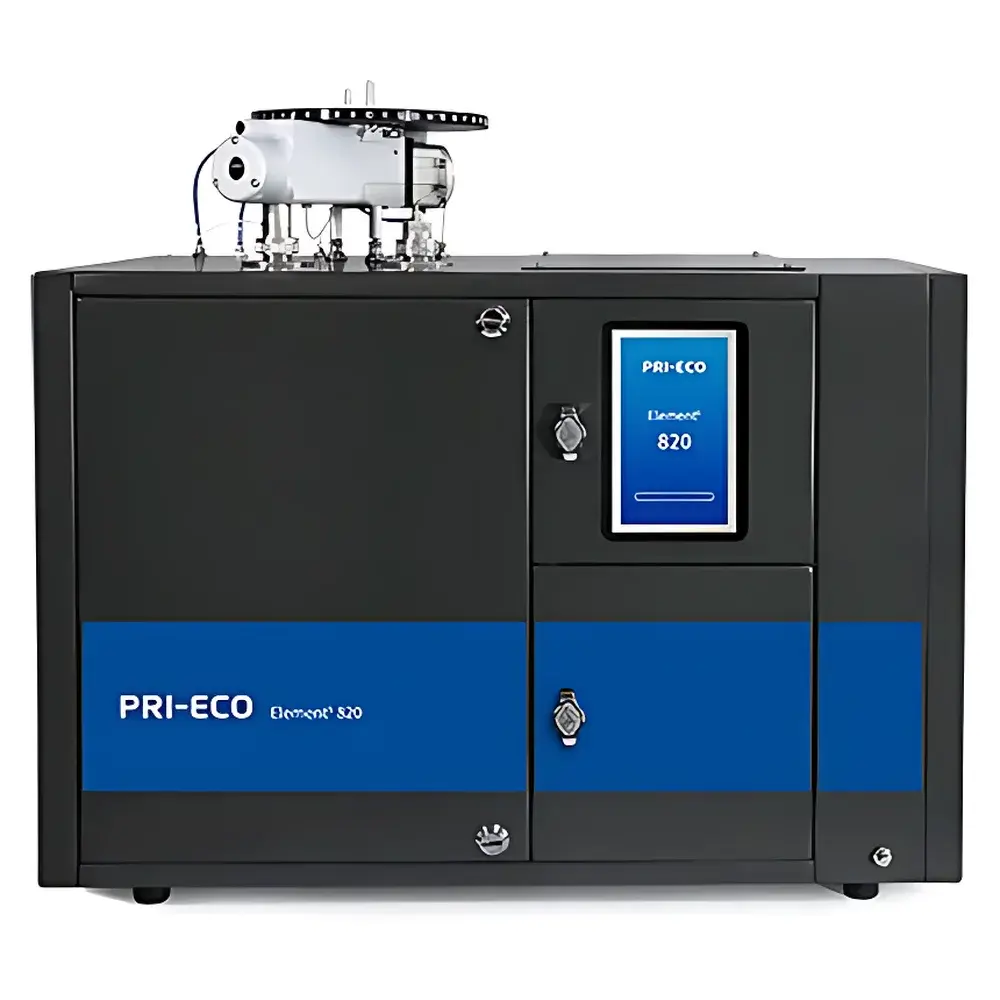
Pri-eco Element5 820 CHNSO Organic Elemental Analyzer
| Brand | Pri-eco |
|---|---|
| Origin | Beijing, China |
| Manufacturer Type | Manufacturer |
| Model | Element5 820 |
| Detection Elements | C, H, N, S, O |
| Sample Introduction | Pneumatic Auto-sampler (147 positions), Electric Auto-sampler (32/50/100 positions), Manual Sampler |
| Analysis Time | CN: 5 min |
| CHN | 8 min |
| CHNS | 10–25 min |
| O | 4 min |
| Measurement Range | C: 0.002–20 mg |
| H | 0.002–5 mg |
| N | 0.002–20 mg |
| S | 0.002–6 mg |
| O | 0.002–2 mg |
| Accuracy | <0.2% (certified reference materials, purity >99.9%) |
| Precision | <0.1% (certified reference materials, purity >99.9%) |
| Furnace Configuration | Dual independent high-temperature furnaces (max. 1100 °C each) |
| Separation Oven Temp. | up to 110 °C |
| Carrier Gas | Ultra-high-purity helium (99.999%, 3–5 bar) |
| Oxidant Gas | Ultra-high-purity oxygen (99.999%, 3–5 bar) |
| Auxiliary Gas | Oil-free compressed air |
| GC Column | 0.8–4 m capillary separation column |
| Detector | High-sensitivity TCD with auto-calibration (no reference gas required) |
| Flow Control | Electronic mass flow regulation |
| Leak Detection | Fully automated self-diagnostic leak test |
| Oxygen Delivery | Intelligent, sample-mass-dependent dosing |
| Software | EAS Clarity (supports linear, quadratic, and cubic calibration models) |
| Sample Mass Range | 0.1–500 mg (up to 1000 mg for soil) |
| Sample Cups | High-purity tin or silver capsules |
| Dimensions | 810 × 500 × 370 mm |
| Weight | 68 kg |
| Power Supply | 230 V, 50/60 Hz |
| Max. Power Consumption | 1100 W, 5 A |
| Touchscreen Interface | Integrated industrial-grade display |
Overview
The Pri-eco Element5 820 CHNSO Organic Elemental Analyzer is a dual-furnace combustion-based elemental analyzer engineered for precise, trace-level quantification of carbon (C), hydrogen (H), nitrogen (N), sulfur (S), and oxygen (O) in organic matrices. It implements the Dumas flash-combustion principle—where samples are rapidly oxidized at controlled high temperatures (up to 1100 °C)—combined with high-resolution gas chromatographic (GC) separation and thermal conductivity detection (TCD). Unlike single-furnace systems, the Element5 820 employs two thermally isolated reaction zones: one optimized for oxidative combustion (C/H/N/S determination) and the other for high-yield pyrolytic reduction (O determination), enabling true simultaneous CHNSO analysis without cross-contamination or method switching delays. The system’s architecture reflects its lineage from NCT (formerly Costech) technology, refined by Pri-eco for enhanced long-term stability, reduced operator dependency, and compliance-ready operation in regulated environments.
Key Features
- Dual independent high-temperature furnaces (each rated to 1100 °C), permitting dedicated optimization of oxidation and reduction chemistries
- Intelligent oxygen dosing system that calculates and delivers stoichiometric O2 volume based on real-time sample mass and elemental composition estimates—minimizing gas consumption and extending consumable life
- Fully automated leak detection protocol executed prior to every analysis cycle, verifying integrity of the entire gas path (He carrier, O2, and purge lines) per ISO 17025-recommended practice
- Self-calibrating TCD detector eliminating the need for reference gases or manual zero/span adjustments—ensuring baseline stability across extended run sequences
- Electronic mass flow controllers (MFCs) for helium carrier and oxygen streams, enabling reproducible retention time alignment and peak resolution across GC separations
- Modular sampling options: pneumatic auto-sampler (147-position carousel), electric auto-samplers (32/50/100 positions), or manual loading—supporting throughput scalability from R&D labs to QC facilities
- Integrated touchscreen interface with embedded diagnostics, real-time gas pressure monitoring, and furnace temperature profiling
Sample Compatibility & Compliance
The Element5 820 accommodates solid and liquid samples ranging from 0.1 mg to 500 mg (soil up to 1000 mg), encapsulated in high-purity tin or silver cups. Its configurable oxidation/reduction tube diameters (e.g., narrow-bore for low-mass biological tissues; wide-bore for heterogeneous environmental solids) allow method adaptation without hardware replacement. The system complies with ASTM D5291, ISO 14852, USP , and EN 15407 for elemental content validation. Data integrity meets FDA 21 CFR Part 11 requirements when operated with EAS Clarity software configured for audit-trail logging, electronic signatures, and user-access controls—making it suitable for GLP and GMP-regulated laboratories engaged in pharmaceutical excipient testing, fertilizer certification, or food authenticity verification.
Software & Data Management
EAS Clarity software provides full instrument control, sequence management, peak integration, and calibration modeling (linear, quadratic, or cubic regression). All raw chromatograms, calibration curves, and system logs are timestamped and stored with immutable metadata—including operator ID, sample ID, furnace temperatures, gas pressures, and leak-test results. Export formats include CSV, PDF analytical reports, and XML for LIMS integration. Audit trails record all parameter modifications, method changes, and data reprocessing events—fully traceable for regulatory inspections. Optional add-ons support isotopic ratio export for coupling with IRMS systems (e.g., Thermo Delta V or Isoprime 100), enabling δ13C, δ15N, δ34S, and δ18O applications in ecological and geochemical research.
Applications
- Environmental science: Total organic carbon (TOC), C/N ratios in soils/sediments, sulfur speciation in coal and fly ash
- Agriculture & food: Protein content (via N × 6.25), adulteration screening (e.g., melamine in dairy), nutritional labeling compliance
- Pharmaceuticals: Active pharmaceutical ingredient (API) assay, residual solvent quantification, excipient elemental impurity profiling per ICH Q3D
- Petrochemicals: Sulfur content in fuels per ASTM D5453, nitrogen in lubricants per ASTM D4294
- Academic research: Stable isotope tracer studies, metabolic flux analysis, polymer composition verification
- Marine biology: Stoichiometric analysis of phytoplankton biomass, nutrient cycling in benthic sediments
FAQ
What distinguishes the Element5 820 from single-furnace CHNS analyzers?
The dual-furnace architecture enables independent thermal programming for oxidation (CHNS) and reduction (O), eliminating carryover, reducing analysis time per element set, and improving accuracy for oxygen-rich or thermally labile samples.
Is helium the only acceptable carrier gas?
Yes—ultra-high-purity helium (99.999%) is required for optimal TCD sensitivity and GC peak shape; argon or nitrogen are incompatible due to thermal conductivity mismatch and column degradation risk.
Can the system be validated for ISO/IEC 17025 accreditation?
Yes—the automated leak test, TCD auto-calibration, electronic flow control, and EAS Clarity’s audit-trail functionality provide documented evidence for measurement uncertainty estimation and method validation per ISO/IEC 17025:2017 Clause 7.7.
What maintenance intervals are recommended for routine operation?
Oxidation/reduction tubes should be inspected every 500–1000 injections; GC columns replaced every 6–12 months depending on sample matrix load; TCD filaments checked annually; and MFCs calibrated semi-annually using certified flow standards.
Does the system support unattended overnight operation?
Yes—when equipped with an auto-sampler and configured with EAS Clarity’s sequence scheduler, the Element5 820 executes multi-day batch runs with automatic shutdown, gas pressure monitoring, and error-triggered email alerts via SMTP integration.





