
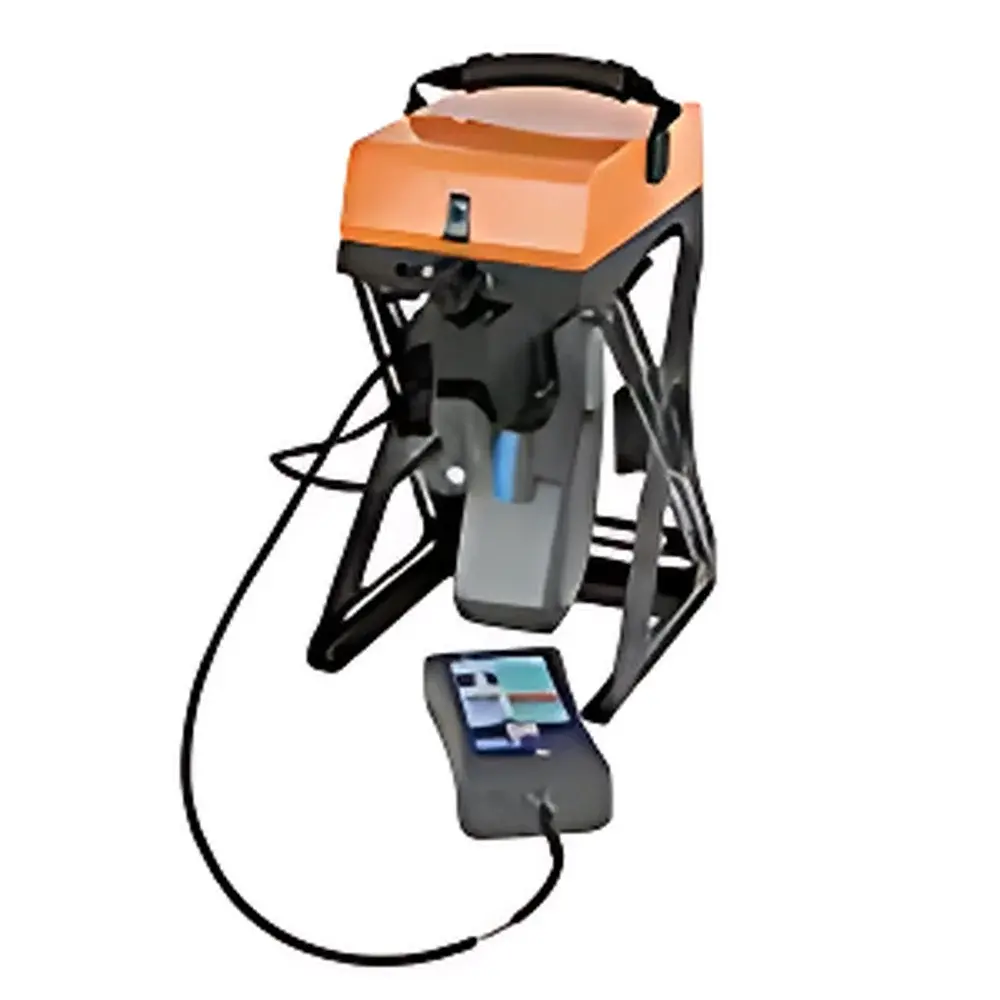
HD Rocksand Heavy Metal Analyzer
| Origin | USA |
|---|---|
| Manufacturer Type | Authorized Distributor |
| Origin Category | Imported |
| Model | HD Rocksand |
| Pricing | Available Upon Request |
Overview
The HD Rocksand Heavy Metal Analyzer is a field-deployable, handheld and benchtop-capable energy-dispersive X-ray fluorescence (EDXRF) spectrometer engineered for rapid, non-destructive elemental quantification in soil, sediment, solid waste, and construction debris. Unlike conventional EDXRF systems, the HD Rocksand integrates XOS’s proprietary High-Definition X-Ray Fluorescence (HDXRF®) technology — based on dual-curved crystal (DCC) monochromators — to deliver enhanced spectral resolution and significantly reduced background noise. By selecting and focusing discrete, monochromatic X-ray beams onto the sample surface, HDXRF® enables selective excitation of target heavy metals (e.g., Pb, As, Cd, Cr, Hg, Ni, Zn, Cu, Mn, Co, Se, V, Sb, Tl, Mo), minimizing matrix interference and improving signal-to-noise ratio. This architecture supports regulatory-grade screening and semi-quantitative analysis directly in situ — aligning with U.S. EPA Method 6200, ASTM D6317, ISO 12847, and China’s GB/T 32722–2016 for soil heavy metal determination.
Key Features
- Triple-mode operation: handheld direct measurement, rotating cup analysis (for homogenized powders/slurries), and removable cup configuration for bagged or irregularly shaped samples (e.g., concrete fragments, asphalt chips, brick rubble)
- Dual-curved crystal (DCC) monochromator system enabling multi-energy, single-wavelength excitation — reducing continuum background and improving detection limits by up to 5× vs. standard EDXRF
- Sub-ppm detection limits for key regulated elements (e.g., <2 mg/kg for Pb, <1.5 mg/kg for As in soil matrix under optimized conditions)
- Pre-loaded regulatory methods: U.S. EPA Region 9 SW-846 compliant soil screening protocols; Chinese GB 15618–2018 (Soil Environmental Quality Risk Control Standard); EU Council Directive 2006/12/EC for waste classification
- Onboard spectral deconvolution engine with peak-fitting algorithms compliant with ISO 18557 for elemental quantification uncertainty estimation
- GLP-compliant data logging: time-stamped spectra, operator ID, GPS coordinates, instrument calibration history, and audit trail exportable in .csv and .xrf formats
Sample Compatibility & Compliance
The HD Rocksand accommodates heterogeneous environmental matrices without digestion or pelletization. Its large-area detector (25 mm² Si-PIN) and adaptive collimation support analysis of granular soils (0.1–2 mm), sludge cakes, crushed rock, and composite debris containing >30% silicate or metallic inclusions. The rotating sample cup ensures reproducible particle orientation and averaging — critical for achieving RSD <5% across repeated measurements of heterogeneous field samples. Instrument firmware complies with FDA 21 CFR Part 11 for electronic records and signatures when used in GLP/GMP-regulated remediation projects. All factory calibrations are traceable to NIST SRM 2710a (Montana Soil) and SRM 2711a (Montana Soil II), with optional user-defined calibration using site-specific reference materials.
Software & Data Management
The analyzer runs on embedded Linux-based firmware with intuitive touchscreen interface and offline operation capability. Data acquisition, real-time spectral visualization, and quantitative reporting are managed via Rocksand Connect™ software — compatible with Windows 10/11 and macOS 12+. Software features include: automated interference correction (e.g., As Kα/Pb Lα overlap), matrix-matched calibration curve generation, customizable pass/fail alerts per element and regulatory threshold, and batch export to LIMS via ODBC or secure FTP. Audit logs record all parameter changes, calibration events, and result modifications — supporting ISO/IEC 17025 accreditation requirements for testing laboratories.
Applications
- Rapid delineation of contaminated zones during Phase I/II Environmental Site Assessments (ESAs)
- In-field verification of excavation boundaries and clean-fill acceptance at brownfield redevelopment sites
- Real-time monitoring of thermal desorption, soil washing, and stabilization/solidification treatment efficacy
- Regulatory compliance screening for landfill disposal classification (e.g., TCLP surrogate assessment)
- Multi-element baseline surveys prior to industrial facility decommissioning or mining reclamation
- Academic and governmental research on geochemical dispersion patterns and anthropogenic metal enrichment indices
FAQ
Does the HD Rocksand require sample digestion or acid leaching before analysis?
No. It performs direct solid-phase analysis; however, for regulatory reporting requiring total metal content (e.g., EPA Method 6010D), lab-based ICP-MS/OES confirmation remains necessary.
Can it quantify mercury in soils with high organic content?
Yes — the monochromatic excitation minimizes carbon scatter interference, and the instrument includes Hg-specific calibration curves validated against NIST SRM 2709 (San Joaquin Soil).
Is the rotating cup mechanism compatible with wet or high-moisture samples?
The cup assembly is sealed and rated IP54; samples must be air-dried to ≤20% moisture content to prevent condensation-induced spectral drift.
How frequently does the instrument require recalibration?
Factory calibration is stable for ≥12 months under normal use; daily verification using a check standard (e.g., stainless steel alloy 316) is recommended per ISO 17025 clause 7.7.1.
Does the system support remote diagnostics or firmware updates?
Yes — over-the-air (OTA) updates and encrypted remote session support are available via Rocksand Connect™ Cloud Portal, subject to customer-configured network security policies.





