
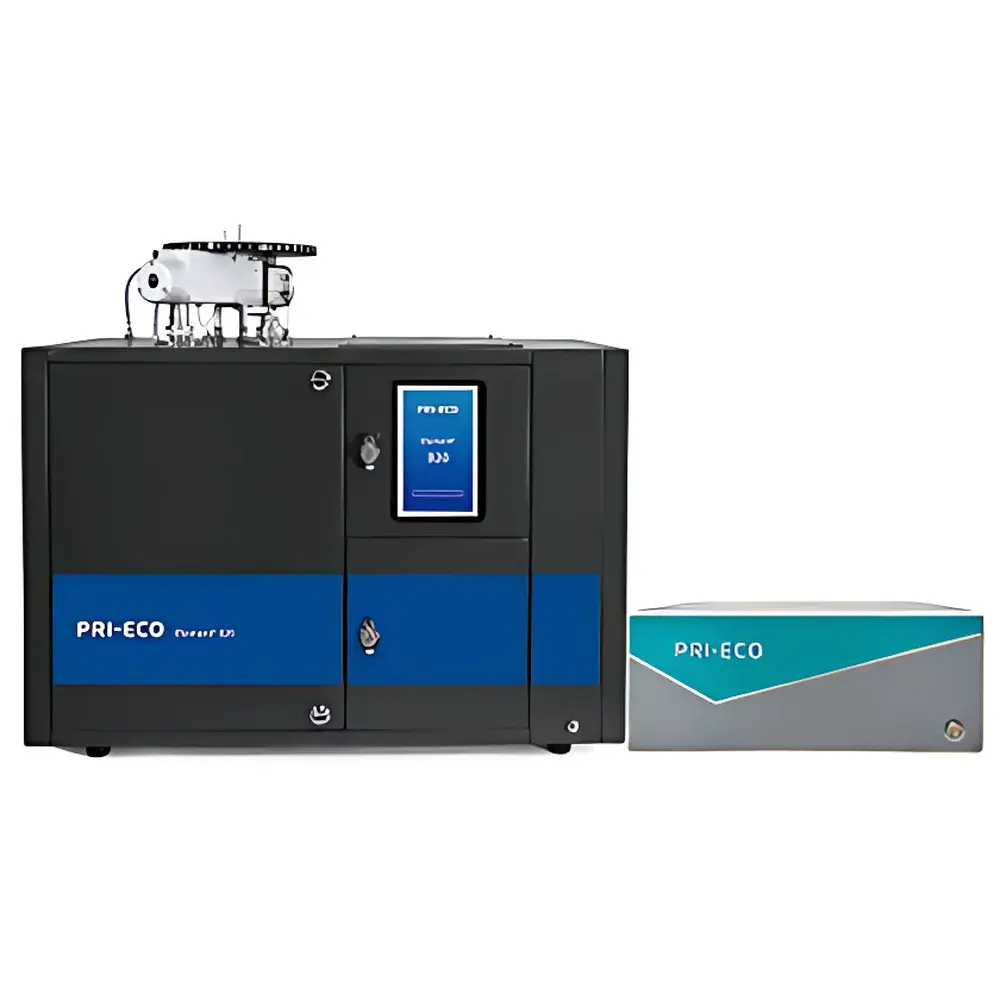
Pri-eco EA-HWG Carbon Isotope Analyzer
| Brand | Pri-eco |
|---|---|
| Origin | Beijing, China |
| Manufacturer Type | Manufacturer |
| Origin Category | Domestic |
| Model | EA-HWG |
| Price | Upon Request |
| δ¹³C Precision (1σ) | <0.1–0.2 ‰ |
| CO₂ Measurement Range | 380–10,000 ppmv |
| Measurement Frequency | 4 Hz |
| Sample Flow Rate | 0.5 mL/s |
| Measurement Cell Volume | <1 mL |
| Operating Temperature | −10 to 45 °C |
| Miniature Vacuum Pump | 100 sccm @ 50 Torr |
| Sampling Pressure | 50–133 kPa |
| Carrier Gas | Ultra-High-Purity N₂ or He |
| Combustion Gas | Ultra-High-Purity O₂ |
| Relative Humidity Tolerance | <99% RH (non-condensing at 40 °C) |
| Calibration | Fully Automated Online Calibration |
| Interface Options | RS-232, Ethernet, USB |
| Inlet/Outlet Fittings | 1/8″ Swagelok |
| Dimensions (CO₂ Analyzer) | 483 × 800 × 476 mm (W×D×H) |
| Weight | 25 kg |
| Dimensions (Elemental Analyzer) | 813 × 394 × 508 mm |
| Weight | 68 kg |
| Power Requirement | 100–240 VAC |
Overview
The Pri-eco EA-HWG Carbon Isotope Analyzer is a fully integrated, benchtop stable isotope ratio measurement system engineered for high-precision δ13C analysis of solid and liquid organic samples. It combines Dumas flash combustion—standardized for quantitative carbon quantification—with hollow waveguide (HWG) infrared laser absorption spectroscopy for real-time, high-sensitivity CO₂ isotopic detection. Unlike isotope-ratio mass spectrometry (IRMS), which relies on high-vacuum ion optics and complex gas handling, the EA-HWG operates at near-ambient pressure with a compact optical cavity (<1 mL volume), enabling rapid thermal equilibration, minimal memory effects, and robust performance across wide dynamic concentration ranges (380–10,000 ppmv CO₂). This architecture eliminates requirements for cryogenic cooling, ultra-high vacuum pumps, or dedicated electrical infrastructure—reducing both capital expenditure and long-term operational overhead by 2–3× and 5–10× respectively versus conventional EA-IRMS platforms.
Key Features
- Dumas combustion module: Optimized for complete, reproducible oxidation of diverse carbon-bearing matrices—including low-carbon soils, sediment cores, plant tissues, polymers, and purified amino acids—without catalyst degradation or incomplete burnout.
- Hollow waveguide CO₂ isotope analyzer: Utilizes tunable diode laser absorption spectroscopy (TDLAS) within a chemically inert, temperature-stabilized fused silica waveguide. Delivers δ13C precision of <0.1–0.2 ‰ (1σ) under routine laboratory conditions.
- High-throughput automation: Supports unattended operation for up to 288 samples per 24-hour cycle via programmable autosampler integration and closed-loop carrier gas management.
- Low infrastructure dependency: Operates on standard 100–240 VAC power; no liquid nitrogen, oil-free vacuum systems, or specialized grounding required.
- Real-time diagnostics & traceability: Embedded sensor suite monitors flow rate, pressure, temperature, humidity, and laser wavelength stability—logging all parameters with timestamped metadata for audit-ready data provenance.
Sample Compatibility & Compliance
The EA-HWG accommodates a broad spectrum of sample types without pre-concentration or derivatization: bulk soils (including paleosols with <0.1 wt% C), marine particulates, food authenticity standards (e.g., honey, wine, vanilla), petroleum fractions, synthetic polymers, and compound-specific isolates (e.g., GC-cut fractions post-pyrolysis or derivatization). Its humidity tolerance (<99% RH, non-condensing at 40 °C) permits direct analysis of ambient-moisture samples without inline desiccants—preserving isotopic integrity. The system complies with ISO 11260 (soil carbon isotope analysis), ASTM D6866 (biobased content testing), and supports GLP/GMP workflows through configurable user access controls, electronic signatures, and full 21 CFR Part 11–compliant audit trails when paired with validated LIMS integration.
Software & Data Management
Control and data acquisition are managed via Pri-eco’s proprietary IsoSoft v4.x platform—a Windows-based application supporting method scripting, multi-point calibration (using NIST-traceable CO₂ reference gases), drift correction algorithms, and automated δ-value calculation against user-defined standards (e.g., VPDB, IAEA-603). Raw spectral data, chromatographic traces, and environmental sensor logs are stored in HDF5 format with embedded metadata (sample ID, operator, instrument state, calibration history). Export options include CSV, Excel, and XML for third-party statistical packages (e.g., R, Python/Pandas) or enterprise LIMS. Remote monitoring and firmware updates are enabled via secure Ethernet connection with TLS 1.2 encryption.
Applications
- Ecological & biogeochemical research: Quantifying C₃/C₄ plant contributions in mixed ecosystems, tracking soil organic carbon turnover rates, and reconstructing paleoclimate from sedimentary carbonates.
- Food authenticity & traceability: Detecting adulteration in premium commodities (e.g., olive oil, maple syrup, dairy fats) via characteristic δ13C fingerprints linked to photosynthetic pathway and geographic origin.
- Petroleum geochemistry: Differentiating thermogenic vs. biogenic methane sources, assessing migration pathways, and correlating reservoir fluids using compound-class-specific δ13C patterns.
- Biomedical & proteomics: Monitoring 13C-enrichment kinetics in metabolic flux studies, validating isotopic labeling efficiency in SILAC workflows, and characterizing collagen turnover in archaeological bone.
- Materials science: Verifying carbon source attribution in graphene, carbon nanotubes, and bio-based plastics for sustainability certification and regulatory compliance (e.g., EU REACH, USDA BioPreferred).
FAQ
What sample forms are compatible with the EA-HWG?
Solid powders (soils, sediments, plant tissue), compressed pellets, liquids (oils, extracts, aqueous solutions), and encapsulated microsamples (e.g., tin capsules ≤10 mg) — all requiring no pre-drying or chemical pretreatment.
Does the system require external calibration gases?
Yes — two or more NIST-traceable CO₂ standards spanning the expected δ13C range (e.g., IAEA-603, USGS24, NBS19) are required for daily calibration; the system performs automated bracketing and drift correction.
Can the EA-HWG be coupled to a gas chromatograph?
Yes — optional GC interface kits (with cryo-focusing and pulse-combustion modules) enable compound-specific isotope analysis (CSIA) of volatile and semi-volatile organics, compliant with ASTM D8223 for environmental forensics.
Is service and technical support available outside China?
Pri-eco maintains certified field service engineers and regional application specialists across North America, Europe, and APAC, with remote diagnostics, scheduled preventive maintenance, and ISO/IEC 17025-accredited performance verification protocols.






