
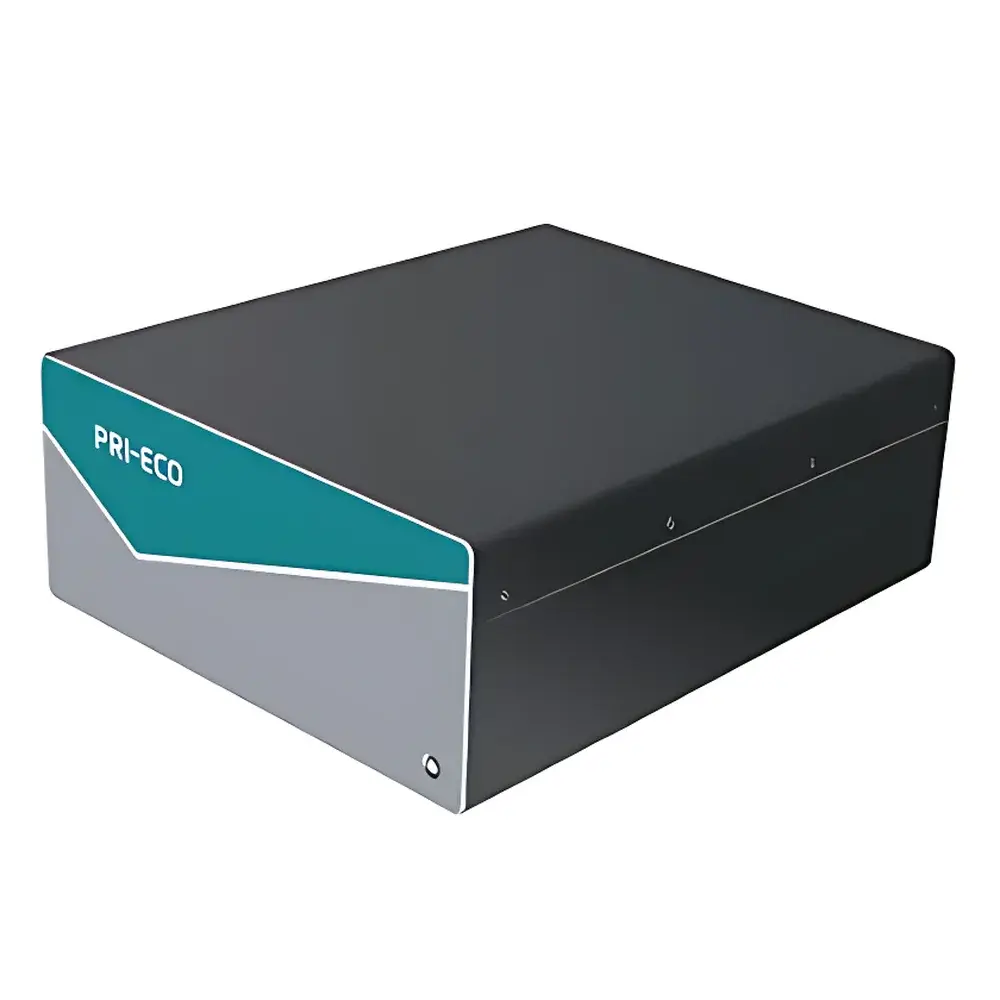
Pri-eco PRI-8300 Continuous Soil Profile CO₂ Profiling System
| Brand | Pri-eco |
|---|---|
| Origin | Beijing, China |
| Manufacturer | Yes |
| Country of Origin | China |
| Model | PRI-8300 |
| Power Consumption | 100 W |
| Input Voltage | 110–220 VAC, 50–60 Hz |
| Dimensions (H×W×D) | 43.2 × 17.8 × 44.5 cm |
| Weight | 18 kg |
| CO₂ Measurement Range | 0–10% and 0–30% (selectable) |
| CO₂ Measurement Uncertainty | < ±2% of reading |
| H₂O Measurement Range | 0–100% RH |
| Sampling Interval | 1 s |
| Response Time (10–90% / 90–10%) | 10 s |
| Number of Standard Sampling Depths | 6 channels |
| Semi-permeable Membrane Material | Polypropylene |
| Membrane Wall Thickness | 1.55 mm |
| Inner Diameter | 5.5 mm |
| Burst Pressure | ≥116 psi |
| Internal Burst Pressure | ≥36 psi |
| Transmembrane Flow Rate | 1.4 mL/(min·cm²·bar) @ 23°C (isopropanol) |
| Saturation Pressure | 15.5 psi @ 23°C (isopropanol) |
| Oil & Grease Residue in Membrane | ≤500 ppm |
| Sampling Temperature Range | −10 to +45°C (extendable to −30°C) |
| Sampling Flow Rate | 0.050 L/min at 760 Torr |
| Operating Pressure Range | 700–1000 Torr (40–133 kPa) |
| Calibration Channels | 3 (optional, customizable) |
| Sampling Method | Diffusive, membrane-based, closed-path stratified profiling |
Overview
The Pri-eco PRI-8300 Continuous Soil Profile CO₂ Profiling System is an engineered solution for high-temporal-resolution, depth-resolved monitoring of carbon dioxide concentration gradients within the soil matrix. Unlike conventional flux chambers or single-point gas samplers, the PRI-8300 implements a closed-path, multi-depth profiling architecture grounded in infrared (IR) spectroscopic absorption detection and diffusion-selective polypropylene semi-permeable membranes. This dual-technology integration enables passive, non-invasive sampling across discrete soil horizons—preserving in situ gas exchange dynamics while delivering quantitative CO₂ concentration data with sub-percent-level uncertainty. The system addresses a critical methodological gap in biogeochemical research: the scarcity of robust, long-term, vertically resolved subsurface CO₂ data required to parameterize soil respiration models, validate ecosystem carbon budgets, and interpret root-zone metabolic activity under varying moisture, temperature, and organic matter conditions.
Key Features
- Multi-channel closed-path profiling: Standard configuration supports six independent, vertically distributed sampling depths; custom configurations accommodate up to 12 layers for fine-scale horizon resolution.
- Wide-dynamic-range NDIR CO₂ analyzers: Dual-range capability (0–10% and 0–30% CO₂) ensures accurate quantification across both aerobic surface layers and anaerobic, high-CO₂ microsites (e.g., waterlogged zones or organic-rich horizons).
- Polypropylene semi-permeable membrane probes: Chemically inert, low-oil-residue (<500 ppm) membranes with precisely controlled wall thickness (1.55 mm), inner diameter (5.5 mm), and pressure tolerance (burst ≥116 psi) ensure long-term mechanical stability and selective CO₂ diffusion while excluding particulates, condensate, and non-volatile organics.
- Diffusion-limited, zero-pump sampling: Eliminates active suction artifacts and pressure-induced soil disturbance; flow rate stabilized at 0.050 L/min (760 Torr) without inline filtration or desiccation requirements.
- Real-time, high-frequency acquisition: 1-second measurement interval with <10-second 10–90% response time enables capture of diel cycles, pulse events following rainfall or root exudation, and transient redox transitions.
- Ruggedized field deployment design: Operating temperature range of −10 to +45°C (extendable to −30°C), IP54-rated enclosure, and modular cabling support unattended operation in remote terrestrial ecosystems for >12 months.
Sample Compatibility & Compliance
The PRI-8300 is compatible with mineral soils, organic peats, volcanic ash, permafrost-affected substrates, and rhizosphere-influenced profiles. Its membrane-based sampling strategy eliminates clogging in clay-rich or high-OM soils where traditional porous-tube systems fail. All wetted components comply with ISO 8573-1 Class 4 for hydrocarbon content, and membrane manufacturing adheres to ASTM D882 tensile strength and ASTM D1248 resin purity standards. Data acquisition meets GLP-aligned traceability requirements: each measurement timestamp includes embedded sensor diagnostics, ambient pressure/temperature compensation flags, and hardware-level audit logs. While not FDA 21 CFR Part 11 certified out-of-the-box, the system’s raw data structure (CSV + JSON metadata bundles) supports validated integration into LIMS or ELN platforms compliant with 21 CFR Part 11 and ISO/IEC 17025 workflows.
Software & Data Management
Acquisition and visualization are managed via Pri-eco’s SoilProfile Suite v3.x—a cross-platform desktop application supporting real-time channel synchronization, automated baseline drift correction using three-point calibration (zero/span/intermediate), and depth-wise gradient calculation (d[CO₂]/dz). Raw data exports include calibrated CO₂ (ppm or %), H₂O (%RH), absolute pressure (Torr), and probe-specific thermal drift coefficients. Time-series datasets conform to CF (Climate and Forecast) Metadata Conventions v1.8, enabling direct ingestion into Python (xarray), R (ncdf4), or MATLAB netCDF toolboxes. Remote firmware updates, SD-card failover logging, and optional LTE telemetry modules support scalable networked deployments across watershed or continental-scale observatories.
Applications
- Ecosystem-scale carbon cycling studies: Quantifying vertical CO₂ production profiles to distinguish heterotrophic vs. autotrophic respiration contributions.
- Root physiology and rhizosphere dynamics: Monitoring CO₂ pulses linked to diurnal root exudation, mycorrhizal activity, or nitrate reduction hotspots.
- Agroecosystem management: Evaluating tillage effects, cover crop impacts, and fertilizer placement on subsurface gas transport and microbial respiration efficiency.
- Permafrost and cryosol research: Tracking CO₂ accumulation and release during freeze-thaw cycles in Arctic and alpine soils.
- Soil health assessment: Correlating CO₂ gradient shape (e.g., exponential decay vs. mid-profile maxima) with porosity, macropore continuity, and redox zonation.
- Model validation and parameterization: Providing high-resolution boundary condition data for HYDRUS-1D, CENTURY, or CLM-Soil biogeochemistry modules.
FAQ
How does the semi-permeable membrane prevent biofouling and water ingress?
The polypropylene membrane’s hydrophobic surface (contact angle >100°) and controlled pore tortuosity inhibit liquid water penetration while permitting gaseous CO₂ diffusion. Field trials across 24-month deployments in tropical Ultisols and temperate Mollisols showed no measurable permeability decline or microbial colonization.
Can the system operate autonomously for extended periods without maintenance?
Yes—standard configuration supports >6 months of continuous operation on a 12V DC auxiliary battery bank (not included); internal diagnostics flag membrane saturation or analyzer drift before measurement uncertainty exceeds ±2.5%.
Is depth calibration required after installation?
No—each probe is factory-laser-marked with depth index; vertical positioning is verified using integrated inclinometer and GPS-synchronized time stamps during deployment.
What data formats are supported for integration with third-party modeling tools?
Native export as CF-compliant netCDF4 files; optional ASCII CSV with ISO 8601 timestamps, SI units, and embedded QA/QC flags (e.g., “pressure_out_of_range”, “membrane_saturation_warning”).
Does the system meet international soil gas monitoring standards?
It aligns with ISO 18512:2017 (soil gas sampling principles), ASTM D5267-22 (subsurface vapor intrusion protocols), and the FAO Global Soil Laboratory Network (GLOSOLAN) recommended practices for profile-based CO₂ monitoring.
Related Products







