
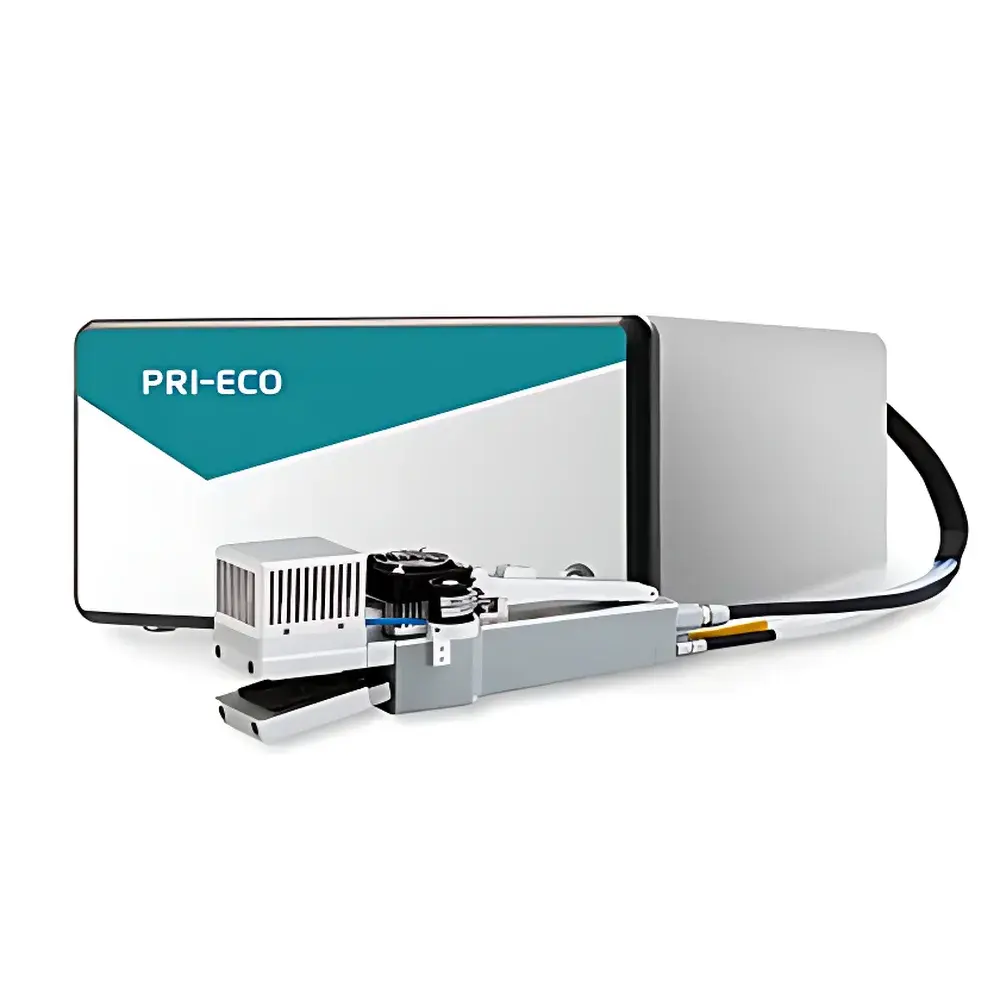
Pri-eco IPS-1000 Portable Isotope-Based Photosynthesis Measurement System
| Brand | Pri-eco |
|---|---|
| Origin | Beijing, China |
| Manufacturer Type | Original Equipment Manufacturer (OEM) |
| Model | IPS-1000 |
| CO₂ Range | 0–3000 ppmv |
| δ¹³C Precision | <0.2 ‰ @ 1 s, 0.03 ‰ @ 60 s |
| δ¹⁸O Precision | <0.2 ‰ @ 1 s, 0.03 ‰ @ 60 s |
Overview
The Pri-eco IPS-1000 Portable Isotope-Based Photosynthesis Measurement System is a field-deployable, high-resolution instrumentation platform engineered for simultaneous, real-time quantification of carbon and oxygen isotope discrimination (δ¹³C and δ¹⁸O) alongside conventional gas exchange parameters during leaf-level photosynthesis. Unlike conventional infrared gas analyzers (IRGAs) or tunable diode laser absorption spectrometers (TDLAS) optimized solely for bulk CO₂ concentration, the IPS-1000 integrates cavity-enhanced absorption spectroscopy (CEAS) with dual-channel isotopic detection and tightly coupled environmental control to resolve isotopic fluxes at sub-second temporal resolution. This enables direct observation of kinetic isotope effects associated with Rubisco carboxylation, photorespiration, stomatal conductance, and mesophyll diffusion—parameters critical for mechanistic modeling of plant water-use efficiency (WUE), intrinsic WUE (iWUE), and carbon allocation strategies under abiotic stress. The system operates across ambient temperature (−10 °C to 45 °C), pressure (300–1000 Torr), and humidity gradients without external drying or scrubbing, preserving natural isotopic signatures in sampled air streams.
Key Features
- Simultaneous measurement of δ¹³C and δ¹⁸O in CO₂ at 1 Hz sampling frequency, with long-term stability supported by six-channel automated calibration using certified reference gases (NIST-traceable standards)
- Integrated LED light source (IPS-1000-02) delivering programmable spectral irradiance: red (660 nm), blue (453 nm), green (523 nm), and white; maximum PAR output >2500 μmol m⁻² s⁻¹ at 25 °C with <5 W power draw at 2000 μmol m⁻² s⁻¹
- Active leaf chamber (3 × 3 cm²) with ±0.5 °C temperature control accuracy, real-time monitoring of leaf and air temperature (±0.1 °C typical error), and programmable CO₂ injection (0–10,000 ppmv at 500 mL/min)
- Dual-mode gas flow architecture: low-flow (<0.3 L/min at 760 Torr) for minimal disturbance to leaf boundary layer; high-flow mode (up to 1500 mL/min) for rapid response kinetics and CO₂ response curve generation
- Onboard Intel Core processor, 8 GB RAM, 256 GB SSD, and tablet-based UI with touchscreen interface for field operation; communication via RS-232, Ethernet, and USB 3.0
Sample Compatibility & Compliance
The IPS-1000 supports broad leaf morphotypes—including monocot and dicot species, succulents, epiphytes, and conifer needles—via interchangeable chamber adapters and non-invasive clamping mechanisms. Its open-path design eliminates filter-induced isotopic fractionation artifacts common in closed-loop systems. All firmware and data logging modules comply with GLP-aligned audit trail requirements, including timestamped metadata, operator ID tagging, and immutable raw signal storage. While not FDA 21 CFR Part 11-certified out-of-the-box, the system’s data export structure (CSV/NetCDF) and metadata schema align with ISO 20613:2019 (plant phenotyping data exchange) and ASTM E2912-22 (standard guide for stable isotope ratio mass spectrometry data reporting). Calibration protocols follow ISO 17025 principles for traceability to NIST SRM 1666b (CO₂ in air) and USGS40/USGS41 (δ¹³C and δ¹⁵N reference materials adapted for CO₂ isotopic analysis).
Software & Data Management
The proprietary IPS Control Suite provides integrated acquisition, visualization, and post-processing tools for isotopic gas exchange. It supports automated generation of A/Ci curves, light response (A/PAR) curves, and isotopic response surfaces (e.g., δ¹³C vs. intercellular CO₂ concentration). Raw absorption spectra are stored with full spectral resolution (0.001 cm⁻¹), enabling retrospective reprocessing with updated baseline correction or line-fitting algorithms. Export formats include time-stamped CSV with column headers compliant with FAIR data principles (Findable, Accessible, Interoperable, Reusable), as well as NetCDF4 for integration with R (isoR, rSIP), Python (PyIsotopomer), and MATLAB-based ecosystem modeling frameworks. Audit logs record all parameter changes, calibration events, and user actions with cryptographic hashing to ensure data integrity.
Applications
- Mechanistic studies of photosynthetic acclimation to drought, elevated CO₂, and heat stress through concurrent δ¹³C and δ¹⁸O discrimination analysis
- High-throughput screening of crop germplasm for intrinsic water-use efficiency (iWUE) and carbon isotope discrimination (Δ¹³C) as proxy traits in breeding programs
- Field-based validation of land surface models (e.g., CLM, ORCHIDEE) requiring leaf-scale isotopic flux constraints
- Ecophysiological investigations of C₃/C₄/CAM pathway plasticity across microhabitats and successional gradients
- Stable isotope tracing experiments using ¹³C-labeled CO₂ pulses to quantify short-term carbon assimilation and respiratory release dynamics
FAQ
What isotopic species does the IPS-1000 measure directly, and how are they resolved?
The system measures δ¹³C and δ¹⁸O in CO₂ via high-finesse optical cavity absorption at near-infrared wavelengths (2.06 μm and 2.73 μm), resolving isotopologue-specific rovibrational transitions with no chemical conversion or cryogenic trapping required.
Can the IPS-1000 operate unattended in remote field sites?
Yes—the instrument supports 12–24 V DC input, optional solar-charged battery packs, and scheduled measurement protocols with internal clock synchronization; data are buffered locally and can be retrieved via Ethernet or USB.
Is calibration traceable to international standards?
All calibrations use NIST-traceable CO₂-in-air standards (SRM 1666b) and secondary references calibrated against USGS40/USGS41; calibration certificates include uncertainty budgets per ISO/IEC 17025.
Does the system support custom light treatment protocols?
Yes—the IPS Control Suite allows scripting of dynamic light intensity ramps, spectral composition shifts, and pulsed illumination sequences synchronized with isotopic acquisition.
How is water vapor interference corrected during δ¹⁸O measurement?
Real-time H₂O concentration is measured concurrently using a dedicated photothermal spectroscopic channel; cross-sensitivity corrections are applied using empirically derived water vapor correction coefficients embedded in the spectral fitting algorithm.




