
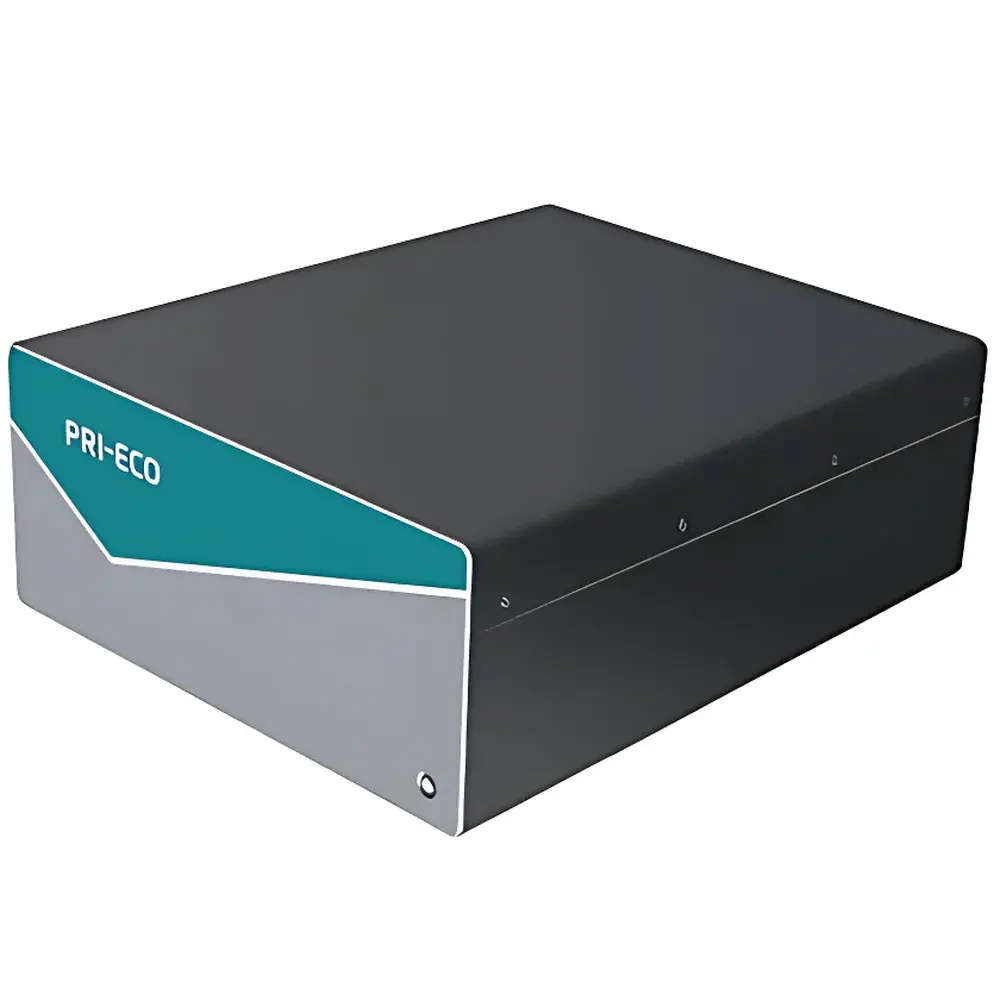
Pri-eco PRI-732 CO₂/CH₄/N₂O/H₂O Trace Gas Analyzer
| Brand | Pri-eco |
|---|---|
| Origin | Beijing, China |
| Manufacturer Type | Original Equipment Manufacturer (OEM) |
| Model | PRI-732 |
| Detection Principle | Mid-infrared Quantum Cascade Laser (QCL) coupled with Photoacoustic Spectroscopy (PAS) |
| Accuracy | ±1% of reading or LOD (whichever is greater) |
| Measurable Gases | CO₂, CH₄, N₂O, H₂O |
| Response Time (T90) | < 10 s |
| Repeatability | ±1% of reading or LOD (whichever is greater) |
| Measurement Cell Volume | 1 mL |
| Gas Consumption | < 80 mL/min |
| Power Consumption | 75 W |
| Weight | 15 kg |
| Output Interfaces | Ethernet, Modbus TCP/IP & RTU, USB |
| Operating Temperature | −10 to +45 °C |
| Relative Humidity | < 99% RH (non-condensing) |
| Detection Limits (LoD) | CO₂: 1 ppm, CH₄: 0.4 ppm, N₂O: 0.15 ppm, H₂O: 0.01 % (100 ppm) |
Overview
The Pri-eco PRI-732 CO₂/CH₄/N₂O/H₂O Trace Gas Analyzer is an engineered solution for high-sensitivity, multi-species greenhouse gas monitoring in field-deployable and industrial process environments. It leverages the physical synergy between mid-infrared quantum cascade lasers (QCLs) and laser photoacoustic spectroscopy (LPAS) — a detection methodology rooted in the photothermal effect first described by Alexander Graham Bell in 1880. In this configuration, tunable QCL light at characteristic absorption lines (e.g., 4.23 µm for CO₂, 7.7 µm for CH₄, 4.5 µm for N₂O, and 2.7 µm for H₂O) is directed into a resonant acoustic cell. Target molecules absorb photons, undergo vibrational relaxation, and generate localized heating pulses that induce pressure waves. These acoustic signals are detected by a low-noise, MEMS-based microphone — eliminating optical detectors, mirrors, or beam alignment requirements. This architecture inherently rejects zero drift, provides intrinsic background-free measurement, and ensures long-term baseline stability without routine optical recalibration.
Key Features
- Multi-gas quantification of CO₂, CH₄, N₂O, and H₂O in a single compact platform with simultaneous real-time output
- Measurement cell volume of only 1 mL — minimizing sample consumption (< 80 mL/min), reducing memory effects, and enabling rapid gas exchange for high temporal resolution
- True zero-drift operation due to PAS’s background-free nature: no signal is generated in the absence of analyte, eliminating baseline drift from optical misalignment or window fouling
- No optical components in the detection path — robust against vibration, particulate contamination, and thermal shock; no collimation or mirror maintenance required
- Linear dynamic range spanning six orders of magnitude — capable of detecting concentrations from sub-ppb (e.g., CH₄ LoD = 0.4 ppm) to percent-level (H₂O up to 6 %) without hardware reconfiguration or range switching
- Acoustically optimized resonant cell design enables T90 response time 10 Hz, suitable for eddy covariance flux studies and fast transient emission monitoring
- Low-power architecture (75 W nominal) and 15 kg mass support mobile deployment, vehicle-mounted installations, and unattended operation in remote sites
Sample Compatibility & Compliance
The PRI-732 accepts raw, unconditioned sample streams within specified environmental limits: inlet gas temperature from −10 to +45 °C and relative humidity < 99 % RH (non-condensing). No external drying, filtering, or dilution is required for standard operation — significantly reducing system complexity and failure points. The analyzer complies with fundamental metrological principles outlined in ISO/IEC 17025 for testing laboratories and supports traceability to NIST-traceable gas standards. Its stable, calibration-interval design aligns with EPA Method TO-15 and ISO 13864 recommendations for continuous emissions monitoring systems (CEMS). While not certified for safety-critical SIL applications, its architecture meets functional safety expectations for environmental QA/QC, research-grade flux towers, and industrial stack monitoring under GLP-aligned workflows.
Software & Data Management
Data acquisition and instrument control are managed via embedded Linux firmware with dual-mode interface support: Modbus TCP/IP and RTU (for integration into SCADA and DCS platforms), plus native Ethernet and USB for local diagnostics and firmware updates. The included Pri-eco DataLink software provides real-time concentration plots, alarm thresholds, event logging, and CSV export with timestamped metadata (including internal pressure, cell temperature, and laser current). All data records include audit-trail-capable timestamps and are stored with immutable write-once attributes — supporting compliance with FDA 21 CFR Part 11 requirements when deployed in regulated environmental reporting contexts. Remote access is enabled via secure SSH or HTTPS, with configurable user roles and password-protected configuration changes.
Applications
- Atmospheric flux measurements using eddy covariance or relaxed eddy accumulation techniques
- Continuous emissions monitoring (CEM) at biogas upgrading plants, landfills, wastewater treatment facilities, and cement kilns
- Soil respiration and chamber-based ecosystem GHG flux studies in agricultural and ecological research
- Process optimization and leak detection in carbon capture utilization and storage (CCUS) pilot systems
- Calibration transfer and reference standard verification for open-path FTIR and CRDS instruments
- Mobile monitoring on UAVs, ground vehicles, or backpack platforms for spatially resolved urban or industrial plume mapping
FAQ
Does the PRI-732 require periodic optical recalibration?
No — the photoacoustic detection principle is intrinsically background-free and does not rely on optical alignment or detector responsivity tracking. Calibration is performed using certified gas standards at user-defined intervals (typically annually under stable operating conditions).
Can the analyzer operate in high-humidity environments without condensation?
Yes — it tolerates up to 99 % RH provided the sample gas remains below its dew point. Optional integrated thermoelectric cooling or Nafion dryers can be added upstream if ambient conditions approach saturation.
Is cross-sensitivity between CO₂, CH₄, N₂O, and H₂O compensated in real time?
Yes — spectral interference is mitigated through multi-wavelength QCL tuning and multivariate regression algorithms embedded in the firmware, trained on empirical mixture spectra across the full dynamic range.
What is the recommended maintenance schedule?
Routine maintenance consists of quarterly inlet filter replacement and annual verification with span gases. No optical cleaning, laser realignment, or microphone servicing is required under normal operation.
Can the PRI-732 be integrated into third-party data acquisition systems?
Yes — Modbus TCP/IP and RTU protocols enable seamless integration with LabVIEW, Ignition SCADA, Python-based DAQ frameworks, and commercial CEMS software suites.
Related Products







