
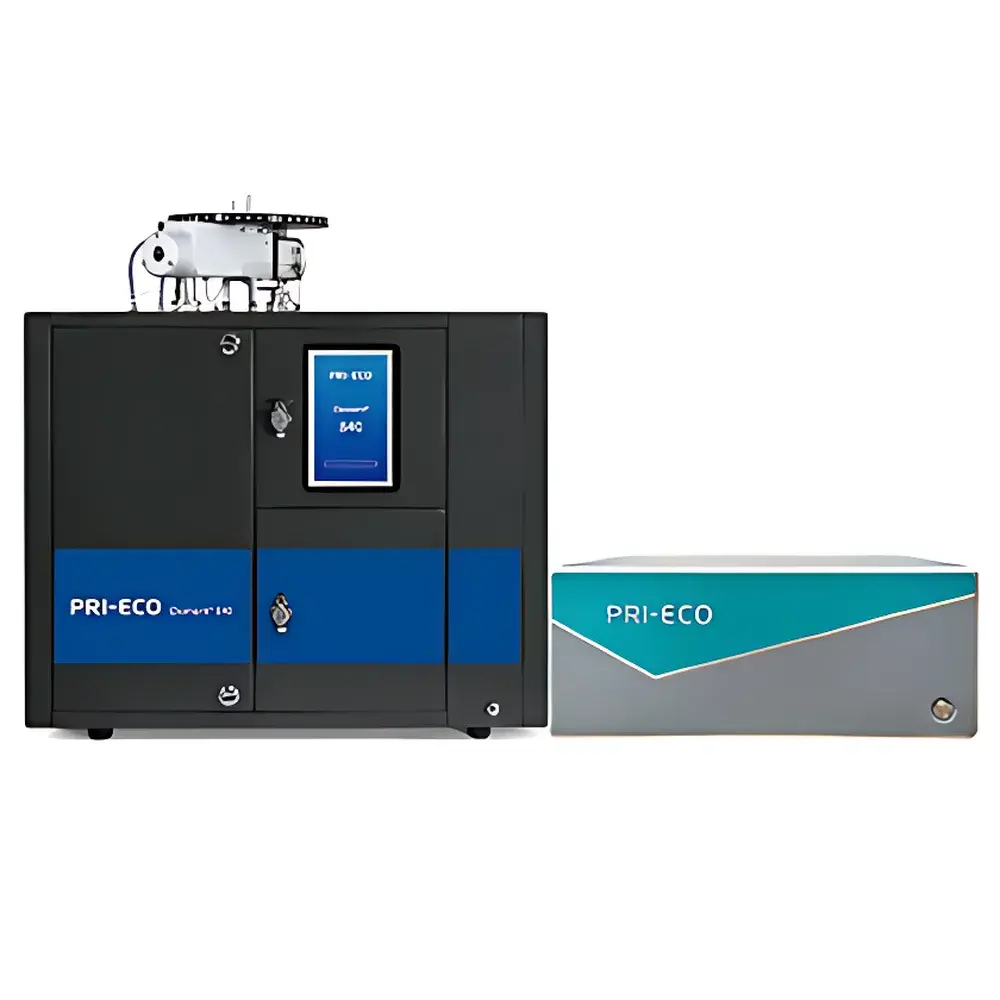
Pri-eco EA-MIR Carbon Isotope Analyzer
| Brand | Pri-eco |
|---|---|
| Origin | Beijing, China |
| Manufacturer Type | Manufacturer |
| Origin Category | Domestic |
| Model | EA-MIR |
| Pricing | Upon Request |
Overview
The Pri-eco EA-MIR Carbon Isotope Analyzer is a fully integrated, benchtop analytical system that combines the Element5 elemental analyzer with a mid-infrared (MIR) laser absorption spectrometer for high-precision δ13C (and optionally δ18O) isotopic ratio analysis. Unlike traditional isotope ratio mass spectrometry (IRMS), which relies on comparative response calibration against reference gases and complex vacuum systems, the EA-MIR employs direct, quantitative measurement of CO2 isotopologues via tunable MIR laser absorption spectroscopy (MIRLAS). This physics-based, absolute detection method eliminates dependency on gas standard drift and inter-laboratory calibration transfer—enhancing data traceability and long-term reproducibility. The system performs complete carbon isotope analysis from solid, liquid, or gaseous samples through high-temperature, oxygen-rich Dumas-style flash combustion in the Element5 module, followed by real-time, non-dispersive spectral quantification of 12CO2, 13CO2, and 16O12C16O/18O12C16O in the MIR unit. Designed for routine laboratory environments—not specialized isotope labs—the EA-MIR delivers IRMS-grade accuracy at significantly lower acquisition, operational, and maintenance cost.
Key Features
- Integrated Dumas combustion + MIR laser absorption architecture enabling end-to-end δ13C analysis without external gas standards or cryogenic traps
- Direct, calibration-free isotopic quantification based on fundamental spectroscopic cross-sections and Beer–Lambert law compliance
- High-throughput capability: up to 150 samples per day using the standard 50-position autosampler (expandable to 99 or 148 positions)
- Multi-phase sample compatibility: solids (soil, plant tissue, food powders), liquids (water, acids, organic solvents), and gases (CO2, CH4)—all analyzed using the same optical path
- Optional acid-digestion pre-treatment module for inorganic carbon (IC/DIC) isotope analysis in carbonates, sediments, or aqueous matrices
- Robust thermal and humidity management: operational range −10 °C to 45 °C; humidity tolerance up to 99 % RH (non-condensing)
- Comprehensive elemental analysis capability: simultaneous C/N/H/S/O quantification with 99.9 %)
Sample Compatibility & Compliance
The EA-MIR accommodates diverse sample types across environmental, life science, and geochemical disciplines—including bulk organic matter, dissolved inorganic carbon (DIC) in seawater, carbonate minerals, biofluids, food authenticity markers, and petroleum-derived hydrocarbons. Sample introduction requires minimal preparation: solids ≥400 μg C for optimal δ13C precision; liquids are introduced via sealed vials or syringe injection; gases flow directly into the MIR cell. All combustion and spectroscopic modules operate under ISO/IEC 17025-aligned procedural controls. Data integrity complies with FDA 21 CFR Part 11 requirements when used with audit-trail-enabled software configurations. System validation supports GLP and GMP workflows, particularly in food origin verification and clinical stable-isotope tracer studies.
Software & Data Management
The proprietary EA-MIR Control Suite provides instrument control, real-time spectral visualization, automated baseline correction, peak integration, and δ-value calculation per IUPAC-defined conventions (VPDB scale). Raw absorbance spectra, time-resolved concentration traces, and metadata (sample ID, operator, timestamp, ambient conditions) are stored in vendor-neutral HDF5 format. Export options include CSV, Excel, and XML for LIMS integration. The software supports multi-user role-based access, electronic signatures, and full audit trail logging—including parameter changes, calibration events, and result reprocessing history—to meet regulatory documentation requirements.
Applications
- Food authenticity and geographical origin tracing (e.g., honey, olive oil, wine, dairy)
- Soil organic carbon turnover and microbial respiration studies (δ13C-CO2 evolution kinetics)
- Oceanic DIC cycling and paleoclimate proxy development (foraminifera, corals)
- Metabolic flux analysis in proteomics and cell culture (using 13C-labeled substrates)
- Petroleum source rock characterization and biodegradation assessment
- Forensic isotopic fingerprinting of illicit drugs and explosives
- Carbon sequestration monitoring (CCUS projects) via soil and vegetation δ13C baseline mapping
FAQ
How does EA-MIR achieve higher reliability than IRMS for δ13C measurements?
It uses absolute, physics-based quantification of isotopologue concentrations via MIRLAS—eliminating reliance on reference gas stability, electron multiplier aging, or mass discrimination corrections inherent to IRMS.
Can the system measure both δ13C and δ18O simultaneously?
Yes—when configured with dual-wavelength MIR lasers and calibrated for CO2 isotopologues, the system reports both ratios from a single combustion event.
Is acid digestion required for carbonate analysis?
Yes—an optional acid-digestion module is available to convert CaCO3 or other carbonates to CO2 prior to MIR analysis.
What is the minimum carbon mass required for sub-0.1 ‰ δ13C precision?
≥400 μg C in solid or liquid samples ensures typical precision of 0.1–0.2 ‰; gaseous CO2 achieves 0.03 ‰ at 60-second integration.
Does the system support remote monitoring or networked operation?
Yes—Ethernet connectivity enables remote diagnostics, scheduled runs, and centralized data aggregation in multi-instrument laboratories.






