
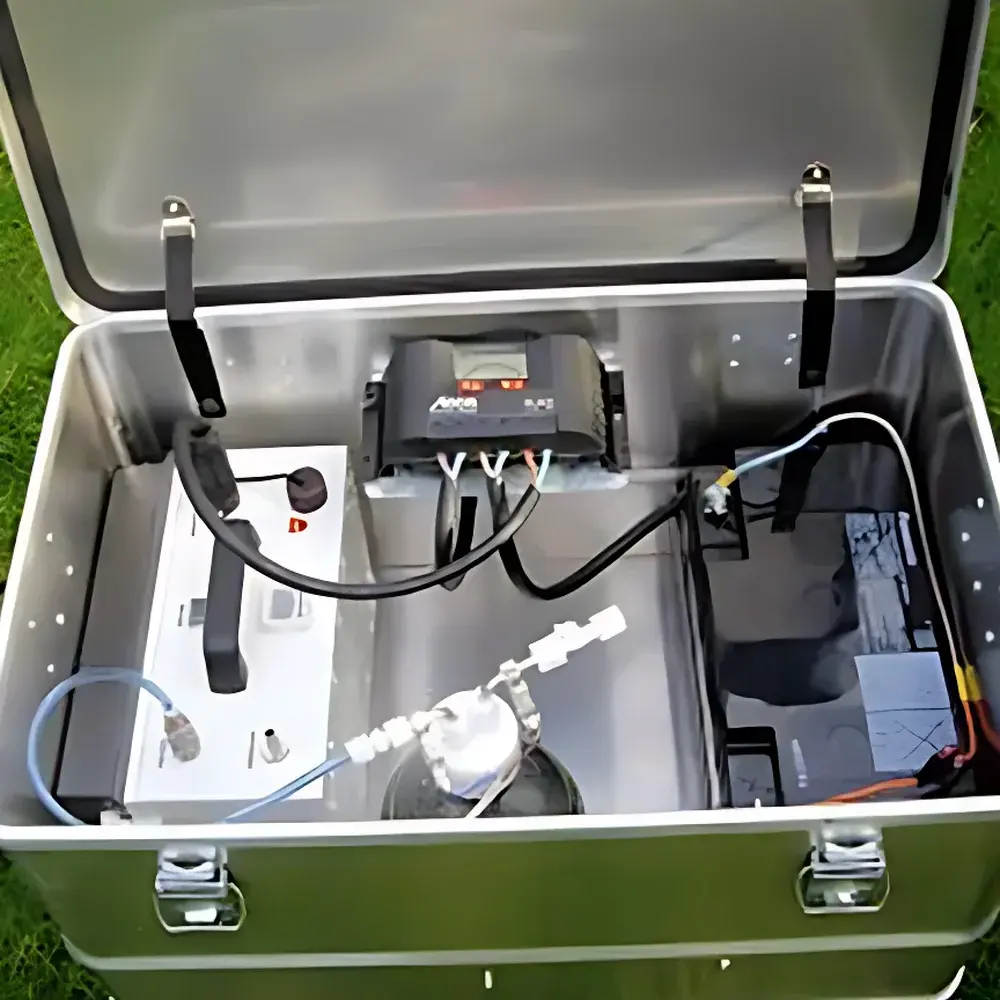
Pri-eco PRENART Soil Water Sampling System
| Brand | Pri-eco |
|---|---|
| Model | PRENART |
| Origin | Beijing, China |
| Manufacturer Type | Direct Manufacturer |
| Vacuum Range | –850 mbar |
| Compressor Output | 2.5 bar |
| Pumping Speed | 7.2 L/min at 0 bar |
| Power Supply | 12 V / 3.4 Ah |
| Power Consumption | 22 W |
| Dimensions | 300 × 200 × 180 mm |
| Weight | 5.6 kg |
| Ingress Protection | IP65 |
| Manual Vacuum Pump Displacement | 36 cm³/stroke |
| Sampler Probe Material | PTFE + quartz powder or stainless steel powder |
| Probe Outer Diameter | 21 mm |
| Probe Length | 95 mm |
| Probe Weight | 50 g |
| Porous Surface Area | 33 cm² |
| Hydraulic Conductivity | 3.31 × 10⁻⁷ cm/s |
| Bubble Point Pressure | >500 mbar |
| Water Extraction Rate | 6 mL/cm²/hr at 600 mbar |
| Pore Size | 2 µm |
Overview
The Pri-eco PRENART Soil Water Sampling System is a field-deployable, low-disturbance suction lysimeter system engineered for quantitative collection of soil solution across diverse pedological and hydrological settings. It operates on the principle of controlled negative pressure (suction) applied to a porous ceramic or PTFE-quartz matrix embedded in situ, enabling equilibrium-based extraction of pore water without mechanical displacement or preferential flow artifacts. Designed for long-term monitoring and discrete sampling campaigns, the system maintains stable vacuum conditions under variable field temperatures and soil moisture regimes, supporting compliance with ISO 10381-5 (soil sampling—part 5: guidance on sampling of soil solution) and ASTM D4448 (standard guide for sampling groundwater). Its compact, battery-powered architecture and IP65-rated enclosure ensure operational integrity during extended unattended deployment in rain, dust, frost, or high-humidity environments.
Key Features
- Integrated dual-mode vacuum generation: automatic diaphragm compressor (2.5 bar output) plus manual piston pump (36 cm³/stroke) for redundancy and field flexibility
- LCD digital pressure transducer with real-time display and ±5 mbar accuracy over –10 to –850 mbar range
- Rapid equilibration performance: achieves –600 mbar vacuum in ≤23 seconds for standard 2 L collection vessels
- Robust mechanical design: aluminum alloy chassis, reinforced polymer housing, and vibration-damped mounting for transport and installation stability
- Low-power operation: 22 W nominal draw from 12 V / 3.4 Ah rechargeable battery, supporting ≥8 hours continuous use per charge
- Field-serviceable components: modular probe interface, tool-less filter cartridge replacement, and sealed electrical connectors rated to IP65
Sample Compatibility & Compliance
The PRENART probe utilizes a sintered PTFE–quartz or stainless-steel powder matrix (2 µm nominal pore size, bubble point >500 mbar), ensuring compatibility with clay-, loam-, and sandy-textured soils while minimizing clogging and biofouling. Each probe undergoes individual hydraulic conductivity verification (3.31 × 10⁻⁷ cm/s at 20 °C) and leak-testing prior to shipment. The system supports trace-metal-clean sampling protocols when paired with certified low-leach polyethylene or fluorinated ethylene propylene (FEP) collection bottles. Analyte detection limits meet requirements for EPA Method 300.0 (anions), EPA Method 200.8 (metals), and ISO 17294-2 (ICP-MS), with documented recoveries for Al, Mn, B, Na, NH₄-N, NO₃-N, Ca, Cu, Fe, K, Mg, Zn, PO₄-P, SO₄-S, Cl⁻, F⁻, and total organic carbon within ±5% of certified reference materials.
Software & Data Management
While the base PRENART system operates as a standalone analog instrument, optional Bluetooth-enabled data loggers (sold separately) provide timestamped vacuum pressure logging at user-defined intervals (1 min to 24 h resolution). Exported CSV files are compatible with LIMS platforms and support audit trails compliant with FDA 21 CFR Part 11 when deployed with electronic signature modules. All firmware updates and calibration logs are stored locally and retrievable via micro-USB interface. No cloud dependency or proprietary software installation is required for core functionality.
Applications
- Long-term solute flux monitoring in agricultural, forested, and reclaimed mine soils
- Nitrogen and phosphorus leaching studies under variable irrigation or rainfall regimes
- Heavy metal mobility assessment in contaminated site characterization (e.g., near landfill leachate plumes)
- Isotopic tracer experiments (δ¹⁸O, δ²H, ⁸⁷Sr/⁸⁶Sr) requiring undisturbed pore-water chemistry
- Calibration and validation of vadose zone numerical models (e.g., HYDRUS-1D, STANMOD)
- Regulatory compliance sampling for groundwater protection zones and nutrient management plans
FAQ
What vacuum range is achievable, and how is stability maintained during extended deployments?
The system delivers and sustains –850 mbar vacuum using a closed-loop pressure control algorithm. An integrated PID-regulated solenoid valve modulates compressor duty cycle to compensate for minor leaks or temperature-induced pressure drift.
Can probes be installed at depths exceeding 1 m, and what installation tools are included?
Yes—probes are rated for burial up to 3 m depth. The standard kit includes a stainless-steel probe driver, torque-limited insertion rod, and depth-marked installation sleeve to ensure consistent burial angle and minimal soil disturbance.
How often must the porous matrix be cleaned or replaced?
Under typical field conditions, cleaning with dilute HCl (0.1 M) followed by deionized water rinse restores >95% hydraulic conductivity after 12 months of continuous use. Replacement is recommended after 36 months or following exposure to highly colloidal or iron-rich groundwater.
Is the system compatible with automated weather stations or SCADA networks?
Yes—via optional 4–20 mA analog output module or Modbus RTU interface, enabling integration into existing environmental monitoring infrastructure without middleware.
Does Pri-eco provide method validation documentation for regulatory submissions?
Yes—each system shipment includes a Certificate of Conformance, probe-specific hydraulic test reports, and a SOP-aligned validation package aligned with ISO/IEC 17025 requirements for field sampling equipment.







