
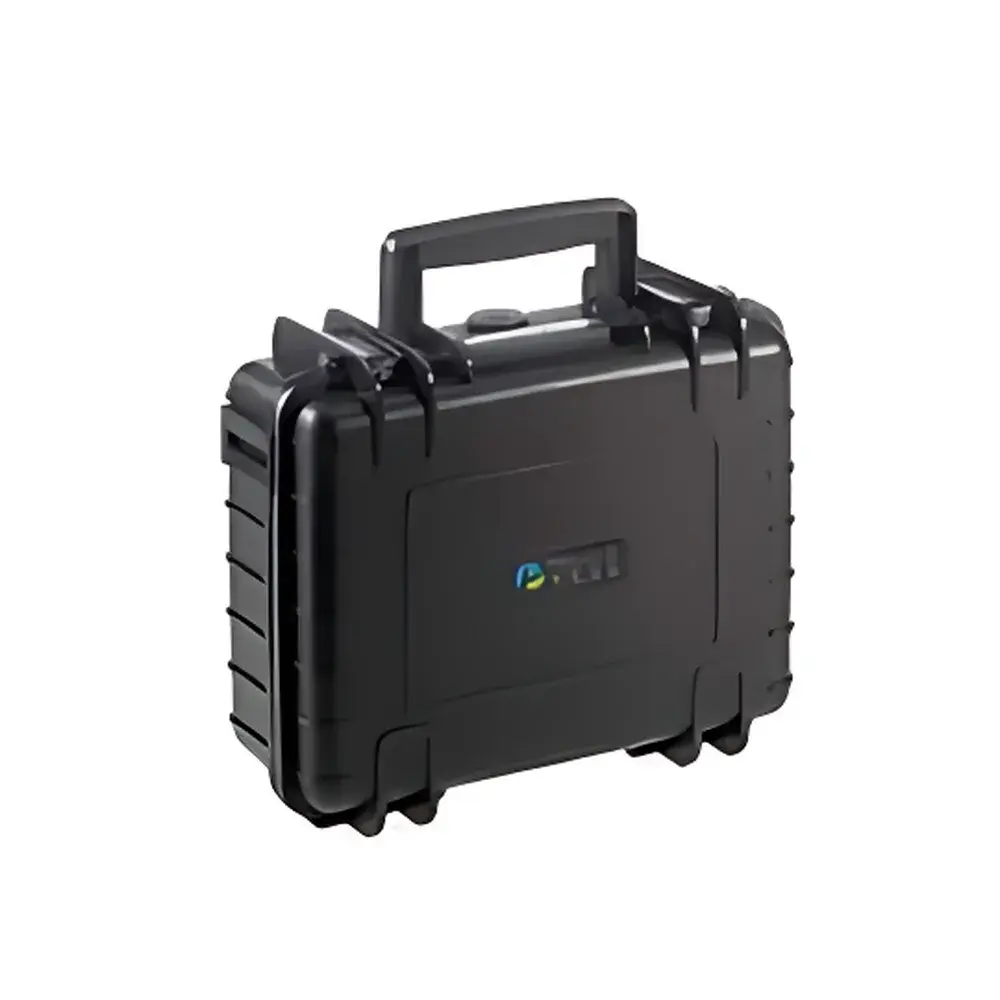
Pri-eco AirPlus CO2/N2O/H2O Analyzer
| Brand | Pri-eco |
|---|---|
| Model | AirPlus |
| Detection Principle | Mid-Infrared Laser Absorption Spectroscopy (MIRLAS) |
| Measured Gases | CO₂, N₂O, H₂O |
| CO₂ Range | 0–3500 ppm |
| N₂O Range | 0–500 ppb |
| H₂O Range | 0–3% |
| Precision (1s) | 0.25 ppm CO₂, 0.25 ppb N₂O, 50 ppm H₂O |
| Precision (5s) | 0.12 ppm CO₂, 0.12 ppb N₂O, 40 ppm H₂O |
| Precision (5 min) | 0.012 ppm CO₂, 0.012 ppb N₂O, 10 ppm H₂O |
| Sample Flow Rate | ~180 mL/min (optional 1000 mL/min pump) |
| Operating Temperature | −10 to +45 °C |
| Relative Humidity Limit | <99% RH, non-condensing |
| Power Consumption | 15 W (steady-state) |
| Dimensions | 29 cm × 20 cm × 9.5 cm |
| Weight | 2.75 kg |
| Response Rate | 1 or 2 Hz |
| Data Interfaces | Wi-Fi, USB, RS-232 |
| Optional Outputs | Analog (4–20 mA), GPS module |
| Battery Life | 6 hours (internal Li-ion) |
Overview
The Pri-eco AirPlus CO₂/N₂O/H₂O Analyzer is a field-deployable, high-fidelity trace gas analyzer engineered for continuous, real-time quantification of carbon dioxide (CO₂), nitrous oxide (N₂O), and water vapor (H₂O) in ambient air and eddy covariance applications. It employs mid-infrared laser absorption spectroscopy (MIRLAS), a physics-based, calibration-free measurement principle that exploits strong fundamental vibrational absorption bands in the 4–12 µm spectral region. Unlike near-infrared (NIR) systems requiring high-finesse multipass cells or retroreflective optics, MIRLAS operates with single-pass optical path geometry—eliminating alignment sensitivity and significantly improving resistance to particulate contamination and humidity-induced optical degradation. The instrument’s core sensor engine integrates thermoelectrically stabilized quantum cascade lasers (QCLs), precision temperature/pressure control (<±0.01 °C, <±0.1 hPa), and low-noise photodetectors to ensure long-term baseline stability and sub-ppb-level detection limits for N₂O.
Key Features
- True portable architecture: Compact footprint (29 × 20 × 9.5 cm), lightweight (2.75 kg), and ultra-low power consumption (15 W steady-state), enabling deployment on backpacks, vehicle mounts, tethered drones, and fixed monitoring stations.
- Dual-channel differential sampling: Simultaneous reference and sample beam paths mitigate common-mode noise from thermal drift, pressure fluctuations, and laser intensity modulation—enhancing measurement reproducibility across diurnal cycles.
- Minimal sample volume requirement: Only 60 mL total internal cell volume enables rapid response (1–2 Hz update rate) without compromising signal-to-noise ratio or spectral resolution.
- Integrated environmental control: Onboard temperature and pressure sensors feed closed-loop compensation algorithms compliant with ISO 14644-1 and ASTM D6196 traceability frameworks.
- Flexible data acquisition: Native support for Wi-Fi (IEEE 802.11n), RS-232 serial, and USB-C interfaces; optional analog output (4–20 mA) and GPS synchronization for georeferenced plume mapping and flux footprint modeling.
- Battery-operated autonomy: Internal rechargeable lithium-ion pack delivers ≥6 hours of continuous operation—critical for remote deployments where grid power is unavailable.
Sample Compatibility & Compliance
The AirPlus analyzer accepts unfiltered ambient air samples across a broad operational envelope: −10 to +45 °C ambient temperature and up to 99% relative humidity (non-condensing). Its robust flow path design tolerates particulate loading typical of forest canopies, urban roadside sites, and agricultural boundary layers. No chemical scrubbers or Nafion dryers are required for routine operation, reducing maintenance burden and potential analyte loss artifacts. The system conforms to EPA Method TO-11A for volatile organic compound interference screening and supports GLP-compliant audit trails when paired with Pri-eco’s certified firmware (v3.2+), which logs all configuration changes, calibration events, and environmental metadata with UTC timestamps. All firmware and data export protocols comply with FDA 21 CFR Part 11 requirements for electronic records and signatures in regulated environmental monitoring programs.
Software & Data Management
Pri-eco’s AirView™ desktop and mobile application provides real-time visualization, spectral diagnostics, and automated zero/span validation routines. Raw absorbance spectra (128–256 points per scan) are stored alongside processed concentration time series in netCDF-4 format—ensuring interoperability with Python (xarray), MATLAB, and R-based flux processing pipelines (e.g., EddyPro®, TK3). The embedded web server enables remote firmware updates, parameter reconfiguration, and diagnostic access via standard HTTP/HTTPS. Audit logs include operator ID, timestamp, and digital signature hash—supporting ISO/IEC 17025 laboratory accreditation requirements for instrument qualification documentation.
Applications
- Eddy covariance flux towers for terrestrial carbon and nitrogen budgeting (FLUXNET, ICOS, AmeriFlux)
- Urban greenhouse gas emission verification (e.g., city-scale inventory reconciliation)
- Agricultural soil-atmosphere exchange studies (fertilizer response trials, manure management evaluation)
- Landfill and wastewater treatment plant fugitive emission monitoring
- Mobile mapping campaigns using UAVs or ground vehicles for high-resolution plume characterization
- Calibration transfer and intercomparison studies between reference-grade CRDS and cavity-enhanced instruments
FAQ
Does the AirPlus require external calibration gases during routine operation?
No. The dual-beam MIRLAS architecture enables continuous self-referencing against an internal optical baseline. Optional automated zero cycles (using integrated purge solenoid and catalytic scrubber) may be scheduled daily or weekly depending on site conditions.
Can the instrument operate unattended for extended periods?
Yes. With external AC power or solar-charged battery bank integration, the AirPlus supports >30-day continuous logging. Internal memory retains 30 days of high-frequency (2 Hz) data at full resolution.
Is H₂O measurement used only for dilution correction, or does it provide independent scientific value?
Both. While water vapor concentration is applied in real time to correct CO₂ and N₂O mole fractions for dilution effects (per ISO 12039), its absolute accuracy (±10 ppm @ 5-min averaging) also supports latent heat flux estimation and atmospheric stability analysis.
How is cross-sensitivity between CO₂ and N₂O minimized?
Spectral isolation is achieved through narrow-linewidth QCLs tuned to non-overlapping rovibrational transitions: CO₂ at 4.26 µm (2349 cm⁻¹) and N₂O at 4.52 µm (2205 cm⁻¹), with >100 cm⁻¹ separation ensuring negligible interferences even at elevated mixing ratios.
What level of technical support and firmware updates does Pri-eco provide?
All AirPlus units ship with 24-month comprehensive support including remote diagnostics, firmware patches, and application-specific configuration assistance. Extended service contracts include annual onsite performance verification against NIST-traceable standards.
Related Products







