
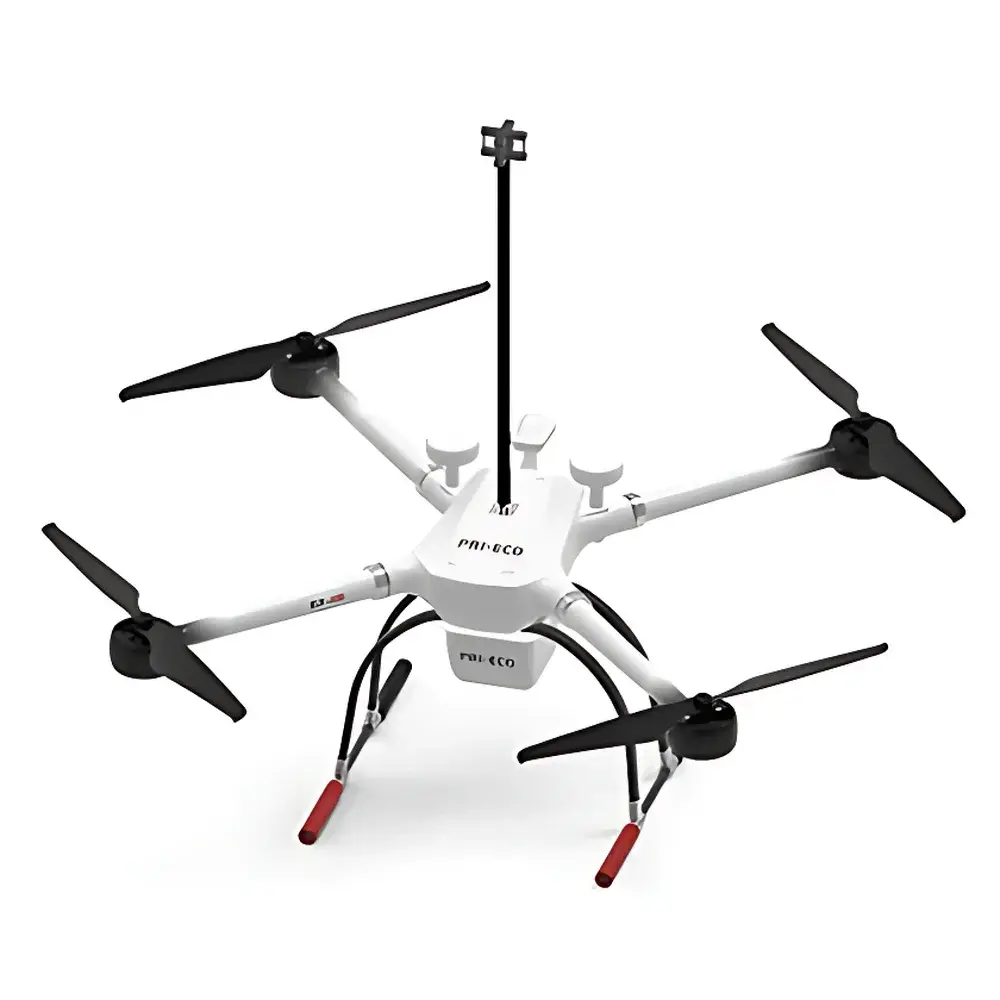
PRI-eco PRI-560 Portable Airborne NOx Analyzer (Chemiluminescence-Based)
| Brand | PRI-eco |
|---|---|
| Origin | Beijing, China |
| Manufacturer Type | Original Equipment Manufacturer (OEM) |
| Country of Manufacture | China |
| Model | PRI-560 |
| Weight | < 2 kg |
| Power Input | 12–24 V DC, max. 700 mA |
| Detection Principle | Luminol-based chemiluminescence |
| Sensitivity | < 1 ppb (NO₂) |
| Accuracy | ±2 % of reading |
| Linear Range | 2 ppb – 500 ppb (NO₂) |
| Sampling Rate | 5 Hz |
| Reagent Consumption | < 100 µL/min |
| Operating Temperature | 0–40 °C |
| GPS Module | Integrated |
| Environmental Sensors | Onboard temperature, relative humidity, and barometric pressure |
| Data Storage | Internal non-volatile memory |
| Output Interface | USB for data download |
| Auto-calibration | Supported via ground control unit with certified standard gases |
| Dimensions | Ø210 mm × H200 mm |
Overview
The PRI-eco PRI-560 Portable Airborne NOx Analyzer is a field-deployable, chemiluminescence-based gas measurement system engineered for high-temporal-resolution quantification of nitrogen dioxide (NO₂) in ambient air. It operates on the well-established principle of luminol-mediated chemiluminescence: gaseous NO₂ reacts with alkaline luminol solution under controlled flow conditions, generating light emission proportional to analyte concentration. This photonic signal is detected by a low-noise photomultiplier tube (PMT), digitized, and converted into calibrated NO₂ mixing ratios (ppb). Unlike ozone-based CLD systems requiring NO conversion, the PRI-560 directly measures NO₂ without catalytic reduction—eliminating interferences from NOₓ partitioning artifacts and enabling unambiguous speciation in dynamic atmospheric environments. Designed specifically for mobile platforms, it comprises two integrated subsystems: a compact, lightweight airborne sensor module (<2 kg) and a ground-based control and data management unit. The system delivers synchronized, time-stamped measurements at 5 Hz, embedding georeferenced metadata—including GPS coordinates, UTC timestamps, ambient temperature, relative humidity, and barometric pressure—into every data packet.
Key Features
- Direct NO₂ quantification via luminol chemiluminescence—no NO-to-NO₂ conversion required, minimizing cross-sensitivity and calibration drift
- Ultra-low reagent consumption (<100 µL/min) enabled by optimized luminol formulation with intrinsic interference suppression (e.g., against O₃, H₂O₂, and particulate quenching)
- Modular architecture: detachable airborne sensor (Ø210 mm × 200 mm, <2 kg) compatible with UAVs (≥2 kg payload), helicopters, light aircraft, electric vehicles, bicycles, and fixed-site masts
- Real-time onboard environmental monitoring: integrated sensors for temperature (±0.3 °C), RH (±2 %), and barometric pressure (±0.5 hPa)
- Automated zero/span calibration sequence executed remotely via ground unit using traceable NIST-traceable NO₂ standard gases
- Robust power architecture: wide-input DC range (12–24 V) with current draw ≤700 mA—compatible with common drone battery systems and vehicle auxiliary ports
- On-device non-volatile data storage supporting >72 hours of continuous 5-Hz logging; data export via USB 2.0 interface
Sample Compatibility & Compliance
The PRI-560 is validated for continuous sampling of ambient air across urban, rural, and boundary-layer atmospheric regimes. Its inlet design complies with ISO 7207-1:2021 (ambient air quality—performance criteria for NO₂ analyzers) and meets key requirements of EPA Method IO-3.2 (chemiluminescence-based NO/NO₂/NOₓ analyzers). While not certified under EU EN 14211 or US EPA EQOA designation, its documented sensitivity ( 0.9998 over 2–500 ppb), and precision (CV < 1.5 % at 20 ppb) align with Tier-2 reference-equivalent performance for research-grade mobile monitoring. All firmware and data handling routines support audit-ready metadata tagging per GLP principles; GPS timestamps are traceable to UTC via GNSS synchronization. No consumables beyond luminol reagent cartridges are required—no filters, scrubbers, or catalytic converters.
Software & Data Management
Data acquisition, visualization, and post-processing are managed through PRI-eco’s proprietary PRI-Link Desktop Suite (v3.2+), compatible with Windows 10/11 and macOS 12+. The software supports real-time telemetry display during flight operations, configurable alarm thresholds, batch calibration report generation (including span drift, zero stability, and response time), and automated geospatial mapping via KML/KMZ export. Raw binary files (.pri) include embedded CRC-32 checksums and are structured to comply with FAIR data principles (Findable, Accessible, Interoperable, Reusable). Export formats include CSV (with ISO 8601 timestamps), NetCDF-4 (CF-compliant), and GeoJSON for GIS integration. Audit logs record all user-initiated calibrations, parameter changes, and firmware updates—supporting 21 CFR Part 11–aligned electronic record integrity where required.
Applications
- Vertical and horizontal NO₂ profiling from UAVs to characterize urban plume dispersion, street-canyon ventilation, and boundary-layer gradients
- Mobile source emissions validation: real-time mapping of NO₂ hotspots along roadways, ports, and rail corridors
- Intercomparison campaigns with stationary reference analyzers (e.g., Thermo Scientific 42i-TLE, Ecotech EC9842) under AQMesh or ACTRIS protocols
- Wildfire smoke chemistry studies—tracking NO₂ evolution during pyroconvection and aging
- Low-cost sensor network validation—providing high-fidelity ground-truth data for algorithm training and bias correction
- Environmental justice assessments—high-resolution exposure mapping in underserved communities with limited regulatory monitor coverage
FAQ
Does the PRI-560 measure NO, NO₂, or total NOₓ?
It measures NO₂ selectively via direct luminol chemiluminescence. NO is not detected unless pre-converted externally; total NOₓ requires integration with a separate NO analyzer or thermal converter.
What is the recommended luminol reagent replacement interval?
A single refillable cartridge supports ≥6 hours of continuous operation at nominal flow rates; actual duration depends on ambient NO₂ concentration and sampling frequency.
Can the system operate without GPS signal?
Yes—internal real-time clock maintains accurate UTC timestamps; position data defaults to last known coordinates until GNSS lock is reacquired.
Is remote firmware update supported?
Firmware updates require local USB connection to the ground control unit; over-the-air (OTA) updates are not implemented for security and verification integrity.
What maintenance is required between deployments?
Routine checks include inlet filter inspection, luminol reservoir level verification, and PMT dark-current validation using built-in diagnostics—no optical alignment or vacuum system servicing needed.
Related Products







