
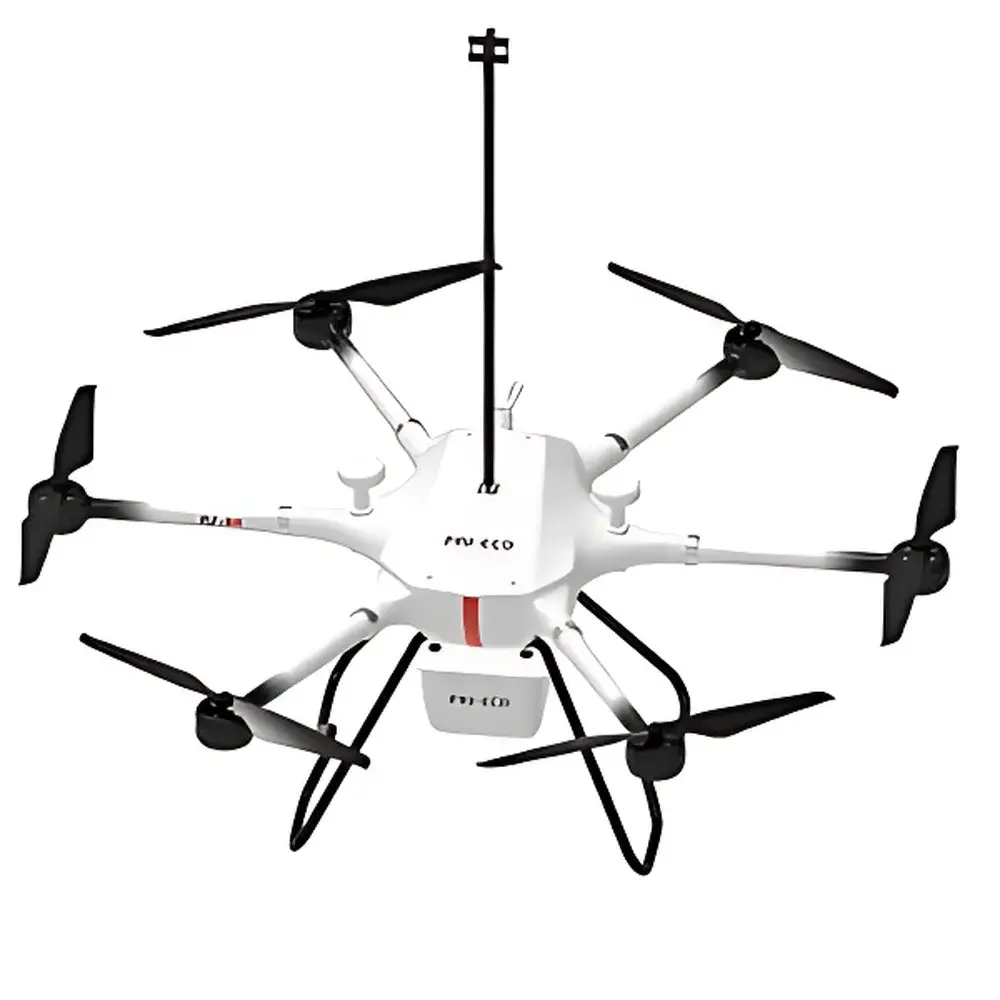
Pri-eco PRI-5251f CO₂ CH₄ N₂O H₂O Airborne Greenhouse Gas Analyzer System
| Brand | Pri-eco |
|---|---|
| Origin | Beijing, China |
| Manufacturer Type | Original Equipment Manufacturer (OEM) |
| Country of Origin | China |
| Model | PRI-5251f |
| Detection Principle | Mid-Infrared Laser Direct Absorption Spectroscopy (MIRLAS) |
| Measured Gases | CO₂ (0–3500 ppm), CH₄ (0–500 ppm), N₂O (0–500 ppm), H₂O (0–3 %v/v) |
| Precision (1-s) | 0.5 ppm CO₂, 2 ppb CH₄, 0.3 ppb N₂O, 50 ppm H₂O |
| Precision (5-s) | 0.4 ppm CO₂, 0.5 ppb CH₄, 0.25 ppb N₂O, 40 ppm H₂O |
| Sampling Flow Rate | ~360 mL/min |
| Operating Temperature | −10 to +45 °C |
| Relative Humidity Limit | <99% RH, non-condensing |
| Power Consumption | 35 W |
| Weight | 5 kg |
| Data Output | WiFi, USB, RS-232 |
| Power Supply | DC |
Overview
The Pri-eco PRI-5251f CO₂ CH₄ N₂O H₂O Airborne Greenhouse Gas Analyzer System is a purpose-built, flight-integrated trace gas measurement platform engineered for high-precision, real-time, in-situ monitoring of four key atmospheric constituents—carbon dioxide (CO₂), methane (CH₄), nitrous oxide (N₂O), and water vapor (H₂O)—from unmanned aerial vehicles (UAVs). At its core lies the PRI-5251f analyzer, which implements mid-infrared laser direct absorption spectroscopy (MIRLAS) at fundamental vibrational absorption bands. This technique leverages strong, molecule-specific rovibrational transitions in the 2.7–4.5 µm spectral region, enabling quantitative detection without optical cavity enhancement or high-finesse mirrors. Unlike near-infrared (NIR) systems, MIRLAS delivers inherently higher cross-sections and reduced interferences from overlapping spectral features, resulting in improved selectivity, lower detection limits, and enhanced long-term stability under dynamic field conditions.
Key Features
- ppb-level detection sensitivity for CH₄ and N₂O, with sub-ppm precision for CO₂ and high-resolution H₂O quantification—validated over 1-second and 5-second averaging intervals.
- Fully integrated airborne architecture: compact form factor (5 kg total mass), low power draw (35 W DC), and robust thermal management optimized for UAV deployment on platforms such as the ELF-600 hexacopter.
- Zero-maintenance optical path design: monolithic sensor head with no moving parts, no alignment-sensitive optics, and minimal susceptibility to vibration-induced drift.
- Environmental resilience: operational across −10 °C to +45 °C ambient temperatures and up to 99% relative humidity (non-condensing), validated per IEC 60068-2 environmental stress screening protocols.
- Onboard micro-meteorological suite: synchronized acquisition of 3D ultrasonic wind velocity, air temperature, relative humidity, and barometric pressure—enabling eddy covariance flux calculations and atmospheric correction.
- Low system drift: calibrated baseline stability <±0.1% of full scale per month, supporting multi-week unattended operation during intensive field campaigns.
Sample Compatibility & Compliance
The PRI-5251f accepts ambient air samples at a controlled flow rate of ~360 mL/min via heated inlet tubing to prevent condensation-induced bias. Sample conditioning includes particulate filtration (≤0.3 µm) and optional Nafion-based drying for high-humidity environments. The system complies with ISO 14064-1:2018 requirements for GHG quantification uncertainty reporting and supports data traceability aligned with WMO GAW guidelines for atmospheric composition measurements. While not certified for regulatory compliance under EPA Method TO-15 or EN 14662, its performance characteristics meet the technical criteria for Tier 2 and Tier 3 inventory verification as defined in IPCC 2006 Guidelines. All firmware and calibration logs are timestamped and stored with audit-trail integrity, facilitating GLP-aligned documentation workflows.
Software & Data Management
Data acquisition is managed through Pri-eco’s proprietary AirSight™ Flight Control & Analysis Suite, supporting real-time telemetry visualization, onboard GPS-tagged georeferencing, and dual-mode storage (internal SD card + wireless streaming via WiFi). Raw absorbance spectra, concentration time series, and auxiliary meteorological parameters are exported in CF-compliant NetCDF-4 format, ensuring interoperability with Python-based atmospheric modeling tools (e.g., PyFluxPro, OpenGHG) and MATLAB-based inversion frameworks. The software implements configurable averaging windows, automatic zero/span validation triggers, and built-in diagnostics for optical path contamination or pressure/temperature deviation alerts. Exported datasets include embedded metadata conforming to ACDD (Attribute Convention for Data Discovery) and support FAIR data principles.
Applications
- Airborne eddy covariance flux mapping of agricultural soils, wetlands, landfills, and forest canopies for bottom-up carbon budgeting.
- Point-source plume characterization and emission rate estimation using mass balance or inverse dispersion modeling (e.g., WindTrax, CALPUFF).
- Validation of satellite-derived XCO₂/XCH₄ products (e.g., OCO-2, TROPOMI, GOSAT) through coordinated vertical profile ascents and horizontal transects.
- Urban greenhouse gas gradient studies, including mobile monitoring along transportation corridors and industrial zones.
- Long-term ecosystem observatory deployments where UAV-based repeatability enables seasonal trend analysis with consistent spatial sampling geometry.
- Support for national MRV (Measurement, Reporting, Verification) infrastructure development under UNFCCC Article 13 and domestic “dual-carbon” policy frameworks.
FAQ
What spectral regions does the PRI-5251f use for each target gas?
CO₂ is measured near 4.26 µm (2347 cm⁻¹), CH₄ near 3.31 µm (3020 cm⁻¹), N₂O near 4.52 µm (2212 cm⁻¹), and H₂O across multiple bands between 2.7 and 3.0 µm.
Is the system compatible with third-party UAV autopilots such as PX4 or ArduPilot?
Yes—the PRI-5251f provides MAVLink-compatible telemetry output and supports UART-based command-and-control integration for coordinated flight-path triggering and payload synchronization.
Does the analyzer require external calibration gases during operation?
No continuous calibration is required; factory-applied multi-point polynomial calibrations remain stable for ≥12 months under typical field conditions. Optional field validation with certified standard gases (e.g., NOAA-certified CH₄ in air) is recommended every 3–6 months for regulatory-grade applications.
Can the system operate in rain or fog?
The analyzer itself is rated IP54; however, sustained exposure to liquid water ingress must be avoided. Use of heated inlet lines and hydrophobic filters is strongly advised in precipitating conditions.
How is data time-synchronized across sensors?
All analog and digital channels—including gas concentrations, ultrasonic anemometer outputs, and IMU data—are hardware-timestamped using a common 10 MHz OCXO reference, achieving sub-millisecond alignment accuracy across the full measurement stack.







