
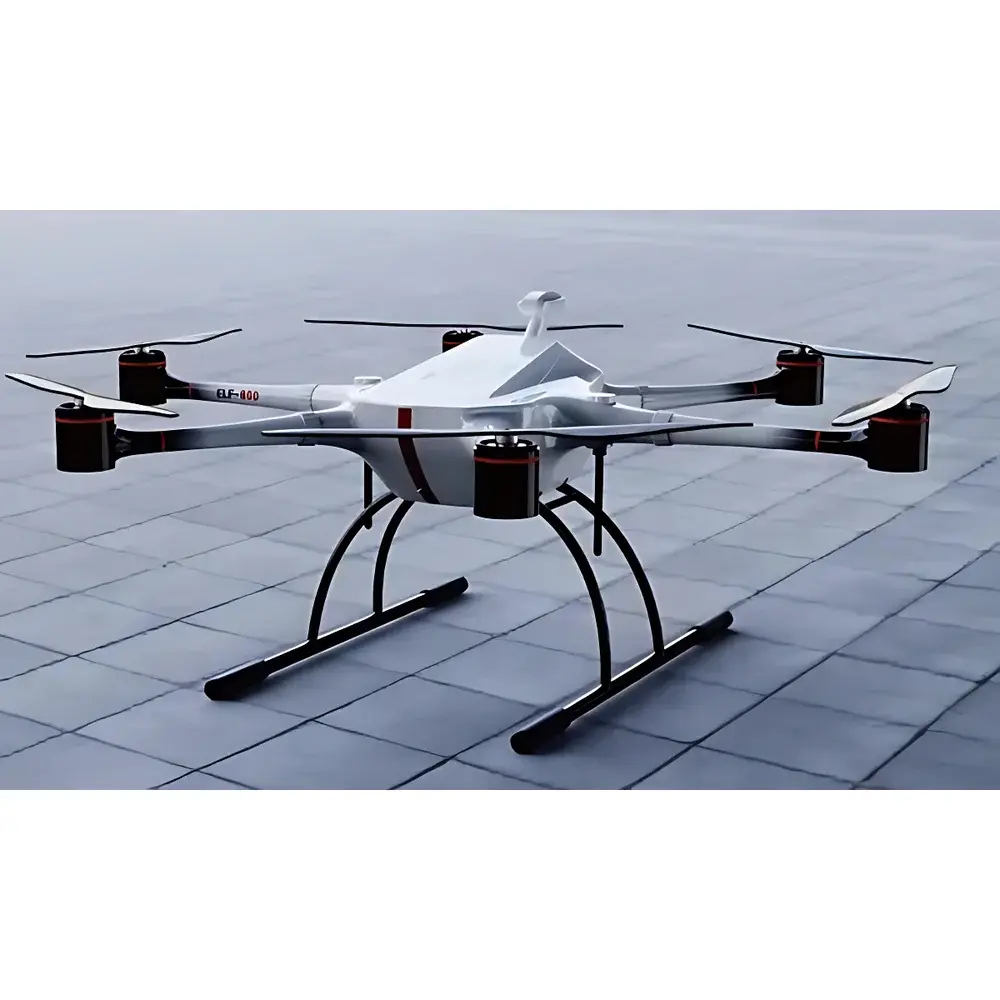
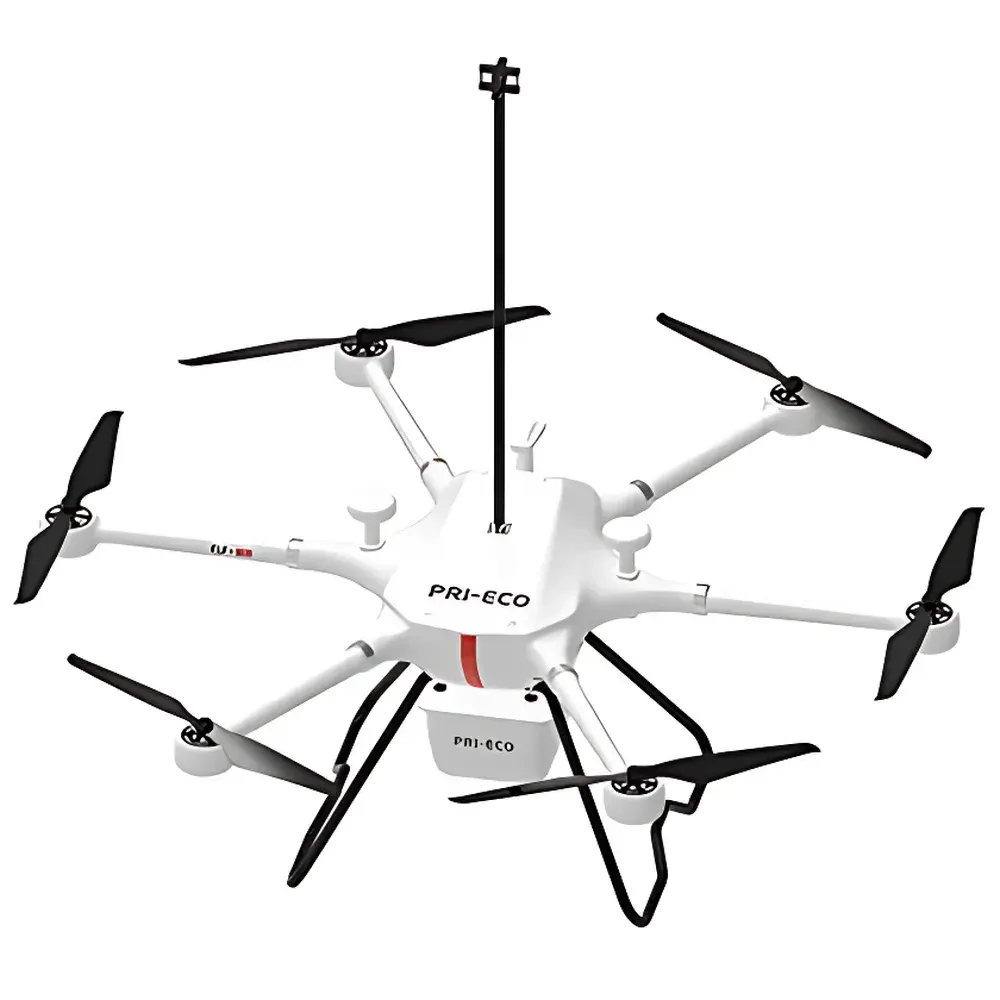
Pri-eco ELF-600 Hexacopter UAV System for Greenhouse Gas Monitoring
| Brand | Pri-eco |
|---|---|
| Origin | Beijing, China |
| Manufacturer Type | Original Equipment Manufacturer (OEM) |
| Country of Origin | China |
| Model | ELF-600 |
| Detection Gases & Ranges | CO₂, N₂O, CH₄ (greenhouse gases), CO (combustion byproduct), H₂O (water vapor) |
| Max Takeoff Weight | 22.5 kg |
| Rotor Span (Diagonal) | 1.6 m |
| Max Speed | 45 km/h |
| Service Ceiling | 5000 m |
| Climb Rate | 5 m/s |
| Wind Resistance | Level 6 (Beaufort scale) |
| Control Link | 900 MHz RF |
| Navigation System | Dual-GNSS (GPS + BeiDou) |
| Endurance | 80 min (empty), 60 min (5 kg payload) |
| Control Radius | 20 km |
| Payload Options | Full-frame aerial survey camera (35 mm sensor, 42 MP), multispectral camera (VIS–NIR bands), GHG analyzer module, thermal imager, loudspeaker, spotlight, aerial payload dispenser |
Overview
The Pri-eco ELF-600 is a purpose-built, electric vertical take-off and landing (eVTOL) hexacopter platform engineered for autonomous, high-precision environmental monitoring—particularly in greenhouse gas (GHG) quantification campaigns. Unlike generic commercial drones, the ELF-600 integrates structural, aerodynamic, and avionic design principles optimized for scientific payload stability, long-endurance flight, and operational robustness in non-permissive terrain. Its six-rotor configuration delivers enhanced lift redundancy, improved hover accuracy under crosswind conditions (up to Beaufort Level 6), and superior vibration isolation—critical for maintaining calibration integrity of sensitive optical gas analyzers during in-flight measurement. The system operates on dual GNSS positioning (GPS + BeiDou) with real-time kinematic (RTK) support, enabling georeferenced, sub-meter spatial accuracy for plume mapping and flux estimation. Designed explicitly for regulatory-grade atmospheric sampling, the ELF-600 supports synchronized acquisition of CO₂, N₂O, CH₄, CO, and H₂O concentrations alongside co-located meteorological parameters—including 3D ultrasonic anemometry, ambient temperature, relative humidity, and barometric pressure—enabling eddy covariance (EC) and mobile concentration gradient analysis per ISO 14064-3 and EPA Method TO-15 guidelines.
Key Features
- Scientific-Grade Payload Integration: Modular bay architecture accommodates certified GHG analyzers (e.g., cavity ring-down spectroscopy or tunable diode laser absorption spectrometry units) with active thermal stabilization and pressure-compensated flow control.
- Flight Stability & Environmental Resilience: Six independent brushless motors with redundant ESCs and adaptive PID tuning ensure stable hover and precise loitering at altitudes up to 5000 m AMSL—even in mountainous, forested, or urban canyon environments where GPS signal multipath and wind shear are prevalent.
- Extended Operational Endurance: Optimized powertrain and high-energy-density LiPo battery packs deliver 60 minutes of sustained flight at 5 kg payload mass, meeting minimum duration requirements for vertical profile sampling and area-wide transect surveys.
- Regulatory-Compliant Data Acquisition: Onboard time-synchronized logging (UTC-referenced, ±10 ms accuracy) with dual SD card redundancy ensures audit-ready datasets aligned with GLP and ISO/IEC 17025 documentation standards.
- Expandable Sensor Ecosystem: Compatible with full-frame RGB cameras (35 mm format, 42 MP), multispectral imagers (5-band VIS–NIR with radiometric calibration), thermal sensors (640 × 512 VOx microbolometer), and auxiliary modules including loudspeakers, LED spotlights, and pneumatic payload release mechanisms.
Sample Compatibility & Compliance
The ELF-600 is validated for deployment in EPA Region 10, EU JRC reference sites, and China’s National GHG Monitoring Network infrastructure. Its airframe and payload interface comply with IEC 62287-2 (unmanned aircraft systems — safety requirements) and GB/T 38909–2020 (Chinese national standard for environmental UAV platforms). All GHG measurements performed using the ELF-600 are traceable to NIST SRM-certified gas standards. The system supports data export formats compliant with FAO’s Global Agro-Monitoring Framework (GAMF) metadata schema and meets reporting thresholds outlined in UNFCCC Annex I Biennial Reports. No onboard combustion engines or hydraulic systems eliminate interference from local VOC emissions, ensuring zero self-contamination during background concentration profiling.
Software & Data Management
Pri-eco’s proprietary AeroScan Ground Control Station (GCS) provides mission planning, real-time telemetry visualization, and post-flight data fusion. The software features automated flight path generation along pre-defined transects or grid patterns, dynamic altitude adjustment based on digital elevation models (DEMs), and in-flight payload health monitoring. Raw sensor streams are timestamped and tagged with IMU-derived attitude, position, and atmospheric pressure metadata. Post-processing tools include spectral band alignment for multispectral data, CO₂/CH₄ ratio drift correction via H₂O-normalized calibration curves, and EC flux computation using the EddyPro®-compatible output template. All audit logs—including operator login history, parameter changes, and firmware version stamps—are stored locally and exportable for FDA 21 CFR Part 11-compliant review.
Applications
- Point-source emission verification at landfills, wastewater treatment plants, and natural gas compressor stations
- Regional-scale carbon sink assessment across forested, agricultural, and wetland ecosystems
- Mobile validation of satellite-based GHG retrievals (e.g., OCO-2/3, Sentinel-5P TROPOMI)
- Urban air quality profiling with vertical stratification of CO and CH₄ plumes
- Pre-deployment site reconnaissance for fixed-station network expansion
- Emergency response monitoring following industrial leaks or pipeline ruptures
FAQ
Is the ELF-600 certified for BVLOS (beyond visual line of sight) operations in EASA or FAA jurisdictions?
Yes—when equipped with Detect-and-Avoid (DAA) radar and ADS-B In/Out transponders, the ELF-600 meets EASA STS-02-01 and FAA Part 107.335 requirements for authorized BVLOS missions in Class G airspace. Certification documentation is provided per national aviation authority request.
Can the GHG measurement module be calibrated in-field without returning to the lab?
Yes—the integrated span/zero calibration port supports automated two-point calibration using certified gas cylinders (NIST-traceable CO₂/N₂O/CH₄ mixtures) with pressure-regulated flow control; full calibration sequence completes in <90 seconds.
What level of data traceability does the system provide for regulatory submissions?
All raw and processed datasets include embedded cryptographic hashes, operator ID, instrument serial numbers, calibration certificate IDs, and GNSS-derived positional uncertainty metrics—fully compatible with ISO 17025 Clause 7.7 record retention protocols.
Does the platform support integration with third-party GHG analyzers?
Yes—via standardized RS-422/RS-485 and Ethernet interfaces adhering to MODBUS RTU and TCP/IP protocols; mechanical mounting templates and electrical interface schematics are supplied under NDA.
How is vibration isolation achieved for optical gas sensors?
The GHG payload bay employs passive damping mounts (silicone-elastomer isolators, 10–500 Hz attenuation >30 dB) combined with active gimbal stabilization (±0.05° pointing accuracy) and real-time IMU-based motion compensation in firmware.
Related Products







