
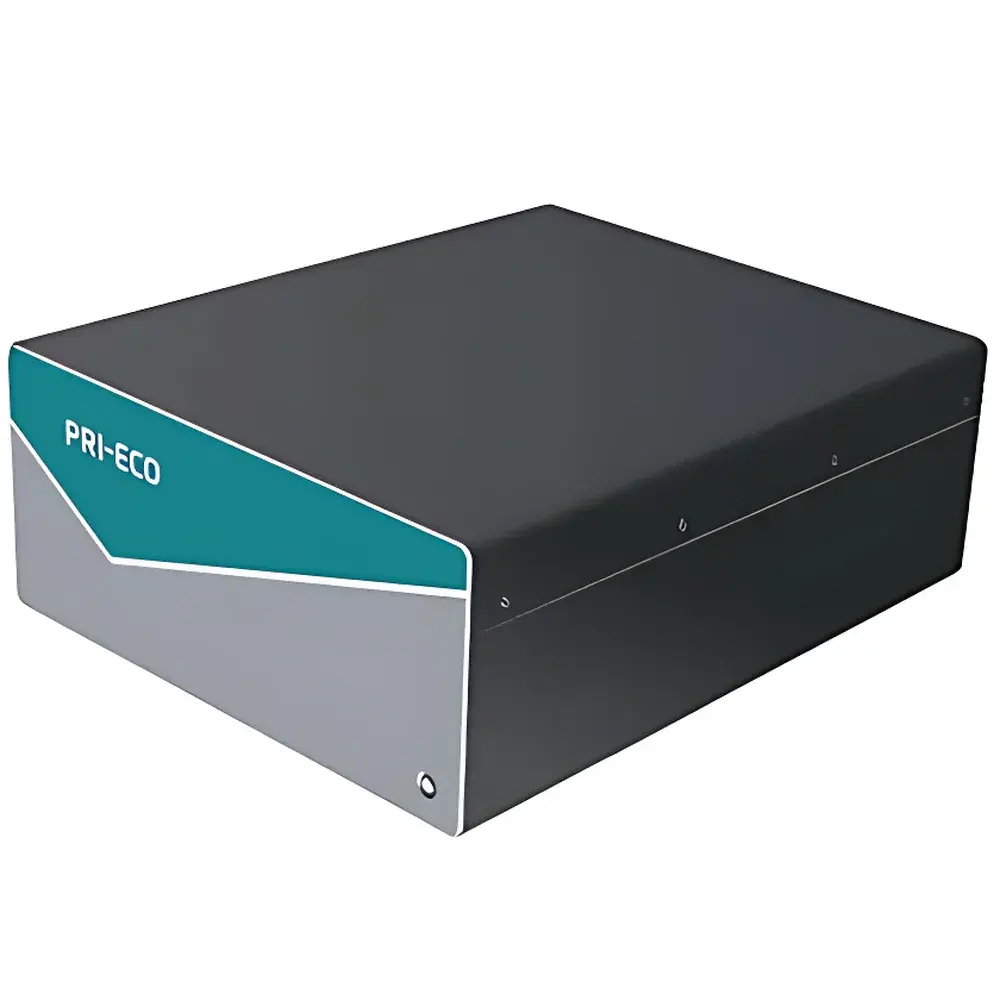
PRI-ECO PRI-5251 PLUS Multi-Gas Greenhouse Gas Analyzer for CO, CO₂, CH₄, N₂O, and H₂O
| Brand | PRI-ECO |
|---|---|
| Model | PRI-5251 PLUS |
| Origin | Beijing, China |
| Manufacturer | PRI-ECO (Domestic) |
| Detection Principle | Mid-Infrared Laser Direct Absorption Spectroscopy (MIRLAS) |
| Measured Gases | CO, CO₂, CH₄, N₂O, H₂O |
| Precision (1 s) | 0.6 ppb (CO), 0.2 ppm (CO₂), 1 ppb (CH₄), 0.2 ppb (N₂O), 50 ppm (H₂O) |
| Precision (1 min) | 0.4 ppb / 0.05 ppm / 0.3 ppb / 0.05 ppb / 40 ppm |
| Precision (5 min) | 0.2 ppb / 0.04 ppm / 0.2 ppb / 0.03 ppb / 10 ppm |
| Measurement Range | 0–500 ppm (CO), 0–3500 ppm (CO₂), 0–500 ppm (CH₄), 0–500 ppm (N₂O), 0–3 %v/v (H₂O) |
| Drift (24 h) | 0.3 ppb / 0.2 ppm / 2 ppb / 0.2 ppb / — |
| Sampling Temp. | −10 to +45 °C |
| Sampling Humidity | <99% RH, non-condensing |
| Flow Rate | ~540 mL/min |
| Output Frequency | 1 Hz per gas |
| Data Interfaces | USB, RS-232 |
| Power Supply | 110–230 V AC |
| Power Consumption | 120 W (steady), 150 W (warm-up) |
| Dimensions | 440 × 190 × 530 mm |
| Weight | 18.3 kg |
Overview
The PRI-ECO PRI-5251 PLUS is a laboratory-grade, field-deployable multi-component greenhouse gas (GHG) analyzer engineered for high-fidelity, real-time quantification of carbon monoxide (CO), carbon dioxide (CO₂), methane (CH₄), nitrous oxide (N₂O), and water vapor (H₂O) in ambient air and controlled emission streams. It employs mid-infrared laser direct absorption spectroscopy (MIRLAS), a physically robust and chemically selective technique that leverages fundamental vibrational-rotational transitions in the 3–12 µm spectral region—where target gases exhibit orders-of-magnitude stronger absorption cross-sections than in near-infrared bands. This inherent signal strength enables sub-ppb detection limits without optical enhancement cavities or high-reflectivity mirrors, significantly reducing system complexity and long-term calibration drift. The instrument’s compact, thermally stabilized measurement cell ensures rapid gas turnover (~1.2 s residence time at 540 mL/min), precise control of pressure and temperature (±0.05 °C, ±0.1 hPa), and minimal sensitivity to environmental fluctuations—critical for compliance with World Meteorological Organization (WMO) Global Atmosphere Watch (GAW) guidelines for GHG monitoring networks.
Key Features
- Simultaneous, independent quantification of five climate-relevant species—CO, CO₂, CH₄, N₂O, and H₂O—at 1 Hz native output frequency, with traceable precision down to 0.2 ppb (CO), 0.04 ppm (CO₂), 0.2 ppb (CH₄), 0.03 ppb (N₂O), and 10 ppm (H₂O) over 5-minute averaging intervals.
- Fully factory-calibrated using NIST-traceable reference standards; no field recalibration required for routine operation under WMO-compliant conditions.
- Compact, vibration-damped optical architecture optimized for mobile platforms—including vehicle-mounted, aircraft-integrated, and marine boundary-layer deployments—with IP54-rated enclosure and shock-tested mechanical design (IEC 60068-2-64 compliant).
- Integrated thermal management subsystem maintains cavity temperature stability within ±0.05 °C across ambient ranges from −10 to +45 °C, ensuring consistent line shape modeling and minimizing spectroscopic baseline drift.
- Low-power consumption (120 W steady-state) and universal AC input (110–230 V) support extended unattended operation in remote observatories, flux towers, and mobile laboratories.
Sample Compatibility & Compliance
The PRI-5251 PLUS accepts sample gas streams with humidity up to 99% RH (non-condensing) and operates reliably across a wide dynamic range: CO (0–500 ppm), CO₂ (0–3500 ppm), CH₄ (0–500 ppm), N₂O (0–500 ppm), and H₂O (0–3 %v/v). Its MIRLAS-based detection eliminates cross-sensitivity from common interferents such as ethane, propane, and formaldehyde—validated via ASTM D6348-19 interference testing protocols. The analyzer meets WMO GAW compatibility criteria for background station deployment (GAW Report No. 257), supports ISO 14064-1 verification workflows for GHG inventories, and provides audit-ready metadata logging aligned with GLP principles. Optional analog voltage outputs and Modbus TCP integration facilitate seamless interfacing with SCADA systems and regulatory reporting infrastructure.
Software & Data Management
The embedded firmware delivers real-time spectral fitting using Voigt-profile line-shape modeling and least-squares minimization against HITRAN2020 database parameters. Raw absorbance spectra, fitted residuals, and diagnostic metrics (e.g., signal-to-noise ratio, path length stability index) are timestamped and stored internally (8 GB flash memory) alongside processed concentration data. The PRI-ECO DataLink™ software suite (Windows/Linux/macOS) enables remote configuration, live spectral visualization, batch processing with customizable averaging windows, and export in CF/NetCDF, CSV, or EPA Method 21-compliant formats. All data files include embedded calibration history, environmental metadata (T, P, RH), and digital signatures—supporting FDA 21 CFR Part 11 requirements for electronic records and signatures when deployed in regulated environmental monitoring contexts.
Applications
- Long-term atmospheric monitoring at WMO GAW stations, tall-tower observatories, and polar research bases.
- Mobile eddy covariance and chamber-based flux measurements for soil-atmosphere exchange studies.
- Urban air quality networks tracking CO/CO₂/CH₄ gradients and fossil vs. biogenic source partitioning.
- Industrial site monitoring for fugitive emissions detection (e.g., landfills, wastewater treatment plants, natural gas infrastructure).
- Validation of satellite GHG retrievals (e.g., OCO-2/3, TROPOMI, GOSAT) through ground-truth campaigns.
- Supporting national MRV (Measurement, Reporting, Verification) frameworks under the Paris Agreement and domestic carbon market development.
FAQ
Does the PRI-5251 PLUS require periodic recalibration in the field?
No—factory calibration using NIST-traceable gas standards is stable for ≥12 months under typical operating conditions. Annual verification against primary standards is recommended for WMO GAW-tier compliance.
Can the instrument operate unattended for extended periods?
Yes—designed for continuous operation with built-in diagnostics, watchdog timers, and automatic recovery from power interruptions. Internal storage supports >30 days of 1-Hz data at full channel resolution.
Is the analyzer compatible with existing data acquisition systems?
Yes—RS-232 and USB-C interfaces support ASCII-based serial protocols; optional Ethernet (Modbus TCP) and 4–20 mA analog outputs enable integration into industrial PLCs and environmental monitoring networks.
What maintenance is required?
Routine maintenance is limited to quarterly particulate filter replacement and annual inspection of inlet tubing and desiccant cartridges. No optical alignment or laser realignment is needed during normal service life.
How does MIRLAS compare to CRDS or OA-ICOS for GHG analysis?
MIRLAS offers superior specificity for overlapping ro-vibrational bands (e.g., CH₄/N₂O), lower susceptibility to mirror contamination, and inherently lower drift than cavity-enhanced techniques—making it optimal for long-term, low-maintenance monitoring where absolute accuracy and inter-laboratory comparability are prioritized over ultra-trace (sub-ppt) detection limits.







