
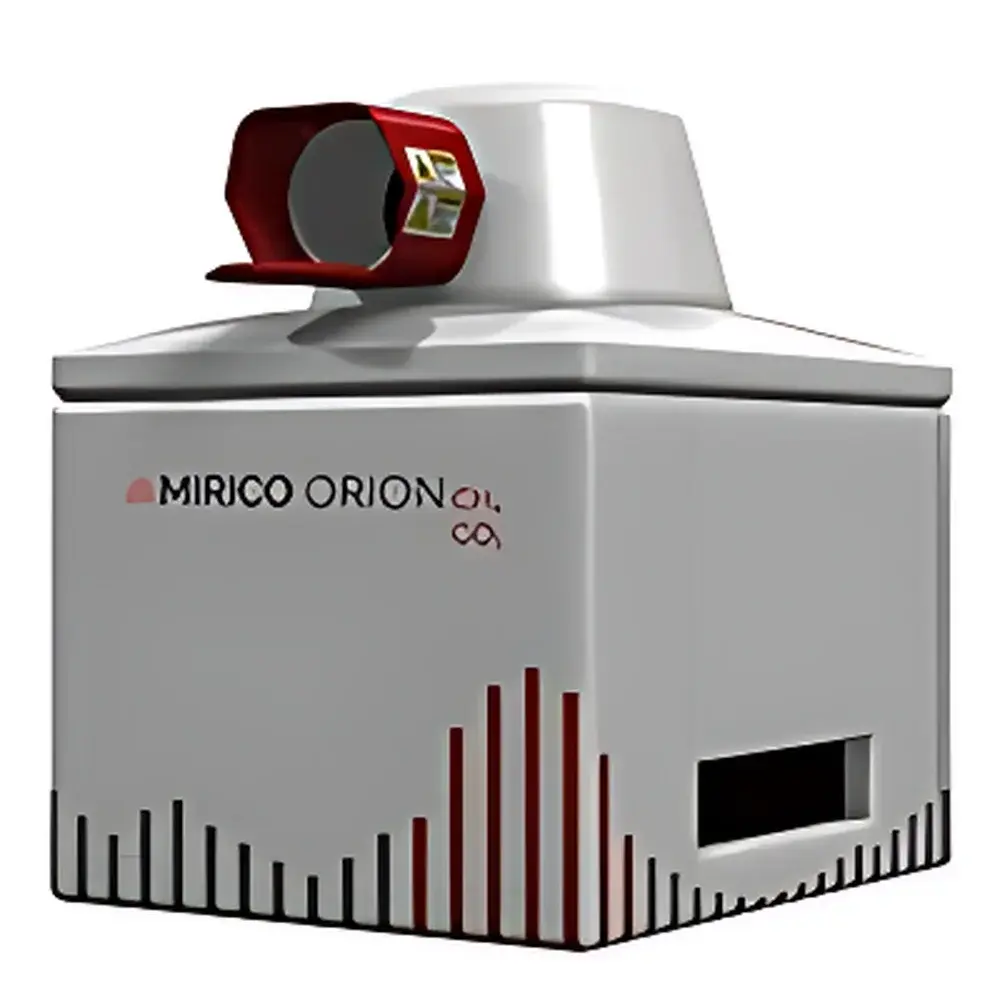
MIRICO ORION Open-Path CO₂ Analyzer
| Origin | UK |
|---|---|
| Manufacturer Type | Distributor |
| Origin Category | Imported |
| Model | ORION |
| Pricing | Upon Request |
Overview
The MIRICO ORION Open-Path CO₂ Analyzer is a field-deployable, laser-based gas sensing system engineered for high-fidelity, real-time atmospheric carbon dioxide concentration measurements. It operates on the principle of mid-infrared (MIR) tunable diode laser dispersion spectroscopy (TDLDS), a technique that exploits the unique absorption signature of CO₂ near 4.2 µm. Unlike closed-path extractive systems or NDIR sensors with optical cells, the ORION employs a true open-path configuration—transmitting and receiving laser light across an unenclosed atmospheric path—enabling direct, in-situ quantification without sample conditioning, pumping, or calibration drift induced by inlet tubing or filters. This architecture delivers inherent immunity to pressure, temperature, and humidity artifacts common in enclosed measurement cells, making it especially suited for long-term eddy covariance (EC) flux studies, ecosystem-scale carbon budgeting, and regulatory-grade ambient monitoring under variable meteorological conditions.
Key Features
- True open-path design: No sampling inlet, pump, or cell—eliminates adsorption/desorption artifacts and maintenance associated with wet or particulate-laden air streams.
- Mid-infrared laser dispersion spectroscopy: Offers superior selectivity against cross-interferences (e.g., H₂O, CH₄, CO) and enhanced sensitivity compared to near-IR NDIR approaches.
- Full 360° horizontal scanning capability with ±10° vertical tilt range: Enables spatially resolved CO₂ mapping across heterogeneous landscapes—including wetlands, agricultural fields, forest edges, and lacustrine boundaries.
- Integrated web-based interface via Wi-Fi: Supports remote configuration, real-time data streaming, firmware updates, and diagnostic logging without local PC dependency.
- Automatic co-located self-calibration: Uses built-in reference path and internal wavelength stabilization to maintain traceability without external gas standards during operation.
- Onboard system health monitoring: Continuous diagnostics of laser output power, detector responsivity, alignment stability, and environmental sensor integrity reduce unscheduled downtime and field service requirements.
Sample Compatibility & Compliance
The ORION is designed for ambient air analysis only; it does not require sample extraction, pre-concentration, or chemical derivatization. Its open-path geometry ensures compatibility with all naturally occurring atmospheric matrices—including high-humidity tropical environments, freezing sub-Arctic conditions, and dust-laden agricultural zones—without performance degradation. The system conforms to fundamental metrological principles outlined in ISO 14064-1 (Greenhouse Gas Inventories) and supports data acquisition protocols aligned with FLUXNET and ICOS standards. While not certified as a Class I, Division 1 hazardous area device, its enclosure meets IP65 rating for outdoor deployment. Data provenance and auditability are supported through optional time-synchronized logging with GPS-stamped timestamps and integration-ready outputs compliant with CF/NetCDF conventions for climate modeling workflows.
Software & Data Management
The ORION runs embedded Linux-based firmware with a responsive HTML5 web interface accessible via standard browsers over Wi-Fi or Ethernet. All configuration parameters—including scan pattern definition, averaging intervals (1–30 s), spectral acquisition settings, and alarm thresholds—are adjustable remotely. Raw spectral data and processed CO₂ mixing ratios (ppm) are streamed in real time via MQTT or HTTP POST to user-defined endpoints. Internal storage retains up to 30 days of high-resolution (10 Hz) time-series data with metadata tagging (temperature, RH, pressure, wind vector from synchronized sonic anemometer). Export formats include CSV and NetCDF4, enabling seamless ingestion into MATLAB, Python (xarray/pandas), or commercial flux processing suites such as EddyPro or TK3. Optional firmware modules support 21 CFR Part 11-compliant electronic signatures and audit trails for GLP/GMP-aligned research applications.
Applications
- Eddy covariance flux towers: Paired with 3D ultrasonic anemometers for high-frequency (10–20 Hz) CO₂ flux computation across diverse biomes.
- Carbon sequestration verification: Quantifying net ecosystem exchange (NEE) at restoration sites, afforestation projects, and managed grasslands.
- Urban emission hotspot detection: Mobile deployment on vehicles or drones to map CO₂ gradients along transportation corridors and industrial perimeters.
- Agricultural optimization: Monitoring diurnal CO₂ drawdown patterns above crop canopies to inform irrigation and fertilization scheduling.
- Wetland and lake-atmosphere exchange studies: Capturing buoyancy-driven CO₂ pulses across water-air interfaces under low-wind conditions where closed-path systems suffer from lag and condensation errors.
- Long-term ecological research networks: Supporting multi-year, multi-site carbon cycle observatories requiring minimal intervention and stable interannual comparability.
FAQ
What is the minimum detectable CO₂ concentration under typical field conditions?
The system achieves an effective detection limit of 5 ppm CO₂ (equivalent to 500 ppm·m/Hz) for path lengths exceeding 100 m with 1-second integration time—scalable with longer averaging or shorter paths.
Can the ORION operate autonomously for extended periods without manual intervention?
Yes—designed for unattended operation up to 12 months with solar/battery power, onboard diagnostics, and remote firmware management.
Is synchronization with a 3D sonic anemometer required for flux calculations?
While not mandatory for concentration measurement, precise spatial and temporal co-location with a collocated 3D ultrasonic anemometer is essential for eddy covariance flux derivation.
Does the system require periodic calibration with certified gas standards?
No—its dispersion spectroscopy architecture and internal reference path enable continuous self-referencing; external calibration is optional for validation only.
What mounting infrastructure is recommended for optimal performance?
A rigid, vibration-isolated mast (minimum 2 m height) with azimuthal freedom and weatherproof cabling; detailed mechanical installation guidelines are provided in the IEC 61000-6-2-compliant hardware manual.





