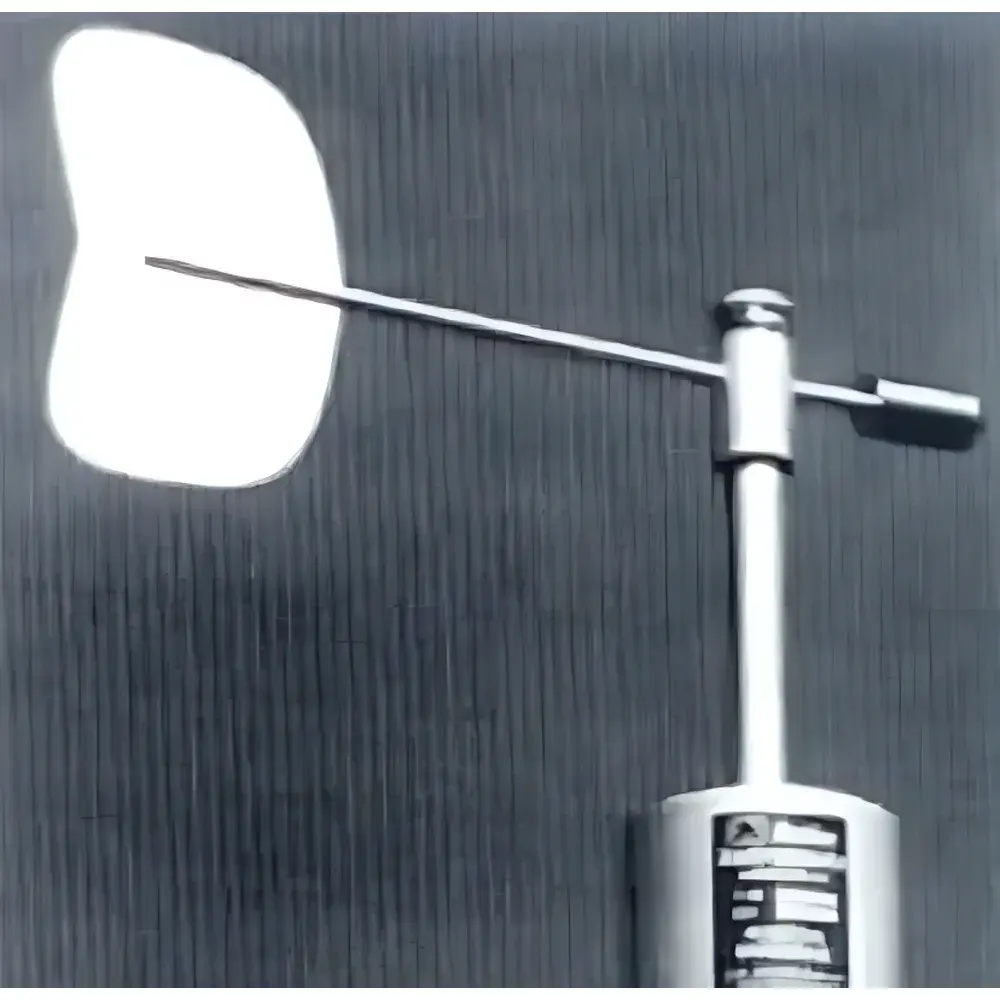
W20 Wind Direction Sensor
| Origin | Beijing |
|---|---|
| Manufacturer Type | Distributor |
| Origin Category | Domestic (China) |
| Model | W20 |
| Pricing | Upon Request |
Overview
The W20 Wind Direction Sensor is an industrial-grade electromechanical transducer engineered for continuous, high-reliability measurement of horizontal wind azimuth across the full 360° mechanical range. It operates on a precision potentiometric principle—where angular displacement of the vane assembly is converted into a proportional analog voltage output—ensuring stable and repeatable directional data under dynamic atmospheric conditions. Designed for permanent outdoor deployment, the sensor integrates a sealed, maintenance-free spherical bearing system that eliminates mechanical hysteresis and supports uninterrupted rotation without positional limits. Its robust mechanical architecture and environmental sealing make it suitable for long-term unattended operation in remote meteorological stations, agricultural monitoring networks, road weather information systems (RWIS), and ecological observatories where data continuity and low drift are critical.
Key Features
- Full 360° continuous rotational capability with no dead zones or mechanical stops
- Corrosion-resistant, dust-tight, and moisture-protected spherical bearing assembly rated for extended field service life
- High angular resolution of ±0.2° and accuracy of ±3° (at steady-state wind speeds >5 m/s), meeting IEC 61000-4-2 and WMO Guide to Meteorological Instruments and Methods of Observation (CIMO Guide) baseline requirements
- Extended operational temperature range from –50°C to +70°C, validated for polar, alpine, desert, and coastal deployments
- Standard 3 m shielded 6-conductor cable with braided copper shielding (optional lengths up to 115 m available)
- Low starting threshold (2.7 m/s nominal) optimized for low-wind environments typical of inland agricultural and forested sites
- Structural design compliant with IP65 ingress protection rating for enclosure integrity against rain, snow, and particulate contamination
Sample Compatibility & Compliance
The W20 is compatible with standard meteorological data loggers supporting 0–5 V or 4–20 mA analog input channels—including Campbell Scientific CR1000X, Onset HOBO RX3000, and Delta-T DL2e platforms. Its electrical interface conforms to RS-485 optional variants (upon custom configuration) and adheres to EMC directives per EN 61326-1:2013 for industrial measurement equipment. While not certified to ISO/IEC 17025 as a standalone calibration artifact, the sensor is supplied with traceable factory calibration documentation aligned to NIST-traceable reference standards. It meets functional requirements specified in ASTM D5096 (Standard Practice for Determining Wind Speed and Direction) and supports compliance with national meteorological network protocols including China’s QX/T 49–2019 (Wind Sensor Technical Requirements).
Software & Data Management
The W20 delivers raw analog output requiring external signal conditioning and digitization; no embedded firmware or onboard processing is included. Integration with third-party acquisition software (e.g., LoggerNet, Meteologger, or custom Python-based SCADA interfaces) is straightforward via linear scaling equations provided in the technical manual. Output linearity is characterized across the full 0–360° range with <0.5% nonlinearity error (typical). For regulatory environments requiring auditability—such as GLP-compliant agrometeorological trials—the sensor may be deployed within systems configured for 21 CFR Part 11–compliant data logging when paired with validated logger hardware and electronic signature workflows.
Applications
- Agricultural microclimate monitoring for irrigation scheduling and frost risk assessment
- Roadway surface condition modeling in intelligent transportation systems (ITS)
- Ecological flux tower networks measuring boundary-layer exchange dynamics
- Renewable energy site assessment, particularly for small-scale wind resource screening
- National and regional automatic weather station (AWS) networks operated by hydro-meteorological agencies
- Long-term permafrost and tundra observation platforms requiring extreme cold tolerance
FAQ
What is the recommended mounting height for optimal wind direction measurement?
Per WMO guidelines, installation at 10 m above ground level is standard for synoptic applications; however, agricultural and ecological deployments commonly use 2–3 m AGL to capture canopy-level flow structures.
Can the W20 be used in salt-laden coastal environments?
Yes—the housing and bearing assembly utilize marine-grade stainless steel (AISI 316) and fluoropolymer-coated components, providing resistance to chloride-induced corrosion when maintained per manufacturer cleaning intervals.
Is calibration verification required after initial installation?
Field recalibration is not necessary under normal operating conditions; however, annual verification against a reference theodolite or dual-sensor cross-check is recommended for QA/QC programs in regulated monitoring networks.
Does the sensor support digital communication protocols out of the box?
No—the base model outputs analog voltage only; Modbus RTU or SDI-12 digital variants are available upon special order with lead-time extension.
What is the maximum cable length without signal degradation?
With proper twisted-pair shielding and termination, reliable operation is confirmed up to 115 m using 22 AWG shielded cable; beyond 50 m, a signal conditioner or active repeater is advised to maintain SNR >60 dB.