
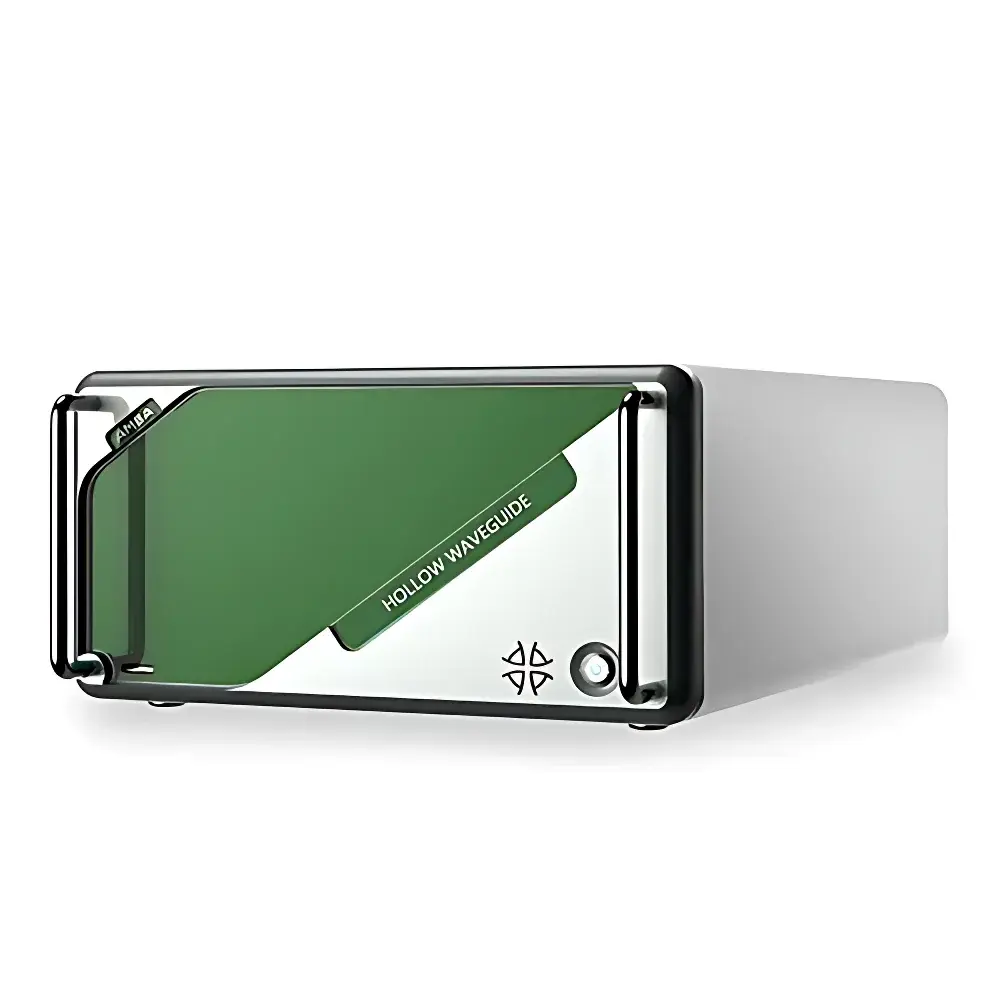
Pri-eco AMBA i3211 CO₂ Isotope Ratio Analyzer
| Brand | Pri-eco |
|---|---|
| Origin | Beijing, China |
| Manufacturer Type | Original Equipment Manufacturer (OEM) |
| Country of Origin | China |
| Model | AMBA i3211 |
| Pricing | Available Upon Request |
| Measurement Principle | Mid-Infrared Hollow Waveguide Absorption Spectroscopy |
| Sample Chamber Volume | ~1 mL |
| δ¹³C Precision | <0.08‰ (1σ, 60 s) |
| CO₂ Concentration Range | 380–5000 ppm |
| Sampling Frequency | 4 Hz (high-speed mode), 1 Hz (standard mode) |
| Sample Flow Rate | 15 mL/min (standard), 5 mL/min (low-flow mode) |
| Sample Cell Volume | 0.1 mL |
| Operating Temperature | −10 to +45 °C |
| Vacuum Pump Capacity | 100 sccm at 50 Torr |
| Operating Pressure | 50–133 kPa |
| Relative Humidity Tolerance | <99% RH (non-condensing at ≤40 °C, no drying required) |
| Calibration | Fully Automated Online Calibration |
| Data Interfaces | RS-232, Ethernet, USB |
| Inlet/Outlet Fittings | 1/8″ Swagelok® Compression Ferrules |
| Dimensions (W×D×H) | 483 × 800 × 476 mm (19″ × 31.5″ × 18.75″) |
| Weight | 25 kg |
| Power Supply | 100–240 VAC, <350 W (startup), ~200 W (steady-state) |
Overview
The Pri-eco AMBA i3211 CO₂ Isotope Ratio Analyzer is a high-sensitivity, benchtop laser absorption spectrometer engineered for precise, real-time quantification of carbon isotope ratios (δ¹³C) and absolute CO₂ concentration in gas-phase samples. It employs mid-infrared hollow waveguide absorption spectroscopy—a robust, non-destructive optical technique that enables stable, interference-free detection of isotopologues (¹²CO₂ and ¹³CO₂) within a single compact optical path. Unlike conventional isotope ratio mass spectrometry (IRMS) systems requiring cryogenic vacuum infrastructure and complex sample preparation, the AMBA i3211 operates at ambient pressure with no high-vacuum pumps or specialized power conditioning. Its ultra-miniaturized measurement cavity (~1 mL total volume, with an effective sample cell of 0.1 mL) delivers rapid gas exchange kinetics and sub-second response time—enabling true online, open-path analysis directly coupled to dynamic biological, ecological, or geochemical systems.
Key Features
- Sub-milliliter optical cavity: Enables high temporal resolution (up to 4 Hz sampling) and low dead-volume interfacing—ideal for micro-scale gas sampling (e.g., headspace from microcosms, vials, or microfluidic reactors).
- High-precision δ¹³C measurement: Achieves <0.08‰ (1σ) precision at 60 s integration, validated against NIST-traceable reference gases and compliant with ISO 13877 and ASTM D7569 protocols for stable isotope analysis in environmental gases.
- Zero-dry-gas requirement: Operates reliably across 0–99% RH (non-condensing up to 40 °C), eliminating need for Nafion dryers, cryo-traps, or chemical scrubbers—reducing system complexity and calibration drift.
- Plug-and-play compatibility: Designed for direct hyphenation with GC ovens, elemental analyzers (EA), TOC/TIC modules, soil respiration chambers, and photosynthesis-IRGA systems via standardized 1/8″ Swagelok® fittings and pressure-tolerant flow control.
- Autonomous operation: Integrated microcontroller supports scheduled auto-calibration using onboard reference gas standards; remote diagnostics, firmware updates, and parameter reconfiguration via Ethernet or RS-232 with full audit trail logging.
- Energy-efficient architecture: Draws <350 W during startup and stabilizes at ~200 W—suitable for field-deployable labs, mobile platforms, or long-term unattended monitoring stations powered by solar/battery systems.
Sample Compatibility & Compliance
The AMBA i3211 accepts raw, humid, and particulate-filtered CO₂ streams without pre-concentration or purification—making it compatible with diverse sample matrices including soil pore gas, plant canopy headspace, microbial incubation headspace, flue gas effluents, and bioreactor off-gas. Its pressure-tolerant inlet (50–133 kPa) accommodates both ambient-pressure sampling and mildly pressurized process lines. All firmware and data handling logic comply with GLP and GMP documentation requirements, supporting 21 CFR Part 11-compliant user access control, electronic signatures, and immutable audit logs when integrated with validated LIMS environments. Instrument validation packages—including IQ/OQ documentation templates and traceable calibration certificates—are provided per ISO/IEC 17025 guidelines.
Software & Data Management
The analyzer ships with Pri-eco’s proprietary IsotraQ Suite, a Windows-based application supporting real-time spectral visualization, multi-point baseline correction, dynamic background subtraction, and automated δ¹³C calculation using dual-ratio referencing (¹²CO₂/¹³CO₂ + CO₂ concentration). Raw absorbance spectra (wavenumber vs. intensity) and processed isotope values are timestamped and exported in CSV, HDF5, or NetCDF formats—ensuring interoperability with Python (Pandas, Xarray), MATLAB, and R-based isotope mixing models (e.g., SIAR, MixSIAR). Remote operation is enabled via TCP/IP socket interface, allowing integration into LabVIEW, EPICS, or custom SCADA frameworks. All calibration events, error logs, and configuration changes are stored locally with SHA-256 hashing for integrity verification.
Applications
- Soil carbon turnover studies using pulse-chase ¹³C-labeled substrates, resolving short-term (<5 min) respiration dynamics.
- Real-time δ¹³C tracking in ecosystem-scale eddy covariance towers, synchronized with net ecosystem exchange (NEE) fluxes.
- In-line isotope monitoring of CO₂ from pyrolysis-GC-EA systems for compound-specific isotope analysis (CSIA) of organic matter.
- Calibration transfer and cross-validation between IRMS and optical isotope analyzers in metrology laboratories.
- Microbial metabolism assays in anaerobic digesters or methanogenic enrichment cultures under variable redox conditions.
- Carbon source partitioning in mixed-culture biofilms using ¹³C-bicarbonate or ¹³C-acetate tracers.
FAQ
Does the AMBA i3211 require external calibration gases during routine operation?
No—it performs fully automated online calibration using two internal reference gas reservoirs (span and zero), triggered at user-defined intervals (e.g., every 2, 6, or 24 hours) or after specified sample volumes.
Can the instrument measure δ¹³C in CO₂ mixed with high concentrations of CH₄ or H₂O vapor?
Yes—its mid-IR spectral window (2200–2400 cm⁻¹) avoids major interferences from CH₄, N₂O, and H₂O rotational bands; humidity tolerance is confirmed up to 99% RH without condensation.
Is the system compatible with third-party data acquisition software such as LabVIEW or Python?
Yes—ASCII-based serial protocol (RS-232) and TCP/IP Ethernet commands are fully documented in the Developer API Manual, enabling bidirectional communication and script-driven control.
What maintenance is required beyond routine filter replacement?
Annual optical alignment verification and cavity cleanliness inspection are recommended; no consumables (e.g., filaments, detectors, or lasers) require scheduled replacement within the first 5 years of operation.
How is traceability ensured for δ¹³C measurements?
Each unit is factory-calibrated against NIST SRM 1610 (CO₂ in air) and IAEA-CO-1; calibration hierarchy follows ISO Guide 34 and ISO/IEC 17025, with uncertainty budgets reported per GUM (JCGM 100:2008).




