
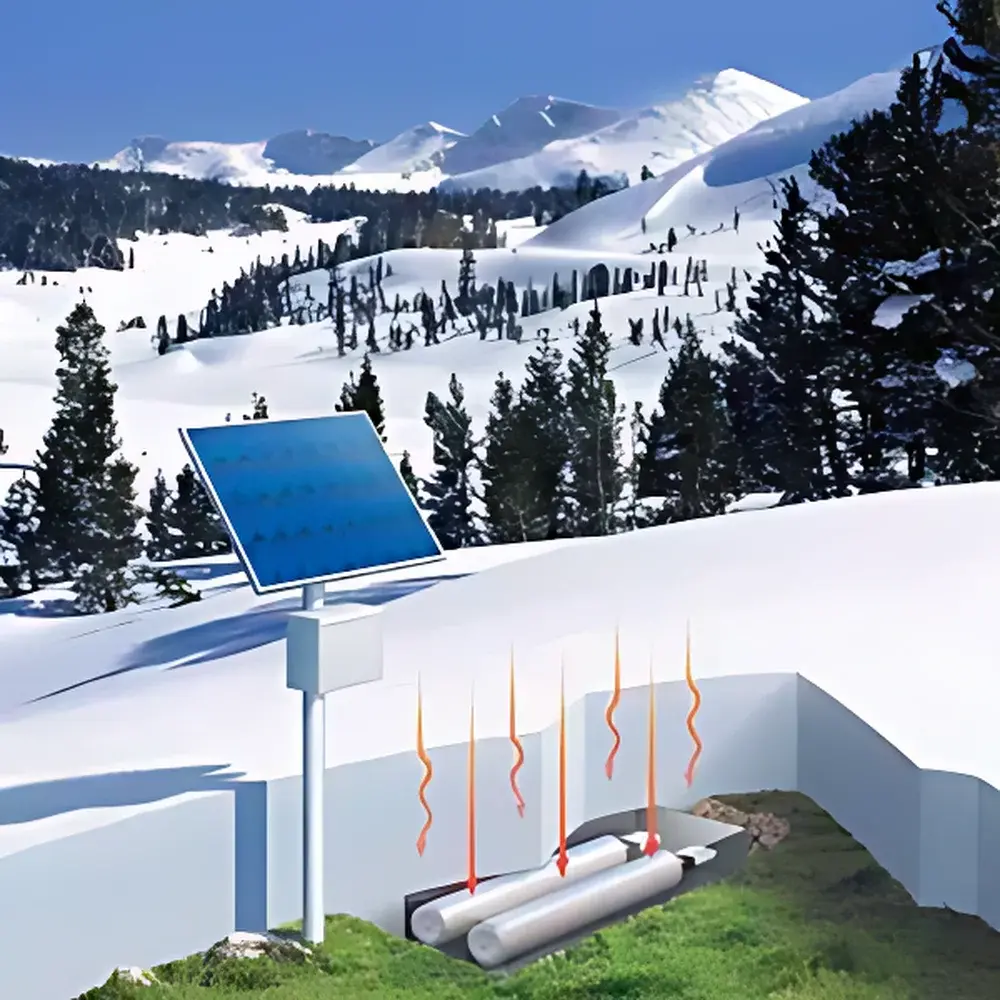
Pri-eco CRS-2000S Cosmic-Ray Snow Water Equivalent and Snow Depth Analyzer
| Brand | Pri-eco |
|---|---|
| Origin | Beijing, China |
| Manufacturer Type | Manufacturer |
| Country of Origin | Domestic (China) |
| Model | CRS-2000S |
| Pricing | Upon Request |
Overview
The Pri-eco CRS-2000S Cosmic-Ray Snow Water Equivalent and Snow Depth Analyzer is a field-deployable, passive neutron detection system engineered for continuous, non-invasive quantification of snow water equivalent (SWE) and snow depth across mesoscale landscapes. It operates on the well-established principle of cosmic-ray neutron sensing (CRNS), leveraging naturally occurring secondary cosmic radiation—specifically epithermal and thermal neutrons—as a proxy for hydrogen density in the snowpack. As high-energy galactic cosmic rays interact with atmospheric nuclei, they generate cascades of secondary particles, including fast neutrons. These neutrons undergo elastic scattering primarily with hydrogen nuclei (protons) in snow, soil, and vegetation, losing kinetic energy and slowing to epithermal and thermal energies. The intensity of downward-directed low-energy neutrons measured at the surface exhibits an inverse exponential relationship with the integrated hydrogen mass in the footprint—dominated by snow water content during winter. By calibrating neutron count rates against reference SWE measurements and accounting for atmospheric pressure, air humidity, and soil moisture contributions, the CRS-2000S delivers spatially integrated SWE estimates over a typical horizontal footprint of 100–250 m radius, independent of snow density gradients or surface topography.
Key Features
- Fully passive, radiation-free measurement—no radioactive sources or active emitters
- Non-contact, non-destructive operation—preserves snowpack integrity and enables long-term deployment
- Topography-agnostic installation—validated for operation on steep slopes (>45°), dense forest understories, and alpine terrain
- Low-power architecture—designed for autonomous solar-powered operation with integrated charge management
- Integrated environmental compensation—onboard barometric, temperature, and relative humidity sensors correct for atmospheric neutron modulation effects
- Modular sensor expansion—supports optional external probes for precipitation, soil volumetric water content (VWC), air temperature, and relative humidity
- Robust telemetry—embedded quad-band 4G LTE module enables secure, scheduled data transmission to cloud platforms or local servers
- Industrial-grade signal conditioning—fully opto-isolated digital I/O (RS232, RS485, TTL) with surge and lightning protection per IEC 61000-4-5
Sample Compatibility & Compliance
The CRS-2000S is optimized for natural snowpacks in alpine, boreal, and polar environments, with demonstrated performance under variable snow metamorphism, wind redistribution, and mixed-phase (snow/ice/rain) conditions. Its measurement footprint integrates heterogeneous terrain without requiring site-level homogeneity assumptions—making it suitable for validation of satellite-based snow products (e.g., NASA’s SnowEx, ESA’s Copernicus CCI Snow) and hydrological model assimilation. The system complies with electromagnetic compatibility (EMC) standards IEC 61326-1 and environmental operating specifications per IEC 60529 (IP67-rated enclosure). Data acquisition protocols support traceable metadata logging aligned with FAIR principles (Findable, Accessible, Interoperable, Reusable), and time-stamped records include audit-ready headers for GLP-compliant field campaigns.
Software & Data Management
Data are acquired at user-configurable intervals (default: 1 hour), timestamped with GPS-synchronized UTC, and stored redundantly on internal 32 GB microSD card and optionally on replaceable external cards. Raw neutron counts, corrected SWE estimates, ancillary meteorological parameters, and diagnostic flags are output in CSV and NetCDF-4 formats. The embedded firmware supports Over-The-Air (OTA) updates and remote configuration via HTTPS-secured REST API. Optional desktop software (Windows/macOS/Linux) provides real-time visualization, spectral quality control (e.g., neutron count stability, atmospheric correction residuals), and batch calibration using local reference datasets. All data streams are compatible with common hydrological modeling frameworks (e.g., SWAT, VIC, WRF-Hydro) and comply with metadata standards defined by the World Meteorological Organization (WMO) and the U.S. National Snow and Ice Data Center (NSIDC).
Applications
- Operational snow monitoring for regional water resource forecasting and reservoir inflow prediction
- Ground-truthing of spaceborne snow products from Sentinel-3, ICESat-2, and upcoming NASA-ISRO NISAR missions
- Long-term climate studies assessing snowpack trends, melt timing shifts, and cryospheric feedback mechanisms
- Validation of land surface models and coupled Earth system models under CMIP6 protocols
- High-elevation ecosystem research—including alpine hydrology, permafrost-adjacent snow insulation effects, and avalanche risk assessment
- Support for ISO 17892-10 (geotechnical investigation) and ASTM D698/D1557 (soil compaction) where snow loading influences subsurface characterization
FAQ
How does the CRS-2000S differentiate snow water equivalent from soil moisture contribution?
It applies a multi-parameter correction model that uses concurrent barometric pressure, air humidity, and soil moisture (if externally measured) to partition the neutron signal between snowpack and underlying soil layers.
What is the effective spatial footprint of the measurement?
Approximately 100–250 meters radius, depending on snow depth, soil moisture, and atmospheric conditions—validated through neutron transport simulations (MCNPX) and field intercomparison studies.
Can the system operate year-round in sub-zero environments?
Yes—the electronics are rated for –30 °C to +60 °C ambient operation, and the neutron detector housing incorporates thermal buffering to maintain stable gain characteristics across freeze-thaw cycles.
Is the CRS-2000S compliant with FDA 21 CFR Part 11 or EU Annex 11 for regulated environmental monitoring?
While not designed for pharmaceutical GMP applications, its audit trail, electronic signature support, and data integrity controls meet core ALCOA+ principles and are deployable in ISO/IEC 17025-accredited environmental laboratories.
Does the system require annual recalibration?
No—neutron detectors are inherently stable; however, empirical calibration against local snow pit measurements is recommended annually or after major hardware upgrades to maintain site-specific accuracy.







