
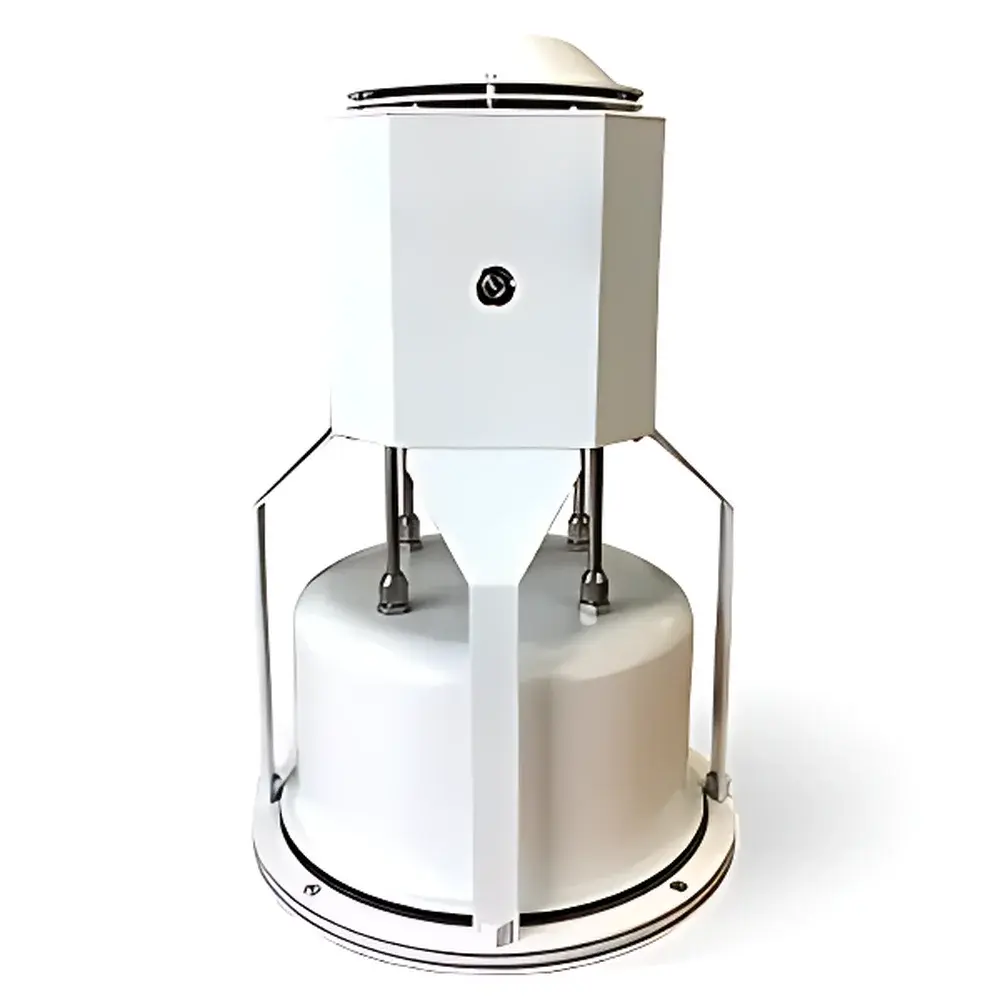
Pri-eco PRI-8610U Ultra-Portable Soil CO₂ and H₂O Respiration Measurement System
| Brand | Pri-eco |
|---|---|
| Origin | Beijing, China |
| Manufacturer Type | Original Equipment Manufacturer (OEM) |
| Country of Origin | China |
| Model | PRI-8610U |
| Instrument Category | Multi-Parameter Soil Respiration Analyzer |
| Dimensions | 400 mm (D) × 250 mm (H) |
| CO₂ Range | 0–2000 ppm |
| CO₂ Accuracy | ±50 ppm or ±5% of reading |
| H₂O Range | 0–6% |
| H₂O Accuracy | ±2% of reading |
| Air Pressure Range | 150–1150 mbar |
| Air Pressure Accuracy | ±2 mbar |
| Soil Temperature Range | −20 to +85 °C |
| Soil Temperature Accuracy | ±0.2 °C |
| Soil Moisture Range | 0–100% |
| Soil Moisture Accuracy | ±3% |
| Respiration Chamber Volume | 3718 cm³ |
| Chamber Base Area | 314 cm² |
| Chamber Dimensions | 220 mm (D) × 120 mm (H) |
| Battery | 12 V Li-ion |
| Operating Temperature | −10 to +45 °C |
| Weight | 5.5 kg |
| Dynamic Pressure Compensation | Yes (Patent ZL201420354126.4) |
Overview
The Pri-eco PRI-8610U Ultra-Portable Soil CO₂ and H₂O Respiration Measurement System is a field-deployable, fully integrated instrument engineered for high-fidelity, real-time quantification of soil carbon dioxide efflux and water vapor exchange. It operates on the physical principle of dual-wavelength non-dispersive infrared (NDIR) spectroscopy—specifically optimized for simultaneous, interference-free detection of CO₂ and H₂O in low-concentration, variable-humidity gas streams. Unlike conventional multi-component systems requiring external gas analyzers, pump modules, and pressure-regulated tubing networks, the PRI-8610U embeds the NDIR optical module, microcontroller-based flow management, dynamic pressure compensation mechanism, and autonomous soil respiration chamber into a single, self-contained unit. This architecture eliminates inter-component calibration drift, reduces system response latency, and ensures measurement integrity under transient environmental conditions—including wind-induced barometric fluctuations and diurnal thermal gradients. The system is designed for compliance with widely referenced ecosystem flux protocols, including those outlined in the AmeriFlux and ICOS network guidelines, and supports traceable data acquisition aligned with ISO 14064-2 (Greenhouse Gas Inventories) and IPCC Tier 2 reporting frameworks.
Key Features
- Integrated dual-channel NDIR analyzer utilizing proprietary “micro-light-source” technology—reducing power consumption by >40% versus conventional broadband IR emitters while maintaining spectral stability across temperature gradients.
- Patented dynamic pressure equalization system (ZL201420354126.4) actively maintains chamber internal pressure at ambient atmospheric equilibrium—minimizing advective bias during rapid CO₂ production events and mitigating wind-induced pressure differentials that compromise flux calculation accuracy.
- Self-contained, cable-free design: no external pumps, valves, or gas lines; all components—including 12 V lithium-ion battery (≥8 h continuous operation), embedded microprocessor, and sealed optical path—are housed within a single 5.5 kg chassis.
- Real-time wireless communication via IEEE 802.11 b/g/n WiFi to Android/iOS tablets; onboard firmware executes iterative Hsieh–Gould–Wilson flux algorithms with automatic background subtraction and temperature-corrected diffusion modeling.
- Factory-applied, temperature-compensated calibration traceable to NIST-certified reference gases; no field recalibration required for standard deployment cycles.
Sample Compatibility & Compliance
The PRI-8610U is validated for use across diverse pedological matrices—including sandy loams, clay-rich vertisols, organic peatlands, and disturbed anthropogenic soils—without modification to chamber geometry or sensor configuration. Its 314 cm² base area and 3718 cm³ chamber volume satisfy the minimum footprint-to-volume ratio recommended in ASTM D6597-21 (Standard Guide for Soil Respiration Measurements) for minimizing edge effects and ensuring representative gas accumulation kinetics. All electronic subsystems conform to IEC 61326-1:2013 (EMC requirements for laboratory equipment), and operating temperature range (−10 to +45 °C) complies with EN 12549:2018 (Environmental monitoring—Soil gas sampling devices). Data logging metadata includes UTC timestamps, GPS coordinates (via paired tablet), and full audit trail of user inputs and system diagnostics—supporting GLP-compliant field studies and regulatory submissions.
Software & Data Management
Field operation is managed through the Pri-eco FieldLink™ mobile application, which provides intuitive parameter configuration (e.g., measurement interval, chamber closure duration, soil temperature probe assignment), live visualization of CO₂/H₂O concentration curves, and on-device flux computation using both closed-chamber linear regression and exponential curve-fitting methods. Export formats include CSV (with ISO 8601 timestamps), NetCDF4 (CF-1.8 compliant), and PDF summary reports containing QA/QC flags, uncertainty propagation estimates, and sensor health diagnostics. Raw spectral data and intermediate calculation logs are retained in encrypted local storage and can be retrieved via secure FTP or USB-C dump for post-processing in MATLAB, R, or Python-based flux analysis pipelines (e.g., REddyProc, eddy4R). Audit trails record all parameter changes, firmware version, and battery state—meeting documentation requirements under FDA 21 CFR Part 11 for regulated environmental monitoring applications.
Applications
- Long-term eddy covariance site validation and gap-filling of soil respiration datasets.
- In situ assessment of climate change impacts on microbial respiration rates across elevation and latitudinal transects.
- Evaluation of agricultural management practices—including tillage intensity, cover cropping, and biochar amendment—on carbon mineralization dynamics.
- Post-remediation monitoring of contaminated soils where hydrocarbon degradation rates are inferred from CO₂ evolution patterns.
- Education and training in biogeochemical cycling, providing students with hands-on access to standardized flux methodology without infrastructure dependency.
FAQ
Does the PRI-8610U require periodic zero/span calibration in the field?
No. The system employs factory-applied, temperature-compensated calibration using NIST-traceable reference standards. Routine recalibration is not necessary under normal operating conditions; however, annual verification against certified gas mixtures is recommended for ISO/IEC 17025-accredited laboratories.
Can the device operate autonomously without a tablet?
No. The tablet serves as the human-machine interface and computational engine for flux derivation. All real-time control, visualization, and algorithm execution occur within the FieldLink™ application; the hardware unit functions solely as a sensor and actuator platform.
Is the dynamic pressure compensation system active during both chamber closure and venting phases?
Yes. The pressure equalization valve operates continuously throughout the measurement cycle—maintaining differential pressure ≤ ±0.5 mbar relative to ambient, regardless of chamber state or ambient wind speed up to 8 m/s.
What soil moisture measurement method does the integrated probe employ?
The system uses a calibrated capacitance-based soil moisture sensor (ASTM D5859-20), validated against gravimetric measurements across 0–100% volumetric water content, with temperature-dependent dielectric constant correction applied in firmware.
How is data synchronization handled when WiFi connectivity is intermittent?
All measurements are timestamped and stored locally on the device’s internal flash memory. Upon reconnection, FieldLink™ automatically initiates delta-sync—transferring only unsynchronized records without overwriting or duplicating entries.
Related Products







