
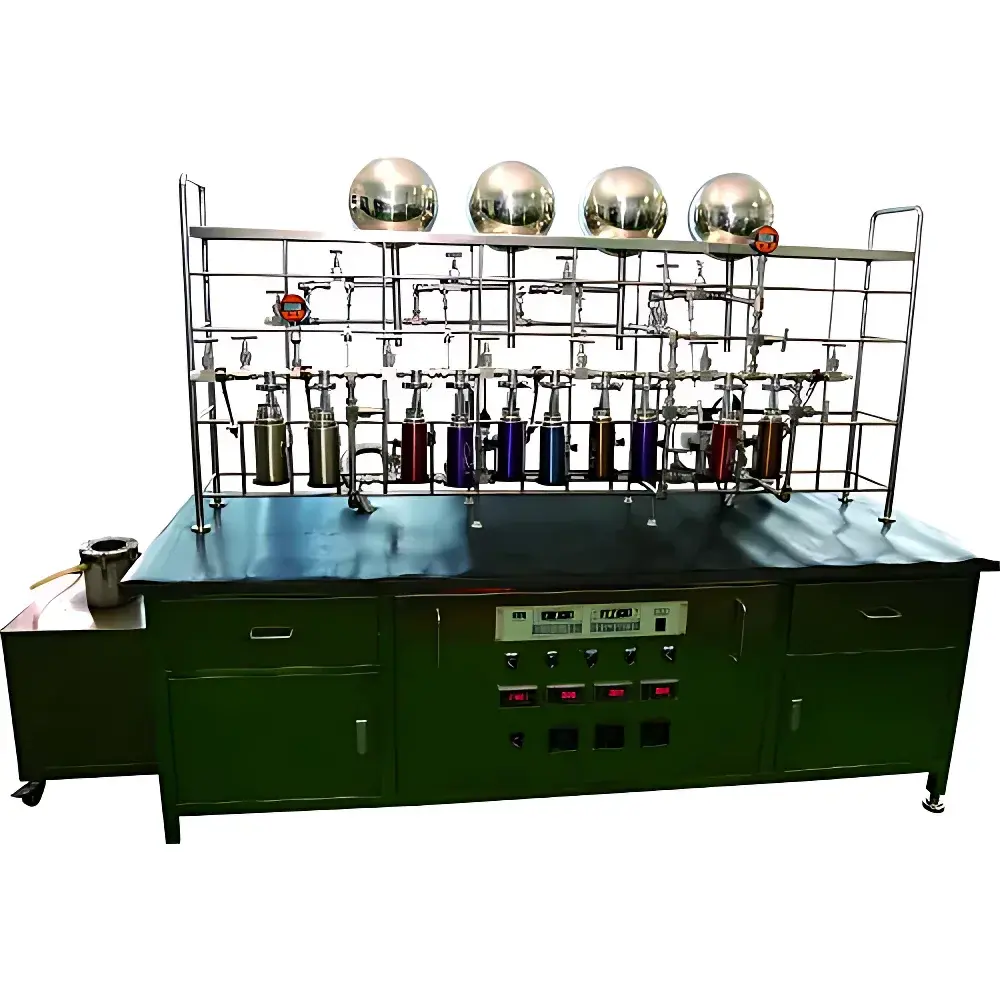
Pri-eco PRI-3500 Metal-Based Sample Preparation System for Radiocarbon (¹⁴C) Dating
| Brand | Pri-eco |
|---|---|
| Origin | Beijing, China |
| Manufacturer Type | Manufacturer |
| Country of Origin | China |
| Model | PRI-3500 |
| Quotation | Upon Request |
| Construction Material | 316 Stainless Steel (main frame) |
| Cold Trap | KF25 Glass |
| Vacuum Measurement | Dual-Sensor Compound Vacuum Gauge (Resistive: 1×10⁵ – 1×10⁻¹ Pa |
| Ionization + Resistive Composite Mode | 1×10⁵ – 1×10⁻⁵ Pa) |
| Digital Pressure Gauge Range | −0.1 to 0 MPa |
| Gas Storage Cylinders | Four 7.5-L Units |
| Overall Dimensions | 2000 mm (L) × 800 mm (W) × 2400 mm (H) |
Overview
The Pri-eco PRI-3500 Metal-Based Sample Preparation System is an engineered solution for the quantitative conversion of organic and inorganic carbon samples into graphite or benzene targets suitable for accelerator mass spectrometry (AMS) or liquid scintillation counting (LSC) in radiocarbon (¹⁴C) dating laboratories. Unlike traditional glass vacuum line systems—whose reliance on borosilicate glass tubing, custom welds, and skilled glassblowing renders them operationally fragile and increasingly unsustainable—the PRI-3500 replaces all load-bearing and vacuum-integrated structural components with precision-machined 316 stainless steel. This architecture eliminates dependence on glass-to-glass seals and hand-blown manifolds, directly addressing a critical infrastructure gap identified across national ¹⁴C facilities in China and other regions where institutional glassblowing capacity has declined precipitously since the retirement of legacy technical staff. The system implements standard ultra-high-vacuum (UHV) engineering principles, including metal gasketed KF25 flanges, bakeable stainless-steel pathways, and dual-sensor vacuum monitoring calibrated per ISO 27893:2017 for residual gas analysis traceability. It supports full sequence processing: combustion (for organics), acid hydrolysis (for carbonates), CO₂ cryogenic trapping, catalytic reduction to graphite (Fe/Ni/H₂), and high-purity benzene synthesis (via acetylene trimerization), all within a single, modular, serviceable platform.
Key Features
- Structural integrity via 316 stainless steel mainframe—resistant to thermal cycling, mechanical stress, and chemical corrosion from HCl, HF, and H₂O₂ used in carbonate and collagen pretreatment
- KF25-standard cold trap assembly with interchangeable glass Dewar inserts—enabling rapid CO₂ condensation at −196 °C without metal fatigue or seal degradation
- Compound vacuum gauge with auto-ranging resistive and cold cathode ionization sensors—providing continuous, NIST-traceable pressure readout from atmospheric to 1×10⁻⁵ Pa
- Modular design with ISO-KF and CF flanged interconnects—permitting field replacement of valves, pumps, and traps without system re-baking or helium leak testing
- Oil-free vacuum architecture—utilizing dry scroll and turbomolecular pumping stages to prevent hydrocarbon backstreaming that compromises ¹⁴C/¹²C isotopic ratio fidelity
- Digital pressure monitoring with 0.1% FS accuracy—integrated into real-time process logging for GLP-compliant audit trails
Sample Compatibility & Compliance
The PRI-3500 accommodates diverse sample matrices requiring radiocarbon dating: terrestrial and marine sediments, speleothems, bone collagen, charcoal, wood cellulose, dissolved inorganic carbon (DIC) from groundwater, and archaeological textiles. All wet chemistry modules comply with ASTM D6866-22 (Standard Test Methods for Determining the Biobased Content of Solid, Liquid, and Gaseous Samples Using Radiocarbon Analysis) and ISO 13877:2016 (Soil quality — Determination of radiocarbon content). Vacuum integrity meets ISO 14644-1 Class 5 requirements for particulate control during graphite target pressing. The system’s material certifications—including EN 10204 3.1 mill test reports for 316 SS—support FDA 21 CFR Part 11 compliance when integrated with validated LIMS software.
Software & Data Management
While hardware-driven, the PRI-3500 includes RS-485 and Modbus TCP interfaces for integration with laboratory information management systems (LIMS) and SCADA platforms. Vacuum sensor outputs, pressure transients, and valve actuation timestamps are timestamped and exported in CSV/JSON formats compatible with Python-based data reduction pipelines (e.g., OxCal preprocessing scripts). Audit logs record operator ID, session start/stop, calibration events, and fault codes—retained for ≥36 months per GLP Annex 11 and ISO/IEC 17025:2017 clause 7.11. No proprietary closed-source firmware is embedded; all communication protocols are openly documented per IEC 61131-3 standards.
Applications
- High-throughput pretreatment of >50 archaeological bone samples per week with automated acid-base-acid (ABA) leaching and gelatin extraction
- Stable isotope-ratio informed ¹⁴C dating of speleothem layers using sequential micromill sampling coupled to online CO₂ purification
- Groundwater residence time modeling via DIC isolation from aquifer pump tests under field-deployable inert gas purging
- Biogenic carbon quantification in soil organic matter (SOM) fractions using density separation followed by ¹⁴C-target graphitization
- Quality assurance for inter-laboratory comparison studies (e.g., FIRI, VIRI) requiring <±0.3% inter-run precision in graphite yield and δ¹³C reproducibility
FAQ
Does the PRI-3500 require specialized glassblowing maintenance?
No. All vacuum-critical joints use metal-sealed KF25 flanges and elastomer-free compression fittings. Routine maintenance involves O-ring replacement and pump oil changes only.
Can it be retrofitted into existing AMS lab infrastructure?
Yes. Standardized 1/4″ Swagelok inlet/outlet ports and 24 VDC actuator interfaces enable direct integration with Edwards, Pfeiffer, or Agilent vacuum controllers.
What vacuum pump configuration is recommended?
A two-stage dry scroll pump (base pressure ≤1×10⁻² Pa) paired with a 70 L/s turbomolecular pump achieves the required 1×10⁻⁵ Pa operating range for graphite synthesis.
Is the system compliant with ISO/IEC 17025 accreditation requirements?
Yes—provided users implement documented SOPs for calibration (vacuum gauge NIST traceability), preventive maintenance, and uncertainty budgeting per ISO/IEC 17025:2017 clause 7.6.
How is cross-contamination between samples prevented?
Each sample path features dedicated, non-recirculating stainless-steel tubing segments; bake-out cycles at 250 °C for 4 hours remove adsorbed organics prior to next run.



