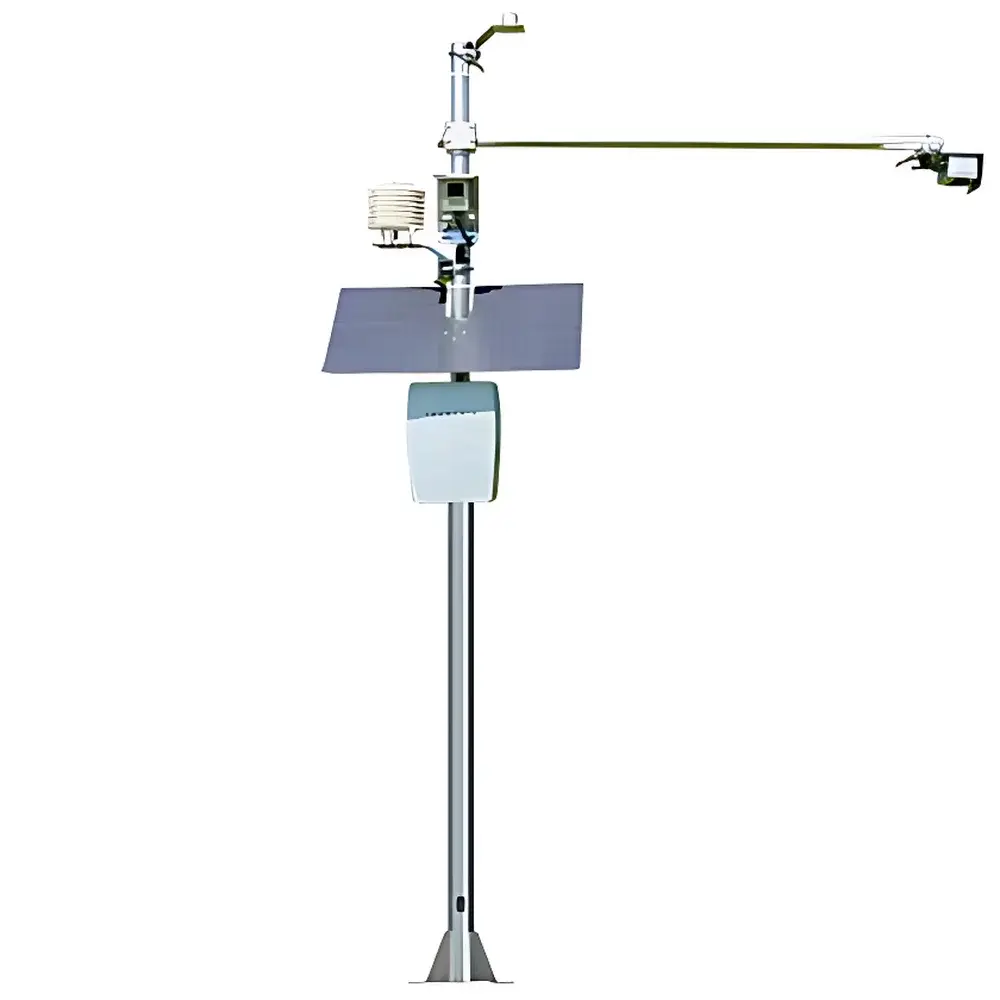
Pri-eco PlantCam Online Automated Plant Phenology Monitoring System
| Brand | Pri-eco |
|---|---|
| Origin | Beijing, China |
| Manufacturer Type | Direct Manufacturer |
| Product Origin | Domestic (China) |
| Model | PlantCam |
| Pricing | Available Upon Request |
Overview
The Pri-eco PlantCam Online Automated Plant Phenology Monitoring System is a field-deployable, solar-powered imaging platform engineered for continuous, year-round observation of plant phenological rhythms—defined as recurring, seasonally synchronized biological events such as budburst, leaf expansion, flowering, chlorophyll degradation, senescence, and abscission. Rooted in optical remote sensing principles, PlantCam captures synchronized visible-light and near-infrared (NIR) imagery to quantify structural and physiological changes in vegetation canopies over time. Its core measurement methodology relies on multi-spectral image acquisition (550 nm, 660 nm, and 850 nm bands), enabling robust calculation of normalized difference vegetation index (NDVI) and other spectral indices without requiring ground-truth calibration at each site. Designed for long-term ecological monitoring, PlantCam operates autonomously in unattended field environments—from alpine meadows to arid steppe—and delivers time-series image data critical for detecting shifts in phenological timing linked to climate variability, land-use change, and ecosystem resilience.
Key Features
- Solar-powered architecture with 30 W monocrystalline photovoltaic panel and 7 Ah low-temperature lead-acid battery, supporting operation across -40 °C to +50 °C ambient conditions
- Dual high-resolution imaging system: 8 MP visible-light camera (3840 × 2160 resolution) with motorized zoom lens (2.8–12 mm / 9–22 mm / 5–50 mm options), auto-exposure (AE), and auto-gain control; plus co-aligned 8 MP NIR module with adjustable viewing angle and narrowband spectral filtering at 550 nm, 660 nm, and 850 nm
- Ultra-low-power data acquisition unit: standby power consumption < 5 mW; equipped with 4 analog inputs, 4 RS485 ports, and 4 dedicated image interfaces; integrated 4G LTE cellular modem for secure wireless telemetry
- Robust outdoor enclosure: IP67-rated aluminum alloy housing with UV-resistant coating and sand/dust ingress protection; paired with height-adjustable stainless-steel mounting mast (2.4 m or 4.0 m options)
- Firmware-level intelligence: supports over-the-air (OTA) updates, remote reconfiguration of sampling intervals and upload schedules, automatic breakpoint resumption, and multi-attempt retransmission for intermittent connectivity
- Comprehensive energy management: built-in low-voltage cutoff, short-circuit protection, and overload safeguards ensure system longevity under variable irradiance conditions
Sample Compatibility & Compliance
PlantCam is optimized for non-destructive, long-term monitoring of herbaceous and woody perennials, shrubs, grasses, and agricultural crops across diverse biomes—including tundra, temperate forest understory, semi-arid rangelands, and managed agroecosystems. It does not require physical contact with plant tissue and imposes no mechanical stress on target specimens. The system complies with international standards for environmental monitoring infrastructure, including IEC 60529 (IP67 enclosure rating), ISO 9001-certified manufacturing processes, and design alignment with FAO and GEO BON phenological observation protocols. Data integrity mechanisms—including timestamped GPS georeferencing, voltage logging, and firmware version tracking—support GLP-compliant field data collection workflows.
Software & Data Management
The PlantCam Cloud Platform is a browser-based (B/S architecture) SaaS solution built on scalable, enterprise-grade infrastructure. It provides TB-scale secure storage, role-based access control, and full audit trails for all image ingestion, processing, and user actions. The platform natively supports NDVI time-series generation, dynamic timelapse video synthesis, and AI-assisted phenophase classification trained on globally validated botanical image datasets. All metadata—including sensor status, battery voltage, signal strength, and acquisition timestamps—is stored alongside raw and processed imagery. Remote configuration capabilities include real-time adjustment of capture frequency, image compression settings, and transmission intervals. The platform meets baseline requirements for scientific reproducibility, with support for CSV/GeoTIFF export, RESTful API integration, and compatibility with common GIS and statistical analysis environments (e.g., R, Python, QGIS).
Applications
- Climate–phenology coupling studies: quantifying interannual variation in spring onset and autumn cessation across elevation gradients or latitudinal transects
- Ecological forecasting: calibrating species distribution models using observed phenological thresholds as input variables
- Agricultural monitoring: early detection of stress-induced phenological anomalies in orchards, vineyards, and cereal systems
- Long-term ecological research (LTER) networks: standardized deployment across distributed observatory nodes for cross-site comparison
- Urban green infrastructure assessment: tracking phenological performance of street trees and green roofs under anthropogenic microclimates
- Education and citizen science integration: providing open-access image archives for phenology curriculum development and public engagement initiatives
FAQ
What spectral bands does the NIR imaging module capture?
The NIR module acquires discrete-band images at 550 nm (green), 660 nm (red), and 850 nm (near-infrared) using interference filters—enabling accurate NDVI and other vegetation index derivation.
Can PlantCam operate without cellular coverage?
Yes. Local onboard storage supports up to 64 GB of image data with intelligent buffering; images are transmitted automatically when 4G connectivity resumes, using configurable retry logic.
Is the system compatible with third-party environmental sensors?
Yes. Four analog inputs and four RS485 ports allow seamless integration with meteorological stations, soil moisture/temperature probes, and water quality loggers for multi-parameter ecosystem monitoring.
How is data security ensured during wireless transmission?
All data transmissions use TLS 1.2+ encryption; device authentication is enforced via embedded certificates, and cloud access requires two-factor authentication (2FA) for administrative accounts.
Does the cloud platform support automated phenophase classification?
Yes. The platform employs convolutional neural networks (CNNs) pre-trained on >200,000 annotated phenological images; users may also upload custom training sets to refine model outputs for local species or growth forms.