
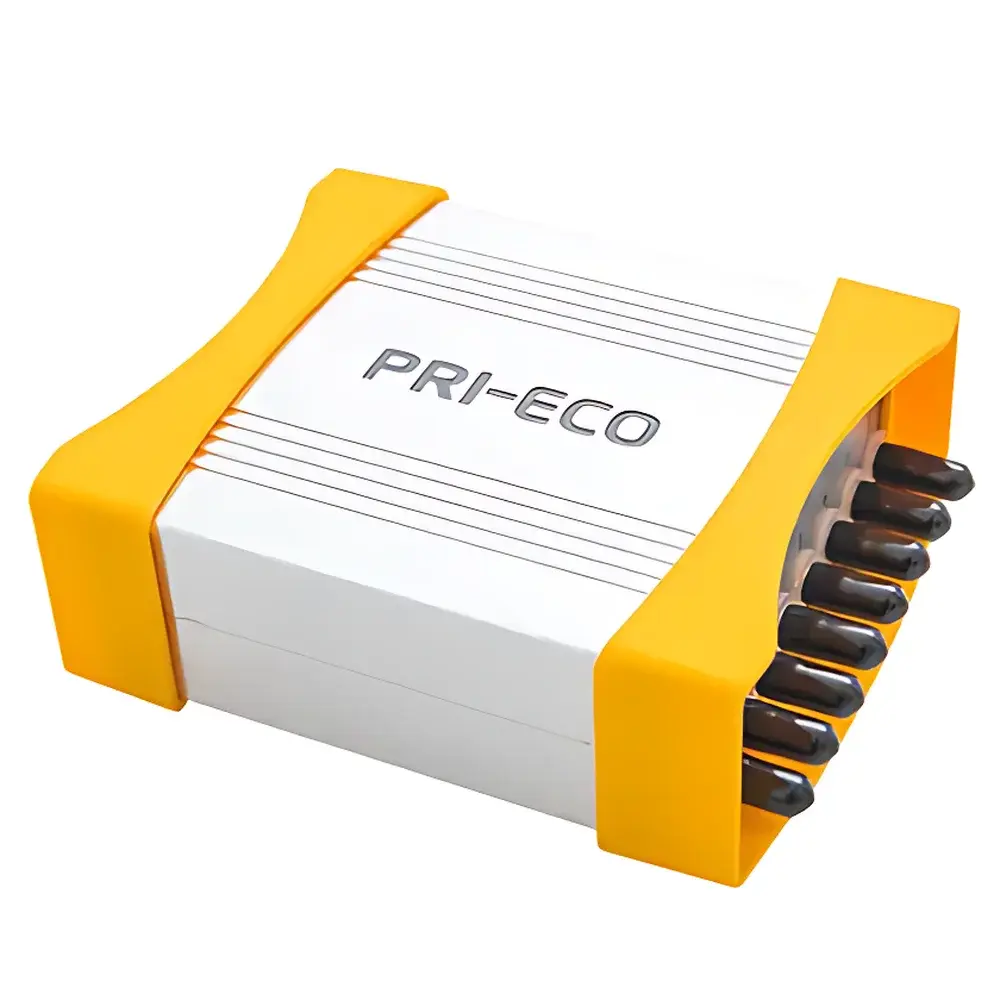
Pri-eco Canary Distributed Soil Moisture, Temperature & Electrical Conductivity Monitoring System
| Brand | Pri-eco |
|---|---|
| Model | Canary |
| Type | Multi-parameter Soil Sensor Network System |
| Origin | Beijing, China |
| Manufacturer | Pri-eco |
| Power Supply | 6–15 VDC |
| Operating Temperature Range | −25 to +50 °C |
| Data Acquisition Channels | 8 per node |
| Sensor Compatibility | Canary-001 (moisture-only), Canary-002 (moisture + temp), Canary-003 (moisture + temp + EC) |
| Moisture Accuracy | ±3% vol (±<3% with site-specific calibration) |
| Temp Accuracy | ±0.4 °C |
| EC Accuracy | ±15% @ 0–1 S/m |
| Moisture Resolution | 0.1% vol |
| Temp Resolution | 0.1 °C |
| EC Resolution | 1 mS/m |
| Moisture Range | 0–70% vol |
| Temp Range | −55 to +120 °C |
| EC Range | 0.000–1 S/m |
| Probe | Dual 50 mm × 3 mm stainless steel rods |
| Housing | PVC tube, Ø20 mm |
| Cable Length | 1.5–10 m |
| RF Frequency | 70 MHz |
| Communication | Wireless (modular RF or LoRaWAN-ready) |
| Cloud Integration | Yes |
Overview
The Pri-eco Canary Distributed Soil Moisture, Temperature & Electrical Conductivity Monitoring System is an engineered field-deployable sensor network designed for continuous, multi-point in-situ measurement of three critical soil physical parameters: volumetric water content (θv), soil temperature (T), and bulk electrical conductivity (EC). Its core sensing principle relies on high-frequency (70 MHz) capacitance-based dielectric spectroscopy — a well-established method grounded in the relationship between soil dielectric permittivity and water content, modified by salinity and temperature effects. Unlike time-domain reflectometry (TDR) or neutron probe techniques, the Canary system employs low-energy, non-radiative electromagnetic excitation, enabling robust operation across diverse soil textures (sand, loam, clay) and moisture regimes (0–70% vol), without requiring complex installation geometry or extensive site-specific calibration prior to deployment. Each Canary data acquisition node serves as a local edge processor, supporting up to eight simultaneously connected sensors — allowing scalable spatial coverage from single-profile monitoring to hectare-scale wireless mesh networks.
Key Features
- Multi-parameter integration: Simultaneous real-time acquisition of θv, T, and EC from a single probe or distributed array
- Distributed architecture: Modular 8-channel data logger enables flexible sensor topology — mix-and-match Canary-001 (moisture-only), Canary-002 (moisture + temperature), and Canary-003 (full tri-parameter) probes
- Low-power design: Operates continuously on 6–15 VDC supply with ultra-low quiescent current — optimized for solar-battery hybrid systems in remote locations
- Ruggedized field construction: Stainless steel sensing rods (50 mm × 3 mm) embedded in UV-stabilized PVC housing (Ø20 mm); rated for long-term burial in agricultural, forest, grassland, and ecological research sites
- Wireless telemetry readiness: Integrated serial interface supports optional RF, LoRaWAN, or NB-IoT modules for autonomous cloud upload without manual data retrieval
- Environmental resilience: Validated operational range of −25 to +50 °C ambient; sensor elements rated to −55 to +120 °C — suitable for seasonal extremes across temperate, arid, and subalpine zones
Sample Compatibility & Compliance
The Canary system demonstrates consistent performance across mineral soils ranging from coarse sands to heavy clays, with minimal hysteresis or drift under repeated wet-dry cycles. Its 70 MHz operating frequency minimizes signal attenuation in high-salinity or organic-rich matrices, reducing the need for empirical correction factors. While not certified to ISO 11274 or ASTM D5859 as a standalone instrument, the system adheres to fundamental metrological principles outlined in ISO/IEC 17025–compliant soil sensor validation protocols. Sensor outputs are traceable to NIST-traceable reference standards via factory calibration using gravimetric and saturated paste EC reference solutions. For regulatory or audit-ready deployments (e.g., USDA NRCS monitoring networks, EU LIFE project reporting), raw sensor data logs include embedded timestamps, channel identifiers, and diagnostic flags — supporting GLP-aligned data integrity requirements.
Software & Data Management
Data from Canary nodes is output via ASCII-formatted serial protocol (RS-232/RS-485) or MQTT/HTTP(S) over IP-enabled wireless modules. Pri-eco provides open API documentation and sample Python libraries for ingestion into custom dashboards (e.g., Grafana, ThingsBoard) or enterprise platforms (e.g., FIWARE, AWS IoT Core). All measurements include metadata headers (sensor ID, firmware version, battery voltage, internal temperature) to support provenance tracking. Optional cloud service offers secure TLS-encrypted transmission, automated daily backups, configurable alert thresholds (e.g., EC > 4 dS/m triggers irrigation advisory), and export in CSV/NetCDF formats compliant with FAO WaPOR and USGS NWIS metadata schemas. Audit trails and user-access logs meet baseline requirements for 21 CFR Part 11–aligned environments where data integrity is formally governed.
Applications
- Agricultural water management: Real-time root-zone moisture profiling for deficit irrigation scheduling and evapotranspiration modeling
- Ecological restoration monitoring: Long-term tracking of soil water dynamics in riparian buffers, post-fire recovery zones, and reforestation plots
- Soil hydrology research: Calibration and validation of vadose zone models (e.g., HYDRUS-1D, SWAP) with high-temporal-resolution θv-T-EC co-variates
- Salinity mapping: Spatially resolved EC gradients in coastal aquifer recharge zones or irrigated croplands undergoing secondary salinization
- Climate change observatories: Multi-depth sensor strings integrated with meteorological stations for carbon–water coupling studies
- Smart nursery and greenhouse operations: Closed-loop feedback control of substrate moisture and nutrient solution EC
FAQ
What is the recommended depth for installing Canary-003 sensors in field conditions?
Standard practice is 10–30 cm for agronomic applications; deeper placement (up to 100 cm) requires custom cable extensions and mechanical protection sleeves to prevent rod displacement during tillage or freeze-thaw cycles.
Can Canary data be integrated with third-party SCADA or farm management software?
Yes — all communication protocols are documented and vendor-agnostic; integration has been validated with FarmLogs, Granular, and Cropio via RESTful API or Modbus TCP gateways.
Is site-specific calibration required for accurate moisture readings?
Factory calibration provides ±3% accuracy across most mineral soils; improved precision (<±2%) is achieved using localized calibrations derived from paired gravimetric samples collected at representative field moisture states.
How does the 70 MHz frequency improve measurement reliability compared to lower-frequency capacitance sensors?
Higher frequency reduces sensitivity to soil texture-induced polarization effects and mitigates electrode polarization errors common below 20 MHz — particularly beneficial in fine-textured or saline soils where low-frequency sensors exhibit significant hysteresis.
What maintenance is required for long-term deployment?
No routine recalibration is needed; annual visual inspection of probe rods for corrosion or biofilm accumulation is advised. PVC housings show no degradation after 5+ years of continuous burial in pH 4.5–8.5 soils.
Related Products







